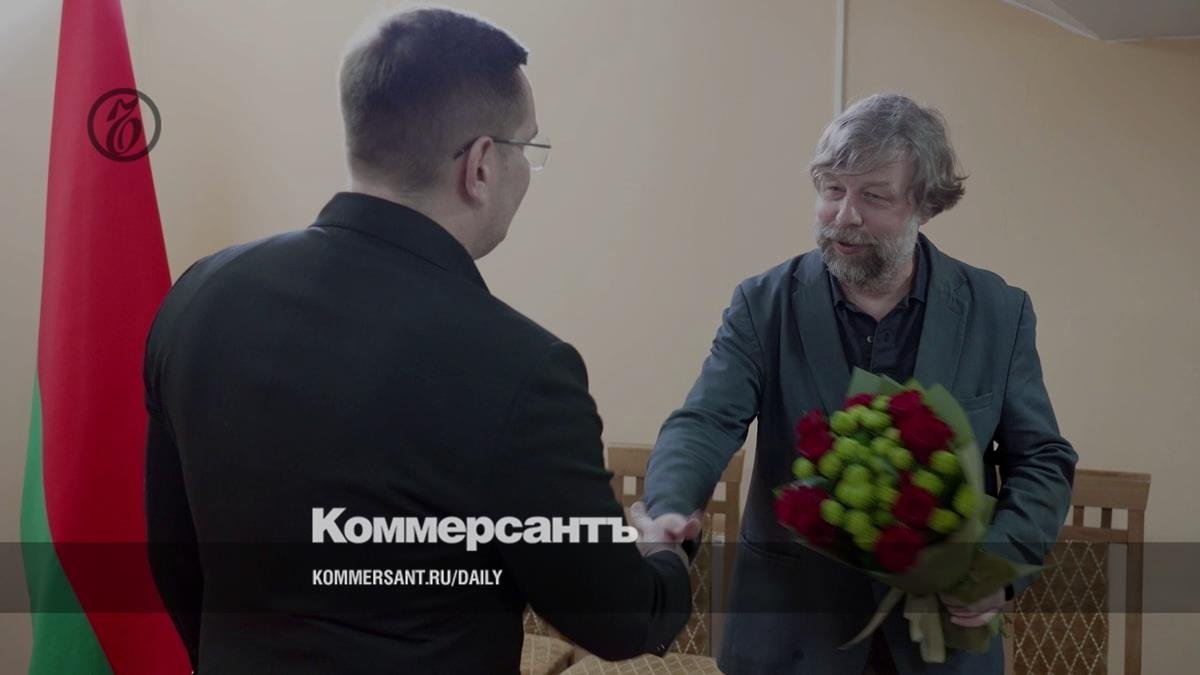
Russian archaeologist Alexander Butyagin avoided extradition to Ukraine from Poland. The scientist was returned to his homeland as a result of a five-by-five exchange carried out within the framework of an agreement between the intelligence services of seven countries. To the representatives of Belarus, who greeted him with flowers, the scientist called his release a wonderful event.
Exchanges of detained agents between intelligence agencies have long become commonplace. However, the operation carried out on April 28 stands out because of the participation of 54-year-old Alexander Butyagin, an archaeologist from the Hermitage.
The exchange itself took place at the Belarusian-Polish border checkpoint Pererov-Belovezha. Alexander Butyagin was greeted on the territory of Belarus with a bouquet of flowers and souvenirs; the scientist called the incident a “wonderful event”, which he still does not fully believe in.
Kommersant was unable to promptly contact Mr. Butyagin – his phone was turned off. Director of the Hermitage Mikhail Piotrovsky in a conversation with Kommersant couldn’t reveal details of the scientist’s release: “You cannot harm a person. Therefore, all I can say is that thank God, thanks to the President of the Russian Federation and all those who decided and managed to rescue him. All this has been done and is being done to ensure that we do not continue to work in Crimea. This concerns not Butyagin, but all of us.”
For excavations in Crimea in 2024, the Security Service of Ukraine accused Mr. Butyagin in absentia of illegally conducting search work at an archaeological heritage site, destroying, destroying or damaging objects of cultural heritage (Part 4 of Article 298 of the Criminal Code).
The Ukrainian side estimated the damage from the archaeologist’s actions at 201.6 million hryvnia (about $4.8 million). In April 2025, a Kiev court arrested the scientist in absentia, and in December he was detained in Poland during a transit trip. In March of this year, the Warsaw District Court granted Kyiv’s request for his extradition.
“I have repeatedly raised the issue of Butyagin’s case at various venues,” Ivan Melnikov, vice-president of the Russian branch of the International Committee for the Defense of Human Rights, told Kommersant. According to him, this is a clear example of political persecution, and the Polish authorities did not have the right to extradite the scientist to Ukraine. In particular, if only because they have ratified conventions and treaties that make it impossible to extradite to a country where there is a threat to the life and health of the person involved and where, among other things, military operations are taking place.
The human rights activist called the extradition of the scientist to Russia a “cunning move” by Poland, which, according to Mr. Melnikov, would still not have decided to send him to Ukraine. Let us recall that the situation with the ex-commander of the “Rusich” detachment in Donbass, Vojislav Torden (Jan Petrovsky), who was detained in Finland in 2023, developed according to a similar pattern. The Finnish authorities ultimately did not extradite him to Ukraine, since human rights are violated in this country and the defendant could be subjected to torture, but they themselves sentenced him to life imprisonment for war crimes. The convict’s appeal was rejected, and he now hopes to be released on exchange.
Representatives of seven countries participated in the current exchange operation. It was dealt with directly on the spot by employees of the State Security Committee (KGB) of Belarus and the Foreign Intelligence Agency of Poland.
The latter received, according to the KGB, “detained on the territory of various EU countries and other states,” and “among those returned to their homeland were citizens of Belarus, Russia and other CIS countries.” “All of them were provided with the necessary primary medical and household assistance,” added representatives of the Belarusian special service, explaining that their department prepared the operation on behalf of President Alexander Lukashenko. In addition to the archaeologist, among those released were the wife of a certain Russian military man serving in the peacekeeping contingent in Transnistria, as well as Belarusians who “carried out particularly important tasks in the interests of ensuring the national security and defense capability” of this country.
The FSB explained that Russian citizens were exchanged for two career officers of the Main Directorate of Foreign Intelligence of the Information and Security Service (SIS) of Moldova. As Kommersant reportedSIS agents were detained in Moscow last spring. During interrogations recorded on video, the detainees admitted that their supervisor was one of the heads of the SIS intelligence service, Alexander Sirbu, and an officer of the same department, Adrian Popescu, was responsible for the transfer to Russia, including the preparation of cover documents.
High-profile exchanges involving Russians
In June 2010, arrests were made in various US cities. ten SVR agents, who lived in the country for a long time (the most famous is Anna Chapman). They admitted their guilt and, by agreement of the Russian and US authorities, were exchanged for four Russians, convicted of treason. Among them was ex-GRU Colonel Sergei Skripal.
In September 2015, an exchange took place at the Kunichina Gora checkpoint in the Pskov region. Estonian intelligence agent Eston Kohver on ex-employee of the Estonian Ministry of Internal Affairs Alexey Dressen. In the Russian Federation, Kohver was sentenced to 15 years for espionage and weapons smuggling. Dressen was convicted in Estonia in 2012 of treason and transferring secret data to the FSB.
In 2022 US Marine Trevor Reed, received a sentence in Russia for attacking police officers, was exchanged for pilot Konstantin Yaroshenko, convicted in the United States on charges of preparing to transport cocaine. In the same year they were exchanged American basketball player Brittney Greiner, convicted in Russia for drug smuggling, and businessman Victor But, served time in the United States for illegal weapons trafficking.
In August 2024, the largest exchange between Russia and Western countries took place at Ankara airport with the participation of 26 people. Eight Russians (as well as two children) returned to the Russian Federation from the USA, Germany, Norway, Poland and Slovenia. Among them – Roman Seleznev, served a sentence in the United States for cybercrimes. Russia freed 15 people, including convicts oppositionists Ilya Yashin And Vladimir Kara-Murza (both are recognized as foreign agents), journalist Evan Gershkovitch And former Marine Paul Whelan. In addition, convicted German citizen Rico Krieger was pardoned in Belarus.
In February 2025, Russia handed over to the United States ex-diplomat Mark Vogel, sentenced in 2022 to 14 years for drug smuggling. The US responded by releasing founder of the BTC-e crypto exchange Alexandra Vinnik, accused of laundering up to $9 billion.
On January 8, 2026, he was released in Moscow French scientist Laurent Vinatier, accused of failing to fulfill the duties of a foreign agent, and a Russian was released from prison in Paris basketball player Daniil Kasatkin, accused of cyber extortion.
Having arrived in Russia, the accused began to establish and develop contacts “with activists of political movements and public organizations” who were allegedly of interest to the Moldovan intelligence services. The agents insisted that they were only carrying out other people’s tasks, and therefore a criminal case was opened against them for cooperation with a foreign state, international or foreign organization on a confidential basis – under Art. 275.1 of the Criminal Code of the Russian Federation, according to which they were threatened with three to eight years in prison. As it turned out, the Moldovans downplayed their own importance, trying to mitigate the punishment as much as possible. In fact, they turned out to be career ISS officers, and therefore they faced 10 to 20 years for espionage (Article 276 of the Criminal Code of the Russian Federation).
The chairman of the Moldovan parliament, Igor Grosu, announced in mid-March that Chisinau was negotiating with Moscow about the release of agents. “This issue has been discussed, there are constant contacts… We will do everything possible to bring our citizens home,” he noted. Apparently, against this background, in addition to intelligence officers, Alexander Butyagin and the journalist of Polish origin Andrei (Andrzej) Poczobut, convicted in Belarus, were added to the lists of possible figures for exchange. If the scientist was never interested in politics, then Mr. Poczobut already had both political and prison experience. It is no coincidence that the latter was personally met at the border by Polish Prime Minister Donald Tusk on April 28.