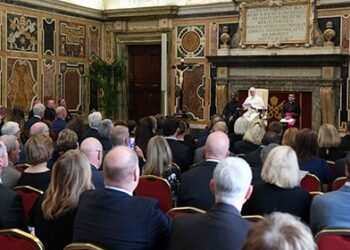
«Participating in the ministry of the Successor of Peter», the «Pontifical Diplomatic Priest welcomes and cultivates a special vocation at the service of peace, truth and justice». This was highlighted by Leo Here is the text of the speech given by the Pope in the chapel of the Roman structure in Piazza della Minerva.
Eminence,
Excellencies,
Dear Superiors and Students of the Pontifical Ecclesiastical Academy,
I am pleased to make my first visit as Roman Pontiff to this ancient and noble Institution, on the occasion of the jubilee of its 325th anniversary of foundation. Already when a few years ago, as part of the meetings offered to the students, I came here to give my testimony as Prefect of the Dicastery for Bishops, I had the opportunity to reflect on the essential mission that theAlma mater of the Papal Diplomats. Today, almost a year after the beginning of my Petrine Ministry, accompanied by the diligent commitment of the Secretariat of State and the Pontifical Representations, those feelings have found confirmation. I therefore look with profound gratitude at the history of dedication and service that this joyful anniversary celebrates.
This history – rooted in the catholicity of the Church itself – over the centuries has seen an uninterrupted chain of priests, coming from various parts of the world, contributing with their humble strength to the construction of that unity in Christ which, in the diversity of origins, makes communion a fundamental characteristic of the diplomatic service of the Holy See. The reform steps – of which the last in chronological order wanted by my immediate Predecessor, of venerated memory – have always aimed at preserving this distinctive and constitutive note of the action of our diplomacy, called every day to pray and work «ut unum synt» (John 17, 21).
In particular, recent changes relating to various aspects of academic and intellectual training have given the Institution the necessary autonomy to renew the study system of legal, historical, political and economic disciplines, together with that of the languages used in international relations. However, I would like to reiterate that the most important reform required of those who cross the threshold of this Community is that of a constant exercise in conversion, aimed at cultivating «proximity, attentive listening, testimony, fraternal approach and dialogue (…) combined with humility and meekness» (FrancisChirograph The Petrine ministry25 March 2025): virtues that must permeate your entire priestly ministry.
Today’s meeting, in this House which has contributed to the intellectual, human and spiritual growth of various Saints and Blesseds – including some of my illustrious Predecessors – is for me the opportunity to outline with you some traits of the Papal Diplomatic Priest who, participating in the ministry of the Successor of Peter, welcomes and cultivates a special vocation at the service of peace, truth and justice.
He must be, first of all, a messenger of the Easter announcement: “Peace be with you!” (John 20, 19). Even when hopes of dialogue and reconciliation seem to fade and peace “as the world gives it” is trampled upon and put to the test, you are called to continue to bring the word of the Risen Christ to everyone: “I leave you peace, I give you my peace” (John 14, 27). And even before attempting to build it with our poor strength, in front of those who do not seek it as a gift from God, your mission calls you to be its “bridges” and “channels”, so that the grace that comes from heaven can make its way through the folds of history.
The Papal Diplomat then – operating in the most diverse cultural contexts and in International Organizations – is particularly sent to bear witness to the Truth that is Christ, bringing his message to the assembly of Nations, and making himself a sign of His love for that portion of humanity, which is entrusted to his mission as a pastor, even before that of a diplomat. As I had the opportunity to indicate at the beginning of this year to the Diplomatic Corps accredited to the Holy See, today it is strongly necessary that “words return to unequivocally expressing certain realities”, because “only in this way can an authentic dialogue resume without misunderstandings” (Speech to the Diplomatic Corps accredited to the Holy SeeJanuary 9, 2026). This is also why it is important that you bring the Word of Life to the world, which revealed itself not with the affirmation of abstract principles and ideas, but by becoming flesh.
Finally, you are preparing to carry out a particular ministry, which is not only expressed in the protection of the good of the Catholic community, but of the entire human family that inhabits a particular nation or that participates in the requests of the various international organizations. This requires you to be promoters of all forms of justice that help to recognise, reconstruct and protect the image of God imprinted in every person. In the defense of human rights – among which those to religious freedom and life stand out -, I therefore recommend that you continue to point the way, not of opposition and claims, but of protection for the dignity of the person, of development for peoples and communities and of the promotion of international cooperation. These are the only tools that allow us to start authentic paths of peace.
Dear Superiors and Students, in a world marked by tensions, which seems to make conflicts the only way to address needs and requests, our ability to dedicate ourselves to dialogue, listening and reconciliation may seem insufficient, sometimes even useless. This shouldn’t discourage us! Let us continue to confidently invoke the gift of Christ’s peace, without fear. And be certain that your generous ministry, at any time and in any place, will always be an instrument to promote and safeguard the dignity of every man and woman, created in the image and likeness of God, and to increase the common good.
With these wishes and with paternal benevolence, I invoke the Apostolic Blessing on each of you and on the future path of the Pontifical Ecclesiastical Academy, through the intercession of the Blessed Virgin Mary and Saint Anthony the Abbot, your Patron.
For 325 years a sign of hope amidst the tensions of the world
The unveiling of a marble plaque and a commemorative stamp, but above all the meeting with the community and in particular the students, the future diplomats of the Holy See. Thus Leo
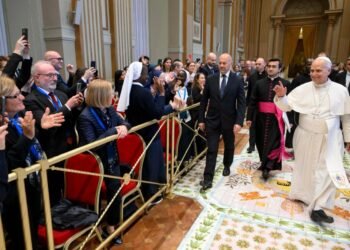
Arriving by car in Piazza della Minerva, after a nod of greeting to the crowd gathered around the obelisk of the little elephant designed by Bernini, the Pope crossed the Ionic columns that flank the monumental access door to the Palace where the Pae is based. It was the first visit as Pontiff to the “school of nuncios” even though Prevost had already been there before ascending the throne of Peter, as prefect of the Dicastery for bishops.
In the Hall of the Plaque, Leo XIV discovered the marble plaque in memory of the anniversary; then in the Hall of the Popes he unveiled the commemorative stamp, signed by himself, by Cardinal Pietro Parolin, Secretary of State and Protector of the Pae, by Sister Raffaella Petrini, President of the Governorate of the Vatican City State, and by Archbishop Salvatore Pennacchio, President of the Academy.
The Bishop of Rome first stamped the stamp and then signed the house’s guest book, then greeted the Pae administrative commission, the staff and other entities directly involved in the Academy’s Jubilee celebrations, including the Domenico Bartolucci Foundation and the Vatican Post Office. Present were archbishops Paolo Rudelli, deputy of the Secretariat of State, Paul-Richard Gallagher, secretary for Relations with States and International Organizations, Luciano Russo, secretary of the Section for diplomatic personnel, and Petar Rajič, prefect of the Papal Household.
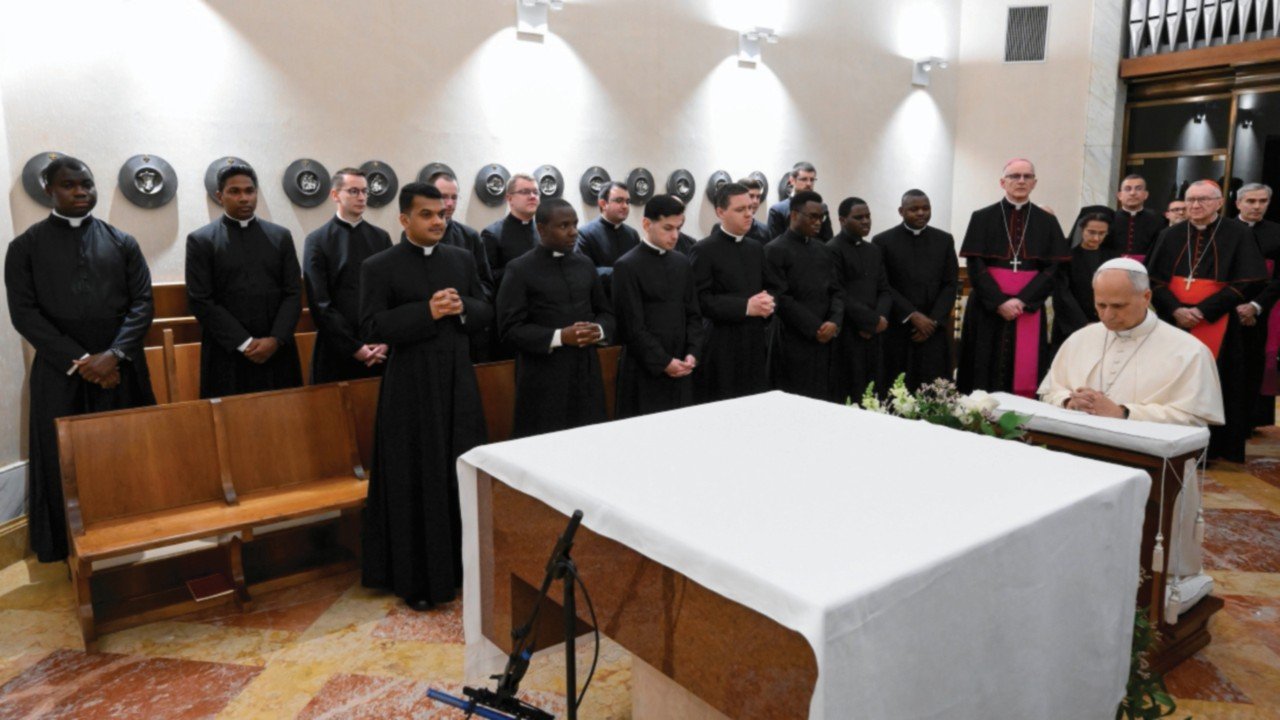
In the chapel, after praying on his knees, the Pope addressed his speech to the Pae students. For his part, Archbishop Pennacchio underlined how the Pope’s visit is “a source of encouragement in the journey of preparation for the diplomatic service of the Holy See”. The prelate also recalled the origins of the Academy – founded in 1701 by Clement
“It is a reality – explained the president – which concretely bears witness to the universality of the Church and the richness of its cultures, called to converge in a single service of communion and peace”. A service which, in a world marked by tensions and conflicts, must be “a sign of hope, through a style of listening, balance and dedication”. The apostolic nuncio Pennacchio also congratulated Cardinal Parolin on the 46th anniversary of his priestly ordination, which took place on 27 April 1980.
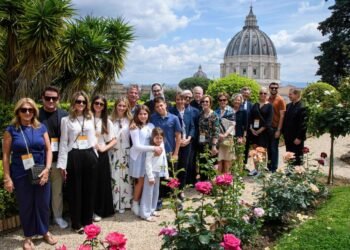
Subsequently, the official photo was taken with the Pae community again in the plaque room, then the Pontiff took leave of the students.
Finally, in the Atrium of Sant’Antonio Abate, Leo XIV met the nuns of the Apostolic Community of the Ever Virgin Mary (Camsvi), who carry out their service within the Academy. About an hour after his arrival, the Pope got into his car to return to the Vatican.