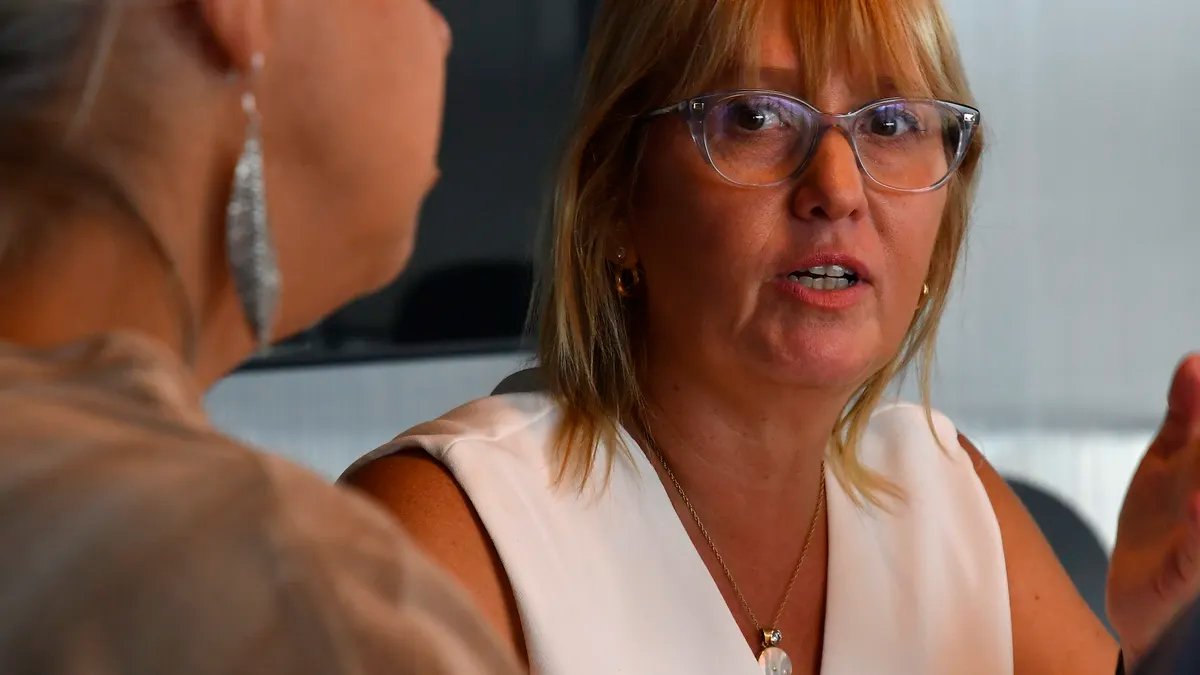
The gynecologist Fernanda Nozar He agreed to occupy the general directorate of Health of this government knowing that he was not going to finish the five-year period. was close to Promote to full teacher (grade 5) at the Udelar Faculty of Medicine.
That was the reason publicly given for her resignation, but her departure – before the selection process ends to become the first female professor of her specialty at the Hospital de Clínicas – symbolizes the drop in a glass that is overflowing due to the differences in management (and the management of power) at the top of the Ministry of Public Health.
As reconstructed The Observer from sources of the MSP, health and the Broad Front, The tensions go beyond this specific case and have other officials angry. The issue also has the attention and alert of legislators from the ruling party who are linked to health and advisors from the left who arrive at the Executive Tower.
One of the triggers for the departure is that Nozar disagreed with the way the minister was leading the ministry. Cristina Lustemberg works with people she trusts and has a circle that is sometimes described as “closed”: Alicia Ferreira, Martín Rebella, Rodrigo Márquez and Zaida Arteta – who at one point was thought to be the general director of Health – are its main members. It is also occupied by Álvaro Danza, who leads ASSE.
The sources indicated that the undersecretary Leonel Briozzo (MPP) had and has little interference. But in putting together the organizational chart, he had proposed Nozar for the position and given the expertise of the gynecologist (who is not an organic member of the MPP) and that Lustemberg knew her, he ended up occupying the role.
Unlike other ministries, In the management of health affairs, a good part of the decisions (especially the most technical ones) pass through the general director of Health. So much so that, regardless of the governments, he is usually the second most visible face after the minister.
The most intimate core of the minister, due to her way of working, was leaving out MSP technicians or the General Directorate of Health itself in aspects that, in reality, were within her competence. They even supported the continuity of the director of the Pereira Rossell Hospital, Gustavo Giachetto, when the director of the pediatric area resigned and most tenured professors threatened to make their positions available.
Within the MSP the deal between Nozar and Lustemberg was (and is) good. It’s not a personal issue. Much less suitability. The differences are due to the way of working.
The informants reported that a good part of the regulation of euthanasia was done by the minister’s inner circle, with minimal participation (in the sense of being heard and actively) from the Digesa and even from legislators who worked for the law.
In turn, Nozar was involved in the mental health plan as one of the priorities. When the Budget Law introduced changes that were later questioned by the National Human Rights Institution Given that they went against the spirit of the law of tending to the disappearance of monovalent hospitals and enabled new hospitalizations, the fingers pointed at Nozar. But, from those around the former leader, they returned that the responsibility lay with people close to the minister.
The issue generates mixed opinions even in El Abrazo, since the leader of the Federation of Public Health Officials, Martín Pereira, is against hospitals stopping having new hospitalizations. The resolution of the matter is in the hands of Parliament, since coordinators of the three parties in the Senate presented a project to once again prohibit new hospitalizations.
Beyond this case, the dissemination in Underlined, on the first day of April, that the MSP would begin to require a prescription to buy paracetamol of more than 500 mg. It was part of the visible wear and tear.
The information came out after The Observer reported that in 2025, almost 67% of the poisoning cases treated by the toxicology center of the Hospital de Clínicas originate from drugs sold in pharmacies.
Channel 10 reported, from “MSP sources,” that in the next few days Lustemberg would sign an ordinance that would require presenting a prescription to buy the medicine.
As reconstructed The Observer, The dissemination of the news took the minister by surprise and bothered her, who was not aware of nor did she endorse the decision. Inside the ministry, Nozar was identified as the person responsible.
Lustemberg’s refusal was such that several days later, in a press conference, he denied that the MSP was going to take this measure: “I want to clarify to the public. When I surprisingly found out what was circulating, I want to say that no one from the MSP, as far as I am aware, and even less so in my person as a minister, said that the MSP was going to start requiring a prescription for this painkiller to be dispensed,” he expressed.
Prior to this, Nozar had participated in an activity of the MPP Health Front, something that was questioned by the minister’s entourage, since according to what they claimed, the leader asked the directors to avoid sectoral issues upon taking office. Although it is not organic, the MPP has Nozar highly valued and Lucía Topolansky has said in some meetings that they are satisfied with her management although she knows that it is fleeting because it comes from the academy.
who’s left
After Nozar’s departure, deputy director Gilberto Ríos is occupying the position although he transmitted internally that he is not willing to take over permanently (in fact his resignation is not ruled out if the leadership remains in that inner circle). One possibility is that the task falls to Arteta, although in the health environment they also mention as possible the internist Laura Llambí, who coordinates the national Tobacco Control program and comes from academia.