Malian Defense Minister Sadio Camara was killed in an attack near the capital Bamako. Referring to their sources, AFP and Al-Jazeera television reported about it on Sunday. Jihadists from the Group for the Support of Islam and Muslims (JNIM) and the rebel movement Front for the Liberation of Azawad (FLA) launched a series of coordinated attacks across the country on Saturday. Their target was also the residence of the Minister of Defense in Kati, a suburb of Bamako. The European Union has already condemned terrorist attacks in the country.
26.04.2026 15:41 , updated: 22:11
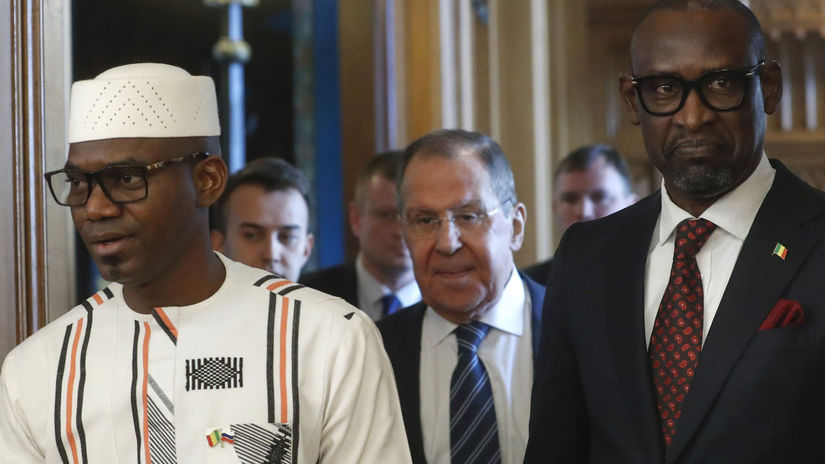
Photo: SITA/AP, Maxim Shipenkov
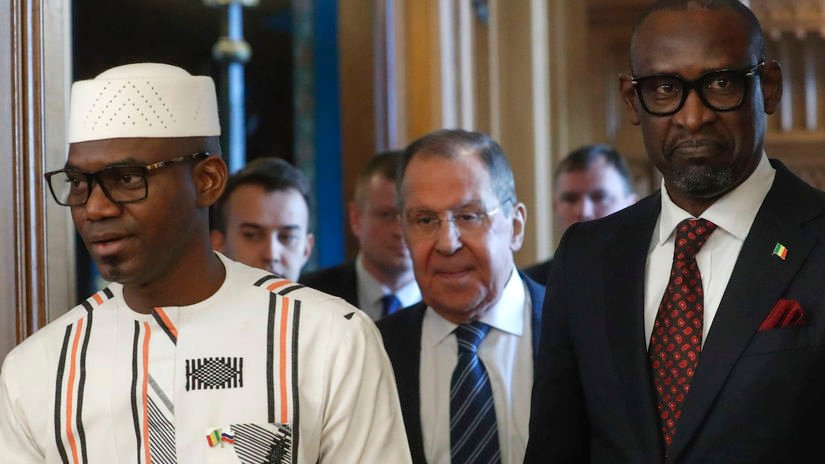
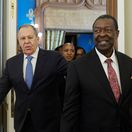
Malian Defense Minister Sadio Camara (left), Russian Foreign Minister Sergei Lavrov (center) and Malian Foreign Minister Abdoulaye Diop in Moscow.
According to AFP sources, a car bomb outside his residence in Kati killed the minister and at least three members of his family on Saturday.
Camara was a key figure in the military junta that seized power in Mali after two consecutive coups in 2020 and 2021. “He was one of the most influential figures within the ruling military leadership and was seen by some as a possible future leader of Mali,” Al Jazeera television reporter Nicolas Haque said. “His death is a big blow to the country’s armed forces,” he said.
According to the government spokesman, the attacks left 16 injured civilians and military personnel, as well as several dead militants, but he did not specify the exact number of victims. The governor of Bamako district also announced a three-day night curfew that will be in effect from 9:00 p.m. to 6:00 a.m. local time.
The suburb of Bamaka Kati is considered one of the safest places in the country as the leaders of the military junta live there. According to al-Jazeera, its leader and the country’s interim president, Assimi Goita, has been under significant pressure since the start of the joint JNIM and FLA offensive, while analysts say the government forces were caught off guard by the offensive.
On Sunday, the EU described the attacks as an act of terrorism and emphasized its commitment to security and stability in the Sahel region. “We strongly condemn the terrorist attacks committed in Mali on April 25,” spokesman Anouar El Anouni said in a statement, offering condolences “to the families of the victims as well as the Malian authorities.”
The United Nations has called for an international response to violence and terrorism in the West African region. The Head of Diplomacy of the European Union, Kaja Kallas, condemned the terrorist attacks and expressed solidarity with the Malian people. The attacks were also condemned by the Economic Community of West African States (ECOWAS).
The rebels announced an agreement on the withdrawal of Russian troops
The Malian Tuareg rebel organization announced an agreement on Sunday that allows the Malian army and Russian troops to withdraw from the town of Kidal. The Front for the Liberation of Azawad (FLA) said on Saturday that its forces had captured the town in northern Mali. It was reported by the AFP agency.
Kidal is a Tuareg stronghold. In November 2023, it was conquered again by the Malian army with the support of the Russian mercenary Wagner group. The group, which was once led by an ally of Russian President Vladimir Putin, Yevgeny Prigozhin, is known for its participation in the war in Ukraine and in war conflicts in Syria, Libya and Mali.
After Prigozhin’s death, Wagner’s group was replaced by a new Russian military unit, the African Corps. According to experts, it has personnel from Russia, Belarus and African states and is estimated to have around 2,000 fighters.
“An agreement has been reached that allows the army and its Africa Corps allies to leave Camp No. 2, where they have been hiding since yesterday (Saturday),” an FLA official told AFP. One resident of Kidalu said they saw a military convoy leaving the town and that “the streets have been taken over by the militants for now”.
According to the agency, the FLA rebels are supported by jihadist fighters from the Group for the Support of Islam and Muslims (JNIM). Both organizations announced on Saturday the launch of coordinated attacks across Mali, including the capital Bamako. Later, the rebels claimed to be in control of Kidal and occupied positions in the northern part of the Gao region.
A security source quoted by AFP said on Sunday that the intention of the groups was not to occupy and control the cities, but to carry out coordinated actions to at least capture Kidal, which it considers a relatively important symbol.
The Malian army said that the attacks also occurred in other places in the country. Fighting was reported on social networks in the eastern city of Gao, in Mopti in the Niger Delta and in Kati, which lies northwest of Bamako. By late Saturday afternoon, however, the military claimed to have the situation under control, with several terrorists “neutralized” and their weapons destroyed.
On Sunday, in addition to Kidal, fighting also broke out in the city of Kati, which is a stronghold of the ruling military junta near the metropolis of Bamako.
UN Secretary-General António Guterres on Sunday condemned the attacks in Mali and called for coordinated international support to address the growing threat of violent extremism and terrorism in the Sahel region.
Mali has experienced two military coups since August 2020, when the military ousted elected President Ibrahim Boubacar Keita. Since 2012, this West African state has been fighting in the north and in the central part against the jihadist insurgency of groups connected to the al-Qaeda network and the Islamic State group. The fighting spread from Mali to neighboring Niger and Burkina Faso, where coups also took place.