
The South Korean Army has begun work on introducing generative artificial intelligence into military operations, aiming to develop an AI-powered system capable of analyzing battlefield data and providing operational recommendations, officials said Friday.
The move comes as artificial intelligence is increasingly viewed as a key asset in modern warfare, with its ability to rapidly process vast amounts of information and assist in identifying optimal strategies and tactics.
According to the military, the Army Information and Communications School has recently issued a research tender for a project on the pilot application and validation of AI agents in the defense sector, seeking institutions to develop and test a prototype system.
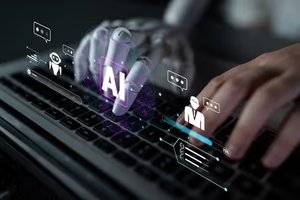
The project focuses on building an AI agent — a software system based on generative AI that can understand user objectives, formulate plans and autonomously carry out tasks using external tools — and verifying its performance through real-world testing.
Officials said the prototype will be used as a reference for developing a more advanced system that can support commanders by analyzing data, assessing situations and generating recommendations across a range of military functions.
“Applying AI technology across weapons systems, combat support systems and administrative tasks is necessary to reduce manpower, time and costs,” an Army official said.
“Existing robotic process automation or simple chatbots are limited to handling structured tasks, making it necessary to adopt AI agents capable of processing unstructured data and supporting complex decision-making.”
The research will also examine the potential application of emerging technologies such as retrieval-augmented generation, which allows large language models to incorporate external databases and documents, as well as the automation of repetitive tasks and the collection and analysis of resource management data.
Key areas of the study include analyzing global and domestic trends in vision-language models and AI agent technologies, designing and developing a prototype system, and conducting pilot applications and validation tests.
The Army plans to use the prototype to accumulate tactical data and refine evaluation processes, with the aim of enhancing the system’s learning capabilities and informing future development.
Officials added that the results could be applied to the Korea Joint All-Domain Command and Control System, or KCCS-A, particularly in integrating intelligent AI agents into operational workflows and identifying core implementation tasks. The system may also be used as a training tool for military personnel.
flylikekite@heraldcorp.com