This story is part of a CBC News series examining the public health impacts of online gambling.
After three years of compulsive online betting, Robin Koczerginski tried to quit in 2025.
He stopped using his favourite sports gambling apps: Bet365, DraftKings and BetMGM.
He says that after installing special software on his devices to prevent him from accessing the apps, almost immediately his phone lit up with email notifications and special offers luring him back.
“Bonuses, free bets, all this stuff. I honestly felt like it escalated even more after I stopped playing,” the Toronto father, writer and communications strategist told CBC News.
It was all to “entice [me] to come back in,” he said.
It worked. He relapsed and started gambling again.
A CBC News investigation has found Koczerginski’s relapse is indicative of a larger problem fuelled by a sophisticated, multibillion-dollar online gambling industry that routinely uses automated inducements and design features to try to keep users hooked.
This despite rules in most jurisdictions, including Ontario and Alberta, that require online casinos to monitor player behaviour and intervene when players show signs of addiction or high-risk play.

Robin Koczerginski’s online gambling began as an escape, but spiralled into a years-long addiction. He shares his story of recovery and how he and his partner, Rachel Lefebvre, overcame his addiction in hopes of helping other families.
‘Dark patterns’ make cashing out difficult
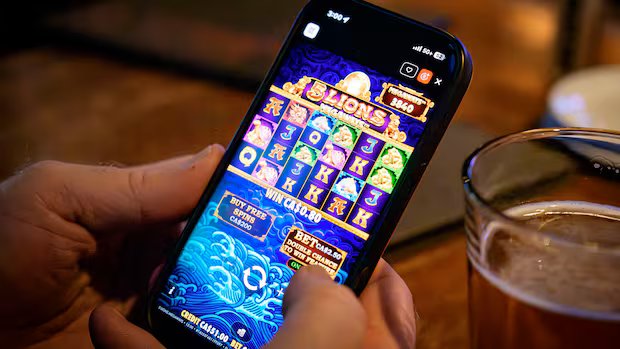
Casino and sports betting apps welcome users into an online experience purposely built to keep people playing and losing money, experts told CBC News.
Beyond attractive colours, flashing animations and a rapid pace of play, experts say companies employ design features known as “dark patterns” crafted to trick users into playing for longer or not notice their losses.
CBC spoke to a former designer from Bally’s Corporation in the U.K., a mid-sized global casino, sports betting and online company, who said they installed features to discourage users from setting up spending limits and added colourful pop-ups to distract them from the feeling of losing.
“Everything on the screen is playing with your psychological feelings,” the former Baily’s designer said, noting this is true of the designs of many popular social media apps and consumer websites.
CBC agreed not to identify the designer, as they fear repercussions for speaking about trade practices.
They also said the company used dark patterns to delay the process of closing an account to allow time for users to change their minds.
Bally’s declined to answer questions about its design features but instead offered a statement that reads in part: “We take our responsibility to our players seriously and work closely with our regulatory partners to ensure responsible gaming principles and safeguards are reflected throughout our products and offerings.”
Experts who study online gambling apps say these features are common.
“On any gambling site that you go to there will be a large deposit button at the top of the screen, but the withdrawal button will be more than likely hidden,” said Jack McGarrigle, a PhD candidate in psychology at Swansea University in Wales who is studying the phenomenon.

Jack McGarrigle, a PhD candidate in psychology at Swansea University in Wales, says gambling apps often make it difficult to withdraw money, cancel accounts or access safer gambling tools in a bid to keep gamblers hooked. (Mat Heywood/CBC)
It works to discourage withdrawals, according to Koczerginski.
“Deposit, it takes 10 seconds. You just click a couple of buttons and your money’s in your account,” he said. “When you withdraw, it is different. There’s a period of time that you have to wait, and it’s super easy to cancel that withdrawal, which I’ve done before, too.”
McGarrigle says apps also often obscure the “responsible gambling” features that allow players to set daily or weekly spending limits.
He likens these features that keep gamblers playing to ones used by social media and online shopping platforms that keep users scrolling as long as possible.
But the stakes are different.
“If you spend too much time on TikTok, you’re not going to go bankrupt or lose your house,” McGarrigle said.
CBC looked into these features by setting up accounts on multiple popular gambling apps and found that cashing out took several extra steps and required waiting eight to 10 days to receive a physical cheque in the mail.
It’s also common for gambling apps to de-emphasize the loss of cash.
T.S., a 22-year-old recent university graduate from Ontario, quit gambling in 2025 after losing $14,000 in one night on blackjack.
“When you played blackjack on FanDuel, for example, they wouldn’t even say that you’d lost money,” he recounted.
“But if you won, you get a big pop-up on your screen that says you won … It’s obvious that they’re trying to make it fun to win and easy to ignore when you lose.”
CBC has agreed not to name him as he fears being stigmatized by prospective employers.

T.S., 22, says the design of gambling apps makes it easier to ignore losses and celebrate wins. (YanJun Li/CBC)
In a statement to CBC News, FanDuel said the company “is committed to providing customers with a clear and transparent entertainment experience.”
“Responsible gaming tools are built directly into our apps and are easily accessible to every customer. These include reality checks, deposit and time limits, and the My FanDuel Spend dashboard, which gives customers visibility into their spending and activity so they can make informed decisions about their play.”
‘Targeting losers’
A former data analyst at DraftKings has been speaking out about his time at the company, which is one of North America’s biggest online gambling companies.
Jayden Butts told CBC and The New York Times that his work between 2022 and 2024 involved identifying and targeting potentially vulnerable gamblers.
Butts says he was tasked with studying DraftKings player data to identify the most profitable customers to target with bonuses.

Jayden Butts, a former data analyst at Draftkings, says the company was using player data to send promotions to potentially high-risk gamblers. (Submitted by Jayden Butts)
“What I was asked to do is, given all the immense amounts of data that we had on customers — where they’re from, how they play, what they like to play, you name it — with all of these features, can we create something that tells us who we should be sending our promotional offers to?”
But he became uncomfortable as he concluded the most profitable customers might also be high-risk problem gamblers.
DraftKings told CBC in a statement, “We do not market to customers based on indicators of potential problem gaming.”
Butts, however, felt he was exploiting vulnerable players.
“I’m making their lives harder and their financial situations worse, the better I do at my job,” he said.
“It’s targeting losers. I don’t want it to sound like, ‘Oh, they’re targeting the suckers.’ It’s literally like they are targeting people who are most likely to lose money.”
Butts says he was dismissed in late 2024 for performance issues. He says he’d become disillusioned.
DraftKings told CBC News in an email that it uses “basic marketing practices” such as data science and analytics — and not AI — to customize its promotional targeting toward “customer groups, not individual customers.”
“Statements by Mr. Butts only reflect his views, as a single junior-level business analyst at DraftKings who was employed at the company for less than two years.”
“The premise that a problem gambler would be ‘the best investment’ is patently false. Our long-term success depends on customers who engage responsibly.”
DraftKings also rejected the characterization that withdrawals are more difficult to make than deposits.
“Withdrawals and deposits involve different processing requirements. DraftKings approves and sends 97 per cent of withdrawal requests within five minutes,” a spokesperson wrote in an email Monday.
Calls for stricter regulation
After Butts’s initial allegations were published by The New York Times in September, politicians and gaming regulators in the U.S. launched inquiries into whether DraftKings and other companies are misusing data and AI to target problem gamblers.
Ontario’s regulator, the Alcohol and Gaming Commission, did not respond to CBC’s questions about whether it is investigating DraftKings.
The AGCO issued a detailed statement citing Ontario’s regulatory standards, which set requirements for game design, player information, advertising, inducements and player protections.

CBC looked into design features of gambling apps by setting up accounts on popular apps, and found that cashing out took several extra steps and required waiting 8-10 days to receive a physical cheque in the mail. (Evan Mitsui/CBC)
“Operators must monitor for indicators of gambling-related harm and intervene appropriately …. Player data or analytical tools cannot be used to target high-risk players with marketing or inducements,” the AGCO wrote.
T.S. and Robin Koczerginski have both quit gambling, sought addictions treatment and are now in recovery. Koczerginski has enrolled in a program called BetGuard, which excludes him from all regulated gambling sites in Ontario, making a relapse near impossible.
They both say that when they were gambling, erratically and at all hours, they felt highly targeted despite showing classic signs of problem gambling.
“They’re really trying to pinpoint exactly who you are, what you like, what is, like, your particular flavour of bets that you like to place, and trying to use that to keep you going, especially as you are fighting really hard [to stop] when you’re addicted,” Koczerginski said.
T.S. believes governments need to step in with stricter controls on gambling companies.
“[The companies are] not going to do it on their own,” he said.
“They’re never gonna stop targeting problem gamblers. That’s where their money comes from.”