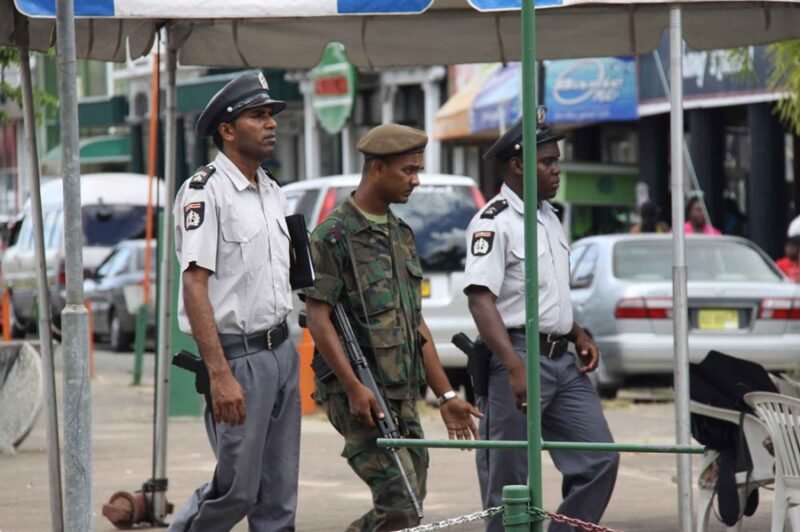
An entrepreneur was recently shot dead during an armed robbery on Wilhelminastraat. In Brokopondo, two people were injured in a robbery in which the perpetrators carried shoulder weapons. In Latour, two victims suffered stab wounds when armed men struck. Last Monday, two teachers from OS Welgelegen were robbed by armed men in the school office. The series of violent incidents has further fueled security concerns in Suriname. What about safety?
Text Ivan Cairo
Image dWT archive
President Jennifer Geerlings-Simons announced extra police patrols and support from the National Army during a press conference last Monday. According to her, the police and military have been significantly weakened in recent years. She did not provide figures showing how great the decline has been. The development of the Suriname Police Force (KPS) over the past ten years provides starting points for assessing its statement.
“The population has an interest in a police organization that has sufficient people and resources to prevent crimes, track down suspects and offer victims protection”
Nearly a thousand police officers short
The most concrete indication of the problems at the KPS came from the now resigned Minister of Justice and Security Harish Monorath. He announced on October 21 that the force has approximately 2,600 police officers. At least 3,500 are needed to properly carry out the tasks, he said. The shortage therefore amounts to approximately nine hundred police officers, more than a quarter of the minimum required strength.
When he took office, the force had 2,773 police officers, according to Monorath. Since then, the workforce has decreased by approximately 173. The minister cited retirement, death and departure abroad as causes. According to him, 24 to thirty employees leave the force and the ministry every month.
By the way, the personnel problems have existed for some time. During the previous government, it was announced that more than three hundred police officers had been removed from regular duty to be deployed as security guards for dignitaries. The 2019 state budget shows that the KPS had approximately 2,217 police officers in April 2018. In 2017, 72 employees left the organization, while only four new employees joined. There were also backlogs in training and promotions.
The force currently has more police officers than in 2018. The recent decrease since Monorath took office has been concretely established. For an accurate comparison over ten years, more data are needed on annual workforce numbers and actual employability.
Some of the police officers are deployed for personal security and other government agencies. Monorath therefore wanted to bring employees back to the regular police service. He mentioned cases in which prominent persons have eighteen to 21 police officers. According to him, some employees have been doing security work for fifteen to eighteen years.
He also previously pointed out that certain police stations only have four police officers available per shift, while according to him eight are needed. This provides a concrete picture of the consequences of the staff shortage for daily police care.
Crime has fallen in ten years
The figures from the Criminal Information Service show that various forms of serious property crime have decreased significantly over the past ten years. In 2017, the police registered 1,220 robberies. There were 586 in 2020 and 554 in 2024. 436 robberies were registered throughout 2025, a decrease of more than 64 percent compared to the peak in 2017.
A similar development is visible in burglaries. The number peaked in 2016 with 4,205 cases and dropped to 2,256 in 2024. Last year, 1,982 burglaries were recorded. The number of robberies also fell, from approximately 390 in 2016 to 180 in 2025.
Developments did not proceed in the same direction every year. For example, an increase was visible again in qualified thefts after 2021. Over the entire period, the registered numbers in various categories are now considerably lower than ten years ago.
The figures concern crimes registered with the police. Changes in the willingness to report crimes can influence the results.
The recent violent robberies show how serious the consequences for victims can be. Figures over a longer period are important for assessing general crime development.
Vehicles remain a problem
Investments have been made in the KPS at various times over the past ten years. According to an overview by former Vice President Ashwin Adhin, 75 police vehicles, fifty motorcycles and eighty bicycles were purchased during his reign until 2020.
At the end of 2024, 28 new police vehicles were handed over under President Chandrikaprsad Santokhi. Additional deliveries followed in 2025. Further purchases were also prepared. However, the force is currently facing a shortage of means of transport.
Chief of Police Melvin Pinas announced during a press conference last Monday that ten vehicles have been rented to support various police regions. Following promises from President Geerlings-Simons, he expects additional vehicles this year. He also wants to make more use of motorcycles and bicycle surveillance.
The communication makes it clear that the vehicle fleet remains a major bottleneck. It has not been announced how many vehicles the force currently owns, how many of them can be used on a daily basis and what happened to the previously purchased equipment.
(read more below the photo)

Investments have also been made in the technological field. Implementation of the Safe City project began in 2018. The following year, approximately three hundred surveillance cameras were available in Paramaribo and Wanica. Sixty were added at the beginning of 2020.
Geerlings-Simons announced last Monday that repairs and expansion of the camera system have been approved. She said Safe City helped track down suspects. Further expansion is planned for 2027.
The KPS also received foreign support. Training and equipment were made available through American programs. The Netherlands supported, among other things, investigative training, management training and forensic research. Cooperation took place with France in the field of border control and specialized police training.
Keep an eye on criminal groups
During the press conference last Monday, Chief of Police Pinas, together with Director of Operations Rishi Akkal, explained the approach to recent violent crime. Suspected criminal groups have been identified with the help of intelligence. Special intervention teams are deployed to track down and arrest those involved. The police are also intensifying vehicle checks and using drones and camera images.
One suspect has been arrested in the investigation into the fatal robbery on Wilhelminastraat. Five other suspects have been identified and are being sought. The Capital Crimes Unit also seized vehicles, firearms and more than a thousand cartridges of various calibers during its investigations.
Akkal stated that existing police operations are being adapted to changing crime patterns. The deployment of personnel and the available resources were also discussed during the press conference.
According to the police leadership, the limitation of overtime is still being discussed with the minister. Akkal stressed that security operations should not be hampered as a result. Pinas also acknowledged that integrity problems within the force deserve attention.
The announcements provide insight into the measures that the police are currently taking. An assessment of the results requires data on arrests, solved cases and the development of crime in the coming months.
How many crimes are solved?
An important indicator of the KPS’s performance is its ability to clarify criminal cases. According to the General Bureau of Statistics, the overall clearance rate fell from 24.5 percent in 2015 to 16.4 percent in 2018. A comparable public series for subsequent years is lacking.
At the end of 2024, then Chief of Police Bryan Isaacs reported that 32 of 36 investigated life deprivation cases had been solved, almost 89 percent. According to the figures presented at the time, the clearance rate for the robberies and robberies investigated was 46.
During his year-end closing, Isaacs also pointed out organizational problems he had encountered within the force. He mentioned a weak information position, backlogs in personnel matters and problems with internal structures. According to him, hundreds of employees were promoted in 2024 and various parts of the organization were tackled. The problems at the KPS therefore also relate to the internal organization and the possibilities for investigating criminal cases.
How big is the attenuation?
President Geerlings-Simons’ statement is supported in various aspects by the current situation at the KPS. According to Monorath, the force has approximately nine hundred fewer police officers than the minimum required. Police posts are understaffed and vehicles have to be rented for surveillance. The force leadership has also acknowledged organizational shortcomings and integrity problems.
“It has not been announced how many vehicles the force currently has, how many of them can be used on a daily basis and what happened to the previously purchased equipment.”
The ten-year data shows that these problems have a long history. During the same period, police officers have been trained, vehicles purchased, surveillance cameras installed and specialized units supported. Registered serious property crime has also fallen significantly in various categories.
To accurately determine the extent of the weakening, data on annual operational personnel, vehicle deployability, investigative capacity and national clearance rates are still lacking. The staff shortage and the current material problems are concrete. It is not yet possible to determine from the available figures how much the KPS has actually lost in effectiveness in recent years.
The recent incidents of violence make this question urgent. The population has an interest in a police organization that has sufficient people and resources to prevent crimes, track down suspects and offer victims protection. The announced reinforcement will ultimately have to be measured against those results. Urgent investments will be needed in the KPS and in a broader context in improving security in the country. If necessary, with borrowed money, as President Geerlings-Simons suggested last Monday.