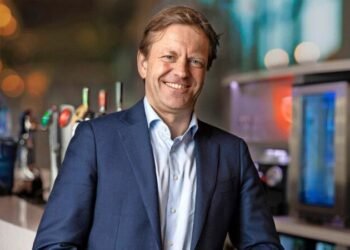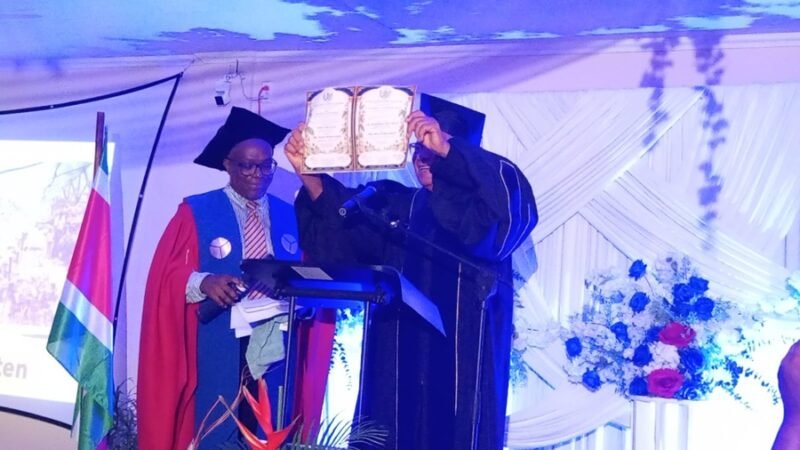
Agricultural expert and culture bearer Iwan Wijngaarde (84) has been awarded an honorary doctorate by the Claudetta Toney University of Suriname for Chemistry, Engineering & Research (CT-Uscer). This was done as a token of recognition for his many years of contribution to agriculture, nature education and the preservation of cultural heritage. Wijngaarde has mainly committed himself to making knowledge accessible to Surinamese society.
Text Audry Wajwakana
Image Ryaen La Rose
The ceremony took place on Monday during the opening of the 2026-2027 academic year, which focused on science and sustainable development. In his laudation (eulogy), Professor Franklin Jabini extensively discussed the social significance of Wijngaarde’s life’s work.
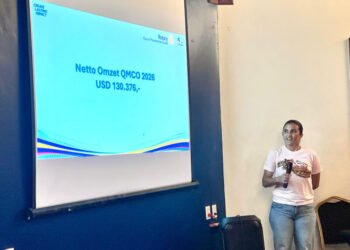
“We want to show the community what we have done in a year. We have achieved more than our goals“
Victorine Pinas
After studying agriculture in the Netherlands, he returned to Suriname in 1967, where he worked at the extension service of the Ministry of Agriculture, Livestock and Fisheries (LVV). He provided information about agriculture, plants, pesticides and food safety through radio and television programs. He also provided training and supported agricultural projects in the interior.
His social involvement extended beyond agriculture. As chairman of the Feydrasi fu Afrikan Srananman, he has been committed to preserving the Afro-Surinamese cultural heritage and raising awareness of the history of slavery for more than thirty years. While Jabini highlighted Wijngaarde’s achievements, collaged images of his work were shown on a screen.
Transferring knowledge
After the reading of the official decision, Wijngaarde received his honorary doctorate accompanied by the apinti. He sees the recognition primarily as an opportunity to further use his knowledge in society and emphasizes that young scientists in particular can benefit from the experiences of older experts.
Despite his old age and years of dedication, Wijngaarde does not yet think it is time to take it easy. “I hasten to pass on my knowledge.” He advocates closer cooperation between academically trained young people and experienced professionals.
Wijngaarde says that he was recently appointed by LVV as chairman of a committee dealing with the residue decision, which relates to pesticide residues in agricultural products. The subject has occupied him for about sixty years.
The issue was already discussed during his studies in the Netherlands, but in his opinion insufficient measures have been taken in Suriname. Wijngaarde is particularly concerned about the consequences of harmful substances for public health. He points to the number of dialysis centers in Suriname, which he links to exposure to pollutants. “The people have suffered for sixty years,” he says critically. He believes that measures should have been taken much earlier to protect the population.
Posthumous recognition
The choice to award Wijngaarde an honorary doctorate was unanimous within the university, says Victorine Pinas, professor and initiator of the university, the True Time. She believes that Suriname shows insufficient appreciation for experts who have contributed to the development of the country for years.
The university therefore also wants to make other people with special social merits eligible for an award. For example, it is being considered to distinguish the late veterinarian Henk van Ommeren. He has provided information for many years through the television program ‘We and the animals’.
Pinas regrets that experts often only receive recognition after their death. “We really want to put those people in the spotlight. It’s a shame that it has to be done posthumously, because we want people to do that during their lives.”
(read more below the photo)

Making a year’s work visible
The university, which has entered its second academic year, also reflected on the results of its first year of existence and the expansion of its scientific activities. The institution has now received recognition from the Ministry of Education, Science and Culture and has started the accreditation process. Pinas expects this process to take four years.
The ceremony started on Monday with a togatia ceremonial parade of academics, who dressed in gowns and berets in procession around the building in the working-class district known as Purupangi (Poelepantje) in Abrabroki. With this parade, the university also wanted to involve local residents in the opening of the academic year. “We want to show the community what we have done in a year,” Pinas said.
For the new academic year, the university is adding three new courses focused on microbiology and biotechnology, ICT and artificial intelligence and heritage and culture from a technical-scientific approach. Pinas looks back with satisfaction on the university’s development. In the first year, three patent applications emerged from scientific research. Interest in PhD research is also growing. “So we have achieved more than our objectives,” she believes.
Students
During the meeting, students also shared their experiences. Shiranigatoun Dhaur, who last year received a scholarship from the late Claudetta Toney to follow a pre-bachelor’s program for her studies in Biopharmacy, talked about the challenges she faced during her studies. She had a lot of difficulty with English. “But with discipline, extra study hours and sometimes sleepless nights, I managed to make progress, as a result of which I have now developed a special interest in biology and physics.” She also gained more confidence in her own abilities.
Master’s student Elisabeth John talked about her research in chemistry. Because laboratories in Suriname do not always have the necessary equipment, she uses small laboratory equipment, which means she needs significantly fewer reagents (chemical substances used in a laboratory for research). With her research she wants to show what possibilities new technology offers for scientific research in Suriname.