Text and image Edwien Bodjie
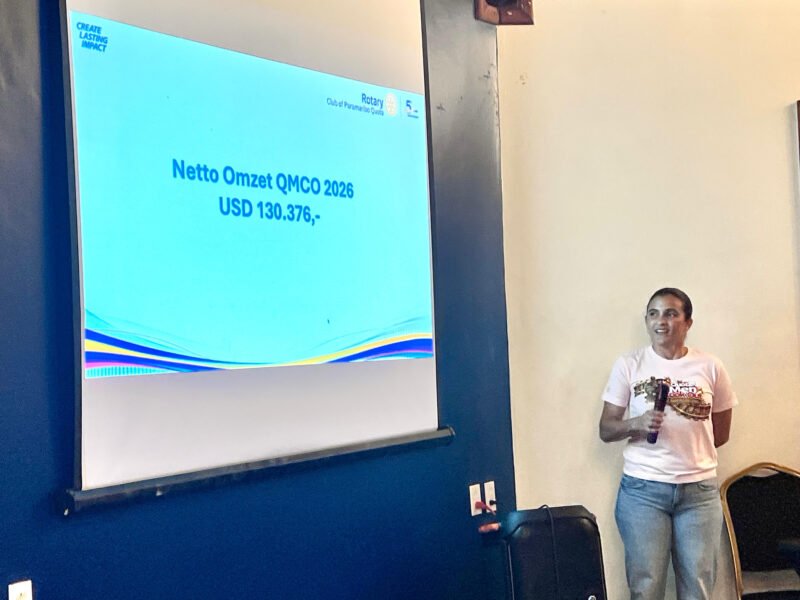
PARAMARIBO — The net proceeds from the Quota Men Cookout 2026 are lower than those of last year. In 2025, the Quota Men Cookout raised USD 149,214. Nevertheless, the organization was satisfied with the result. Anthousa Karsodikromo-Lim A Po pointed out that every contribution counts. The 26th edition of the event generated net proceeds of USD 130,376. That amount was paid on Tuesday evening during the teach-out at Het Park announced by Rotary Club of Paramaribo Quota.
“We are only happy with all the proceeds you bring in, because thanks to you we can carry out our projects,” she told those present. The three companies with the highest turnover were Baitali, with SRD 462,275, followed by Interfarm with SRD 383,750 and Nemo with SRD 372,102.50.
“STICRIS, a shelter for female victims of domestic violence, and the Grietjebieschool also receive support”
Although the revenues per team were compared, Karsodikromo-Lim A Po indicated that the ultimate goal for the club outweighs the mutual competition. “For us it is not important how much a team brings in. It is important that everyone contributes, in his or her own way.”
“We also know what men are like. Men just like a little bit of competition,” she noted. According to her, the organization is especially grateful for the commitment, creativity and support of all participating companies and other stakeholders. Karsodikromo-Lim A Po clearly says that the Quota Men Cookout is not only about competition between the participating companies, but above all about the joint contribution to society.
The cookout took place on Saturday, October 31 under the theme All Aboard the Flavor Express. A total of 47 companies participated. The event attracted approximately 6,800 adults and 600 children. The proceeds are used to finance the club’s social projects and support various target groups in Suriname.
Chairman Derrick Klaverweide also spoke about the club’s work during the meeting. Rotary Club of Paramaribo Quota supports sixteen or more projects every year, partly independently and partly in collaboration with other Rotary clubs. The initiatives focus on various groups in society, including the elderly, children, young people, people with hearing impairments and women who are victims of domestic violence.
Projects supported include Bigisma Dei, which focuses on elderly people in retirement homes, and the Hearing Impairment Program (HIP), which focuses on the hearing impaired and the deaf. STICRIS, a shelter for female victims of domestic violence, and the Grietjebieschool also receive support. The club also conducts awareness campaigns on topics such as mental health and cardiovascular disease in women.
Scholarships are provided through the Circle of Life project. Other initiatives are aimed at teaching skills that can help groups become more self-sufficient. School students also have the opportunity to become acquainted with different professions through a program. The club also handles applications for smaller social projects submitted by society. These are first assessed before support is granted.
Klaverweide indicated that the club tries to make visible during the year what happens with the funds raised. “For every project we carry out, you can see messages about it on our social media or in the newspapers. We often indicate that the funds come from the Quota Men Cookout.” In this way, the club wants to be accountable to the people and companies that support the event. This year’s edition also brought organizational challenges, as the cookout was held in a new location. According to the club, the event nevertheless went well.