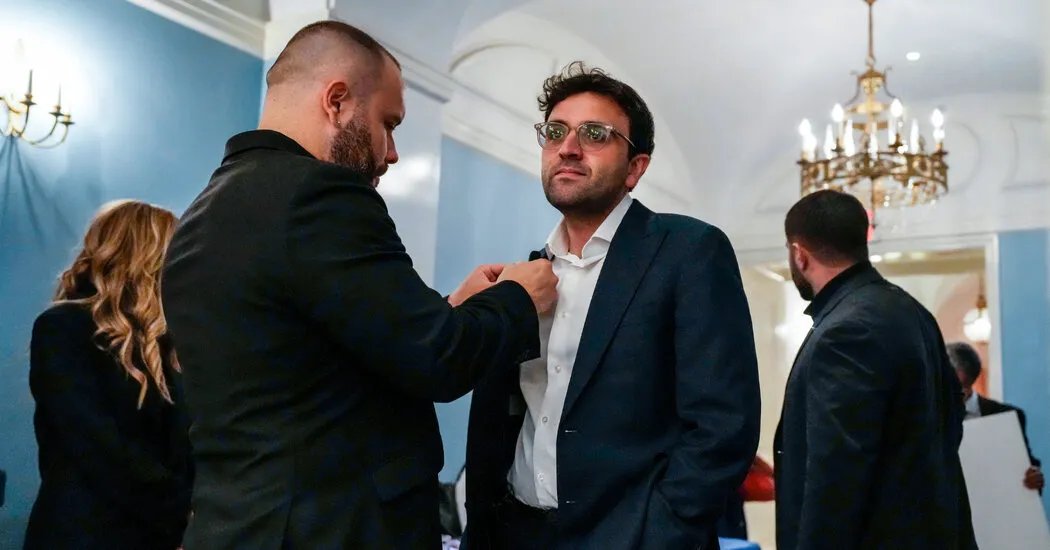
In late April, Kalshi, the world’s largest prediction market, invited a big crowd to a posh event to launch a new type of trading that would allow customers to wager on cryptocurrencies they did not own.
This type of trading had never before been permitted in the United States. But Kalshi was so confident that it would win approval from its regulator, the Commodity Futures Trading Commission, that it booked the event before it had even put in its formal application. After all, the agency’s chairman, Michael S. Selig, had repeatedly signaled that he was a prediction markets booster.
When the C.F.T.C. did not move fast enough, Kalshi was forced to cancel the gathering at a glass-domed Brooklyn penthouse with sweeping views of the Manhattan skyline. And the firm’s chief executive, Tarek Mansour, called Mr. Selig to complain, according to three people with knowledge of the call who spoke on the condition of anonymity to describe a private conversation.
But Kalshi just needed to be patient. Mr. Selig’s support was never in question.
In a series of decisions from May onward, he reversed years of agency policy and gave Kalshi what it wanted: permission to let customers bet on the prices of individual stocks, cryptocurrencies or other assets without buying them or being forced to settle up by a specific date. Now, for example, clients could simply wager that the price of shares of ExxonMobil would fall and then get paid if it did.
It was the first time the trades, called perpetuals, were permitted to be offered to American customers. And the agency’s authorizations immediately infuriated officials at some of the nation’s largest trading exchanges who saw Kalshi as a privileged new competitor.
Two powerful clearinghouses — the Chicago Mercantile Exchange and Cboe Global Markets — have filed suit against the agency, claiming that giving prediction markets this leeway violates federal laws designed to protect investors from insider trading, market manipulation and other abuses.
Lawsuits brought by major trading clearinghouses against their own regulator are extremely rare, partly for fear of repercussions. Nasdaq, one of the nation’s leading stock exchanges, has also publicly objected to perpetuals trading but has not filed suit.
The C.F.T.C. turnabout is one of a string of actions benefiting prediction markets, a fast-growing business sector that President Trump enthusiastically supports, and in which his oldest son, Donald Trump Jr., has a financial stake worth millions. The authorizations also help the cryptocurrency industry in which the Trump family is heavily invested.
The agency has also mounted legal challenges this year against both red and blue states that claim prediction markets are evading state regulations on sports betting, a battle that many expect to end up in the Supreme Court.
“The C.F.T.C. is proving eager to push the envelope on its own legal interpretations, and frankly partner with its own regulated entities” to avoid both securities laws and state regulators, said Tyler Gellasch, who leads Healthy Markets Association, a nonprofit organization that focuses on financial policy.
A Lucrative New Product
Mr. Selig, who is currently the C.F.T.C.’s sole commissioner, has said that customers are seeking perpetual trades and that Americans should not be “forced to turn to offshore, and often unregulated, venues” to conduct them.
“Fearing change, Cboe and other incumbents have decided to take frivolous legal action by attempting to undermine the administration’s pro-innovation agenda,” the agency’s spokeswoman said in an email.
Mr. Mansour, Kalshi’s co-founder, promotes perpetual trades as the most flexible financial instrument ever invented, one that will help his firm develop from a betting platform into a full-service financial exchange. Prediction markets are especially keen to expand their products in case the courts impose restrictions on sports betting, the source of most of their revenue.
In a statement, Kalshi said the lawsuits over perpetual trading were merely “a tool for the current winners to prevent competition and protect the sweet deal they have going: Whether it’s sports books, options, futures or stocks, it’s all about keeping their market share.”
Perpetuals, or “perps” for short, were initially popularized outside the United States partly by Samuel Bankman-Fried, the convicted fraudster who offered such trades for cryptocurrencies on his former trading platform FTX before its spectacular collapse in 2022. The trades also took off on Binance, the world’s largest cryptocurrency exchange whose founder pleaded guilty to violating an anti-money laundering law, then was pardoned by Mr. Trump a year ago.
Crypto firms pushed hard to legalize such trading in the United States, and Mr. Selig embraced their argument as soon as he was appointed last December. He has said perpetuals would further the president’s goal of making America “the crypto capital of the world.”
Platforms like Kalshi use periodic payments between the traders who bet an asset will go up and those who bet it will go down to keep the contract price in line with the actual market price. Because traders tend to jump in and out of such contracts as the prices fluctuates, they can be highly lucrative for platforms that charge a fee for each transaction.
Before Mr. Selig authorized Kalshi, Coinbase and another crypto firm to offer such trades, his agency had pressed civil charges against firms like Binance for doing so.
Perpetual trades on stocks are in some ways like stock options, where ordinary investors can gain the right to buy or sell an individual stock at a certain price on or before a certain date.
But those investors have a wealth of protections that opponents say are much diminished for perpetual traders. For instance, stock options are traded through broker-dealers, creating an audit trail, and monitored through the surveillance system of the Securities and Exchange Commission.
While Kalshi has also registered with the S.E.C. as an exchange, the C.F.T.C. is acting as the primary regulator for perpetual trades. It generally oversees futures and commodities markets that professional traders use to hedge risk, not financial tools for individual investors, like the S.E.C.
The traditional trading exchanges argue that the prediction markets are setting up a kind of shadow stock market that puts investors, and potentially the broader financial markets, at risk.
“We certainly don’t want to see public customers be negatively impacted because of a lack of customer protection that the securities laws in particular are specifically designed to address,” Craig Donohue, Cboe’s chief executive officer, said in an interview last week.
Coming Scrutiny
Terrence A. Duffy, the chairman of the C.M.E. Group, which runs the Chicago Mercantile Exchange, has been especially vocal in his criticism of the C.F.T.C.
“It does feel a bit of a ready, fire, aim strategy going on right now where anything can go, and so it’s very disconcerting,” he said on a Bloomberg podcast in October. “They are circumventing basically acts of Congress.”
In closed-door meetings, some career officials at the S.E.C. voiced concerns that the C.F.T.C. was skirting securities laws, according to three people familiar with the situation who spoke on the condition of anonymity to describe internal government deliberations. A spokesman for the S.E.C. said the agency “supports bringing previously unavailable products to the U.S. markets within a framework of comprehensive oversight.”
Cboe made some initial headway after it sued in federal court last week over perpetual trades on stocks. A federal judge ruled that the exchange was likely to prevail with its claim that the C.F.T.C. had exceeded its statutory authority. Citadel Securities, Healthy Markets and other broker-dealers and exchanges are also plaintiffs.
“The C.F.T.C.’s actions seem to represent a major disruption to the equities market, and the public, including plaintiff, would be served by preventing such a disruption before it occurs,” wrote Judge Valerie Caproni of Federal District Court for the Southern District of New York.
The agency could also face scrutiny from the Senate Banking Committee. Come January, it is set to be led by Senator Elizabeth Warren, Democrat of Massachusetts. Last week, she said perpetuals trades are highly risky and accused the C.F.T.C. of “rubber-stamping 24/7 high-stakes gambling on our stock market.”
The C.F.T.C. and the prediction markets claim such protests are vastly overblown. They say the agency is acting within its powers and protecting traders and markets with strong rules, surveillance and enforcement.
Kalshi officials say that perpetual trades are no more risky than any other betting on predictions markets, such as how a particular sports team will perform or who will leave the Trump administration before the end of the year. They contend that these trades are more flexible and cheaper than traditional trades like stock options.
The C.F.T.C. is also permitting Kalshi to list other types of stock-related trades, including bets on how the stock market indexes like the Nasdaq 100 will perform and on key corporate indicators that help drive individual stock prices. For example, traders can bet on the amount of sales McDonald’s Corporation will report or how many commercial airlines Boeing will deliver during a certain period.
Kalshi is now offering perpetual trades on at least 50 individual stocks, including some of the country’s biggest companies, such as Google, Apple, Nvidia, Microsoft and Amazon. Since the C.F.T.C. authorized the product on Nov. 3, the platform says it has seen particularly brisk trading volume, amounting to billions of dollars.
“Stock market exposure is the next step towards Kalshi becoming a full-service financial exchange, and perps are the best way for our traders to get this exposure,” Mr. Mansour said last month.