

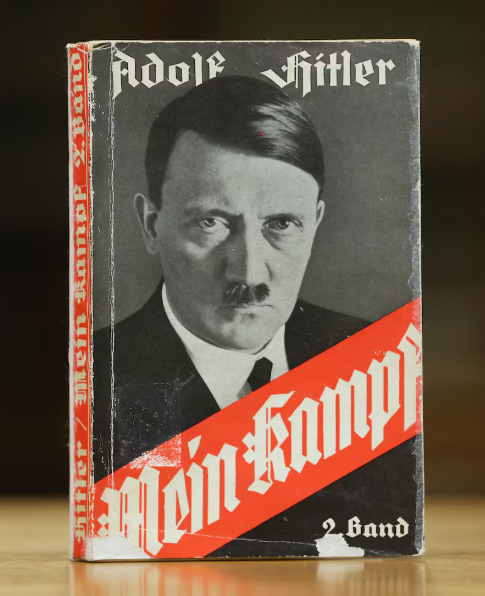
The police action that ended on Saturday with the removal of two copies of the Mein Kampf, by Adolf Hitler, from the bookstore Llibre Idees d’Escaldes-Engordany would not have been adjusted to the ordinary criminal procedure, according to legal sources consulted by the diary. Experts question whether the agents directly confiscated the books without prior judicial authorization nor having taken a statement to the managers of the establishment. They consider that, faced with the suspicion of a possible crime of apologia for genocide, the police would have had to follow other paths to investigate the facts and determine whether the content of the work could constitute a criminal offence. However, the case is already in the Batllia
The shelf of Book Ideas from which they confiscated ‘Mein Kampf’.
The legal sources consulted explain that the Code of criminal procedure foresees the immediate police intervention in the face of flagrant crime. However, they consider this assumption would not correspond to the known facts, since the officers did not act against a person who was allegedly committing a crime, but directly removed objects that they considered possible evidence. For this reason, they argue that it would have been more appropriate subpoena the managers of the bookstore to give a statement and, if it was necessary to intervene in the material, request a judicial authorization.
“This book is a way of knowing history with the aim of not repeating it”
Lawyers point out that the usual way to investigate the content of a publication would be transfer the evidence to the Prosecutor’s Office so that he asked the batle for the necessary measures. In this way, the withdrawal of the specimens could be carried out under judicial control. The question also affects the content of the work. Article 457 of the Criminal Code punishes the apology of genocide, but does not establish an express prohibition of market the Mein Kampf. The sources consulted point out the need to differentiate the dissemination of an ideology that justifies genocide from the sale of a document of historical interest. In this sense, they consider it relevant to examine the specific edition, the foreword, the editorial annotations and the purpose of the publication before determining whether there are indications of criminal conduct.
“I will not limit access to freedom of information, unless a book is banned”
The owner of the bookstore Llibre Idees, Pamela Méndezexplained to diary that the events began around eight in the evening, when an off-duty police officer entered the establishment plain clothes According to his account, the agent observed a copy of the book in the history section and demanded its withdrawal, ensuring that “it was banned in Europe”. Mendez denies this statement and specifies that the work was placed on the back among other publications, without any outstanding exhibition or Nazi symbology.
“The police action is absurd and barbaric, absolute solidarity with the bookstore”
An intimidating accusation
The bookseller explains that, after identifying herself as a police officer, the man showed the plate to the workers and alerted a patrolwhich arrived about twenty minutes later. “The truth is that it was intimidating”, he says Mendezwhich describes the agent’s attitude as “presumptuous”. the patrol he took the two available copies and, according to the owner, he told her by phone that the case would be transferred to the Batllia for a possible hate speech crime.
“If we want to fight Nazism, we have to know what it says in order to do it knowingly”
Méndez defends that the sale of the book responds to thehistorical interest of certain readers and not to any desire to exalt Nazism. He explains that they usually sell between six and eight copies a year and that buyers are usually students or people interested in World War II. “It’s a way to learn about history so as not to repeat it,” he says. The owner hopes that the procedure will be archived and regrets that the intervention has caused the opposite effect to what the agent intended, arousing more interest now in the publication.
“I am in favor of marketing these books, but in an academic sense, not for dissemination”
The agent who originated the notice also has literary interests, self-publishes books and is linked to the organization of Geek Festival of Encampaccording to the information collected by diary. Mendez confirm that Book Ideas he does not market his works and explains that the bookstore has been around for a long time stopped accepting self-published books for management issues. However, he avoids linking this circumstance to police action. “We will never know,” he says, without attributing any personal motivation to the agent.
Very “out of place”
The intervention has also generated strong criticism among other establishments in the sector. Lluís Canal, manager of La Llibreria, in Andorra la Vellaconsiders that “the performance is totally disproportionate and out of place” and questions that a book can be “seized without a court order.” He defends that the copies arrive through the usual commercial channels and assures that does not intend to withdraw them. “I will not limit access to freedom of information to my clients, unless a book is banned”, he says.

The book was in the store without any prominent display or Nazi symbology
In the same vein, Haydée Vila, owner of La Trencadescribes the police action as “nonsense and barbarity” and expresses “absolute solidarity” with Book Ideas and its owner. Although he does not have the work in his bookstore, he claims that I could order it if a customer asked for itwithout demanding explanations about the reasons for the purchase. “Normally, these books are requested with a clear study objective”, he defends. Village considers that the commercialization of historical documents it does not necessarily involve sharing their ideas and demands that access to information be respected