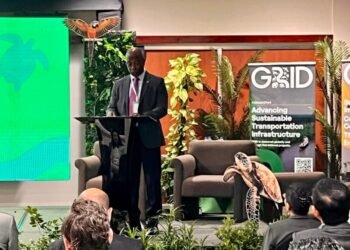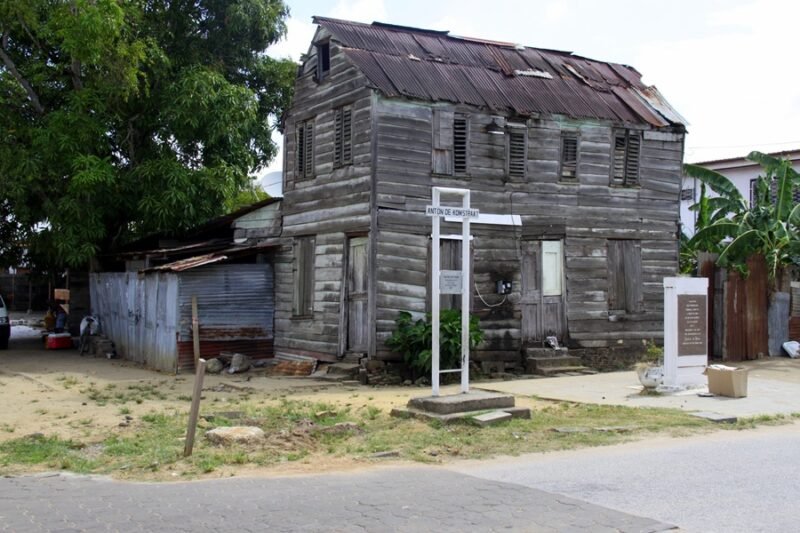
The parental home of freedom fighter Anton de Kom on the corner of Anton de Kom and Hofstraat no longer exists. However, the historic building will soon become visible again, albeit in a reduced form. By symbolically connecting two wooden building parts, Minister André Misiekaba of Health, Welfare and Labor (VWA), who represented President Jennifer Geerlings-Simons, gave the go-ahead for the reconstruction of the house on Thursday. The act took place at the Labor Mobilization and Development Foundation (SAO). This means that the project ‘A prasi fu Anton’, an initiative of the Under the Blue Surface foundation in collaboration with SAO, has officially started.
Text Audry Wajwakana
Image Audry Wajwakana & dWT archive
“Building brings people together, but then touring the house also brings people together,” says Robert van der Horst of the Under the Blue Surface foundation. This idea forms the basis of the project in which the Anton de Kom University, the Suriname Conservatory and the cultural organizations Naks, the Hindi Parishad Foundation and the Javanese Immigration Commemoration Association (VHJI) also participate. The replica will travel to various locations in February 2027, where the cultural organizations will each highlight the life and ideas of Anton de Kom from their own background.
“You should keep a house like that with such a history behind it“
VWA Minister André Misiekaba
The initiative stems from last year’s ‘Oso Tori Oso’ project, in which Under the Blue Surface built a traditional wooden people’s house in a reduced form together with SAO students. It formed the backdrop for theater performances at various locations, including Anton de Komstraat.
That’s where the idea arose to do something with the freedom fighter’s missing parental home. “People who came to see that performance asked if something could be done together,” says Van der Horst.
In ‘A prasi fu Anton’ the replica is placed alternately on the grounds of Naks, Hindi Parishad and VHJI. These organizations each investigate from their own vision what significance the freedom fighter had for their communities and what place his ideas have today. Based on this, they decorate their yards and jointly develop a performance.
Museum
However, the replica is offset by the loss of the original house, which despite its great historical significance has not been preserved. Misiekaba acknowledges opposite the True Time that the disappearance of the house is regrettable. “You should keep a house like that with such a history behind it,” says the minister.
He asked his deputy minister Raj Jadnanansing, who was also present, to find out what was currently happening in the yard where the house once stood. He does not rule out that the government and society will take the initiative to rebuild the house and turn it into a museum.
Van der Horst does not see such a reconstruction as a task that his foundation can carry out independently. This foundation focuses on making heritage history accessible through a traveling reconstruction and cultural activities.
The disappearance of Anton de Kom’s parental home is not an isolated incident. In the historic city center of Paramaribo, more old wooden buildings are falling into disrepair, while the city center has now been placed on the UNESCO list of endangered world heritage.
(read more below the photo)

When asked about the government’s responsibility to protect this material heritage, Misiekaba initially refers to his colleague from Education, Science and Culture (OWC), under whose responsibility heritage policy falls. Yet he acknowledges that the protection of the historic city center is under pressure from economic interests. “People want modern construction in the city center and the government will have to stand firm,” he says.
The minister realizes that it is not always easy to reconcile economic developments and heritage protection. “It turns out that it is not always easy for the government to fight and win the economy, but the government will have to stand firm to ensure that our historic downtown is preserved.”
He emphasizes that Suriname has entered into international obligations for the protection of its heritage. Entrepreneurs must also take this into account. It is up to the government to monitor the boundaries of the protected heritage area and enforce the rules. He could not mention concrete new measures, but he assured that the subject has the attention of the president and the minister of OWC.
Education
In addition to its cultural and historical significance, the project also has an educational function. Students from SAO’s construction department will manufacture the replica with the involvement of Architecture students from Anton de Kom University. Misiekaba hopes that, in addition to building knowledge, students will become aware of the struggle that previous generations have waged for freedom, self-determination and better working conditions.
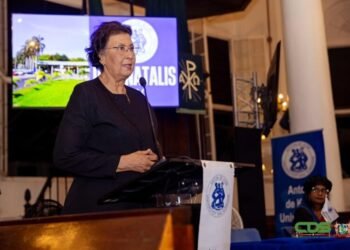
During the ceremony, Dutch Ambassador Martine Jacoba Busstra emphasized the importance of cooperation between Surinamese and Dutch partners to tell history from a Surinamese perspective.
Construction of the house should be completed by the end of January 2027. The first performance is scheduled for February 7, the day that two people were killed and many injured in 1933 when the colonial police opened fire on demonstrators demanding the release of the arrested Anton de Kom. After the premiere, performances will follow on February 9 and 11. The series at the Waterkant will conclude on February 13.