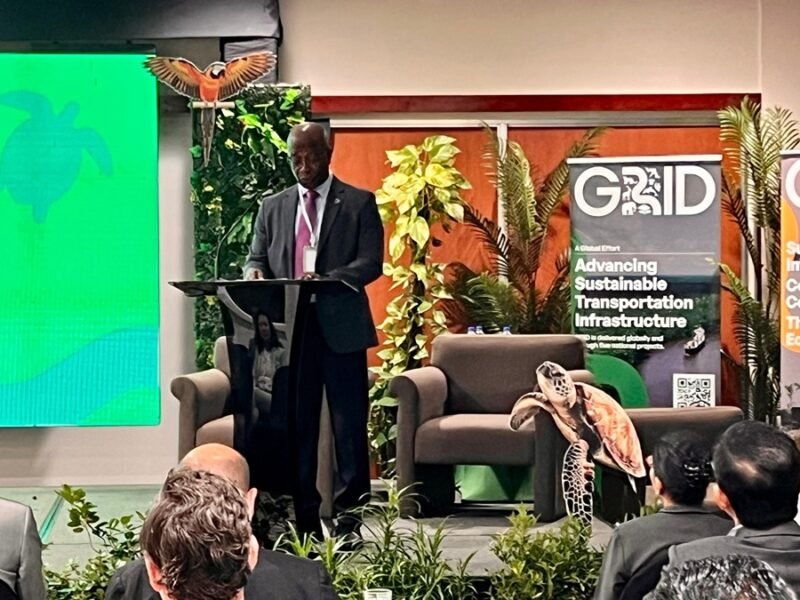
“The best way to ensure that transport infrastructure development strengthens the economy while protecting nature is to include climate and biodiversity considerations from the start.” This was said by Mohamed Bakarr of the Global Environment Facility (GEF) during the first annual Grid conference at Hotel Torarica. He calls the global need for new infrastructure so great that countries must take the consequences for nature and climate into account at the earliest planning stage. With the international Greening Transportation Infrastructure Development (Grid) program, the GEF wants to support countries in making this transition. “We must ensure and work together that nature must be part of infrastructure planning from the first phase,” he explains. the True Time.
Text and image Edwien Bodjie
Bakarr is manager of the Integration and Knowledge Division and Lead Focal Point for Grid within the GEF. He spoke on behalf of the secretariat of the organization, which has been supporting developing countries in tackling global environmental problems for more than 35 years. The GEF works with 145 countries and is increasingly trying to tailor its financing to the development goals and needs of those countries.
“In the coming years, together we can create something that really brings about change”
Bakarr predicts that the pressure to build new infrastructure will increase further in the coming years. It is estimated that approximately US$95 trillion in investments for new infrastructure will be needed worldwide by 2040. That is almost twice as much as the existing infrastructure in 2012.
Transport facilities in particular, such as roads and other connections, can have major consequences for nature reserves if the environment is not sufficiently taken into account during planning. Bakarr warns: “If this development is not thoughtfully planned and implemented, it could have far-reaching social and environmental consequences. We must take into account biodiversity loss, deforestation and greenhouse gas emissions.”
He points out that transport infrastructure is necessary for economic growth and connecting communities, but can put great pressure on ecosystems. By 2050, an estimated 25 million kilometers of new roads are expected worldwide, of which approximately 90 percent will be in developing countries.
This expansion could lead to further deforestation, habitat fragmentation and disruption of natural connections between ecosystems. Roads and other infrastructure can also be vulnerable to flooding, extreme heat and other consequences of climate change. Their construction, maintenance and use can also generate significant amounts of greenhouse gases.
Cooperation
The GEF has therefore designated Grid as one of its integrated programs. It is not just about making money available, but also about cooperation between governments, implementing organizations, scientists, social organizations and financial institutions. “When we talk about integrated programs, we expect countries to involve government agencies and society as a whole in the approach,” Bakarr explains.
This also requires a different way of thinking about infrastructure financing and procurement. Investments should, where possible, be accompanied by measures to protect and restore ecosystems. The program should help countries to include nature and climate in the first phase of infrastructure development.
This means that possible environmental damage is not only considered during construction, but that biodiversity is taken into account when choosing locations, investment decisions and design. Knowledge and information also play a major role in this.
Bakarr sees opportunities to better connect the knowledge platforms of GEF programs. This way, countries and partners can exchange experiences and solutions and prevent knowledge from remaining within separate projects.
Five countries as pioneers
Grid brings together five countries: the Philippines, Malaysia, Nepal, Ukraine and Suriname. These must demonstrate with their national projects how economic development and protection of natural resources can be better linked. Suriname is hosting the first annual conference.
Bakarr also says that countries can learn from each other through national priorities. They are not all at the same stage of their projects, but can share experiences on policy, technical solutions and how biodiversity can be incorporated into infrastructure planning.
He also says it aligns with broader international efforts, including the UN Decade for Sustainable Transport. In addition, there are similarities with other integrated GEF programs, such as initiatives for sustainable landscapes in the Amazon region, nature-friendly development and sustainable cities.
Bakarr expects that the collaboration within Grid can also be followed outside the five participating countries. The experiences from the projects can encourage other countries to take nature and climate into account when investing in transport and infrastructure.
Bringing change
This first annual Grid conference is designed as a platform for collaboration and knowledge exchange and not solely as a meeting to discuss project progress. The participating countries and partners discuss, among other things, the policy frameworks, technical instruments, financing options and partnerships that are needed to structurally incorporate biodiversity into infrastructure development.
For the coming phase, the emphasis is on converting acquired knowledge into practical implementation, technical support and policy measures. National projects and the international program must also be better aligned. “This program offers us something very special. In the coming years, together we can create something that really brings about change,” says Bakarr. He is especially looking forward to further cooperation between the countries and partners.
For Suriname, Grid comes at a time when new investments in ports, roads and other transport facilities are on the agenda. The Surinamese project focuses on port development along the Suriname River, where the protection of biodiversity must be included in the planning.
The challenge is to develop infrastructure that not only supports economic activities and connections, but also takes into account the ecosystems on which communities and future generations depend. Grid wants to offer countries not only financial support for this, but also knowledge, cooperation and practical instruments.