Belgrade/The Student List, an anti-corruption university candidacy, won an absolute majority of 52.6% of the vote in Sunday’s snap elections in Serbia, compared to 39.2% for the coalition led by Aleksandar Vucic’s conservative SNS party, which had dominated politics since 2014.
That is the result that the Electoral Commission of the Republic of Serbia offers this Monday on its website, according to the count of 96% of the polling stations. No other candidate exceeded the 3% of the votes necessary to enter Parliament.
Although the Commission does not offer what distribution of seats corresponds to that percentage of the vote, the population institute Ipsos and the NGO Cesid estimate that university students will have an absolute majority of 140 of the 250 seats, while Vucic’s SNS would remain at 103, 26 less than in 2023, when it achieved the absolute majority.
The Socialist Party, which has governed in coalition with the SNS, is left out of Parliament, where it had 18. Although they have not achieved the 3% threshold, the Hungarian minority parties (three) and the Albanian and Bosnian minority parties, two each, enter the chamber thanks to special legislation.
The Socialist Party, which has governed in coalition with the SNS, is left out of Parliament
Participation was 68.8%, about 10 percentage points more than in the 2023 parliamentary elections, and very close to the country’s historical record.
Vucic already recognized defeat on Sunday and announced that the distribution of seats would be 103 for his party and up to 140 for the Student List, made up mainly of academics, engineers, doctors, jurists, sociologists, artists and, in general, specialists in different fields without experience or political affiliation.
Among them is Dejan Bodiroga, European basketball legend and current president of the Euroleague, who said yesterday that Serbia has won freedom “thanks to this youth.”
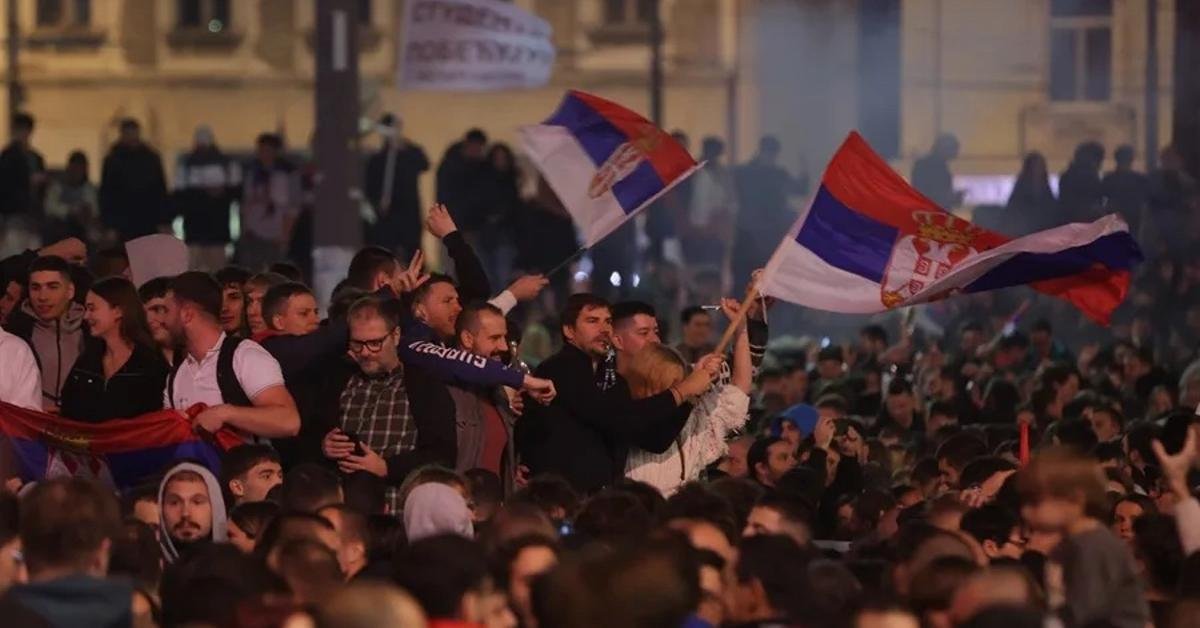
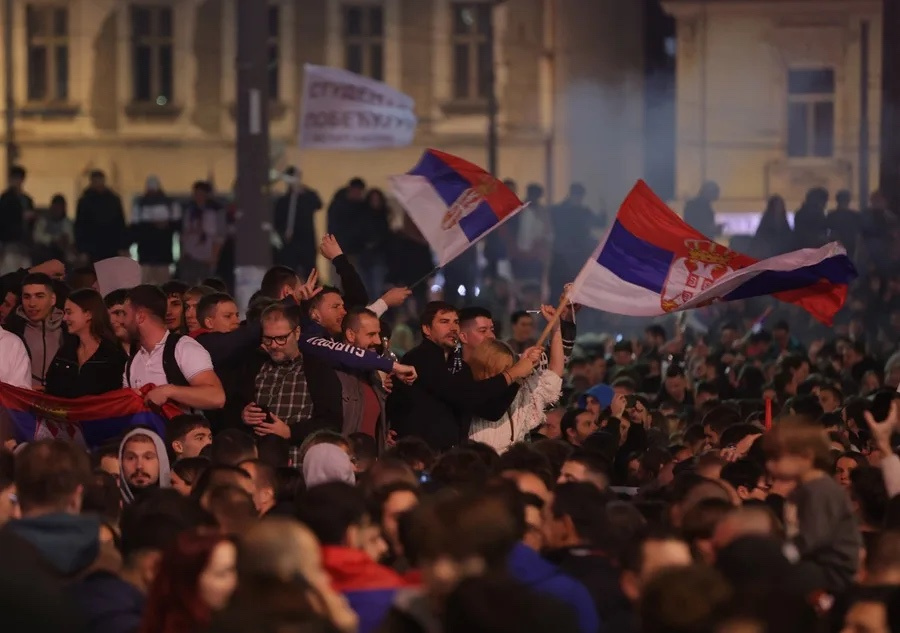
After Vucic publicly acknowledged defeat, several hundred thousand people took to the streets to celebrate with shouts of “victory.”
Several hundred thousand people took to the streets to celebrate with cries of “victory”
Vucic resigned as head of state last September to aspire to the position of prime minister, which he already held between 2014 and 2017.
His electoral advance was a response to the pressure of the massive protests, led by university students, who for two years had accused him of corruption and authoritarianism and demanded elections.
The movement began after the death of 16 people when a cantilever of a train station in Novi Sad collapsed, which had just been rehabilitated by Chinese companies under an opaque contract.
What began as a movement to ask for explanations for the awarding and execution of the work ended up becoming a demand for more rule of law.
During Vucic’s terms, as president or head of state, Serbia has seen its score on Transparency International’s corruption index worsen, and even the EU has expressed its doubts about the deterioration of the rule of law.
Serbia has seen its score worsen in Transparency International’s corruption index
After the result and the recognition of the result by the Government itself, the Kremlin, close to the Vucic Administration, expressed this Monday its confidence that the Student List understands that cooperating with Russia “is profitable” for Serbia.
“We want to express the hope that the actions taken by (Student List) will be aimed at the constructive development of relations,” presidential spokesman Dmitri Peskov said in his daily telephone press conference.
He added that Moscow trusts that “this new political force understands that cooperation with Russia responds to Serbia’s interest, since that is profitable, especially for it.”
“For our part, we will continue to contribute by all means to the development of relations with Belgrade. But, as you know, it takes two to tango,” he said.
In turn, he stressed that the Russian authorities “highly value” Aleksandar Vucic’s contribution to relations between both Slavic countries. “We hope that even in the opposition, he will still contribute to promoting bilateral relations,” he said.
This is the second setback for the Kremlin in Europe since the electoral defeat in April of its other ally, the Hungarian Viktor Orbán.