
Listen to this article
Estimated 3 minutes
The audio version of this article is generated by AI-based technology. Mispronunciations can occur. We are working with our partners to continually review and improve the results.
It was an afternoon full of celebration, punctuated by the plucking of ukulele strings.
J. Chalmers Doane, an educator who introduced the instrument into public schools across the country, is enterring the Ukulele Hall of Fame based in Hawaii.
Friends, family and fellow musicians gathered for a musical tribute to the 87-year-old Doane at The Carleton in Halifax on Sunday. He is the first Canadian and first international inductee.
For Doane, it was an exciting day.
“It’s a privilege to have people making special attention to this,” he says. “I’ve been doing this for many years.”
Doane studied a variety of instruments throughout his life, but the ukulele in particular grabbed his attention.

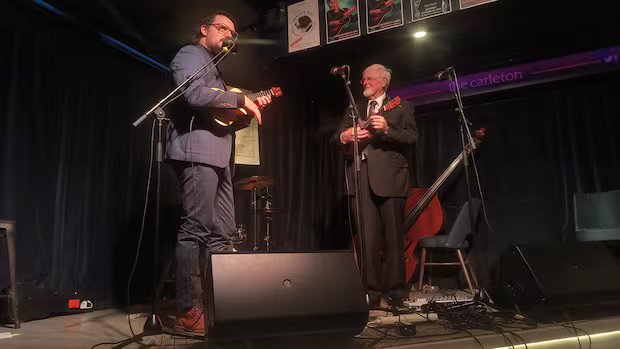
Melanie Doane, James Hill and J. Chalmers Doane perform together at The Carleton in Halifax. (Colin North/CBC)
“It has so many good things about it,” he says. “You can play melody, harmony and rhythm on it. You can accompany [it] with singing.”
As friends, family, and generations of former students gathered around him, speeches and performances honoured his decades of work.
His daughter, Melanie Doane, is an accomplished performer and educator. She says it’s a special feeling to have people gather in the city to celebrate the Halifax-to-Hawaii connection.
“It’s a really neat day. As a family member and as one of his students, I’m the beneficiary of all of his work,” she says.

J. Chalmers Doane, left, is shown with his daughter, Melanie. (Colin North/CBC)
Often called the “Pied Piper of Halifax,” Doane influenced music education by creating a ukulele program that public schools across Canada adopted.
Tom Walsh, a board member of the Ukulele Hall of Fame, says Doane’s influence is in a league of its own.
“There’s probably not another single person that has touched so many people in terms of learning the instrument,” he says.
After earning a teaching certificate from the Nova Scotia Normal College and a bachelor of music degree from Boston University, Doane started exploring the ukulele as a teaching instrument in public schools in 1967.
Educators viewed the ukulele as a more affordable and practical alternative to wind and brass instruments. Doane began fleshing out the concepts of teaching ukulele in his first book, Classroom Ukulele Method, published in 1971.

Paul Syphers of the Ukulele Hall of Fame says the instrument allows kids to play and learn music while building confidence. (Colin North/CBC)
Paul Syphers, director of the Ukulele Hall of Fame, says introducing the ukulele to children in public schools can be a positive force in their formative years.
“If [a child] learns to read music and play music through this very simple instrument, the child gets a real feeling of confidence,” says Syphers. “Learning how to play this instrument is really building a character in the young kids.”
Among the performers who took the stage on Sunday was renowned ukulele player James Hill. Originally from Langley, B.C., he learned the instrument in school when it adopted Doane’s program.
For Hill, it was a vindicating moment for those who pursued the ukulele when it was less popular.
“This whole [event] comes from a place of believing that music is for everyone,” he says. “That philosophy is in everything that Chalmers did.”
Toward the end of the ceremony, elementary school children joined past generations of ukulele players on stage to play together. Melanie leaned over to her father.
“We’re so proud of you, Dad.”
MORE TOP STORIES