Sunday, October 25, 2026
    The GeoStrategic Consensus
    No Result
    View All Result
    • Login
    • HOME
    • AMERICAS
      • Argentina
      • Brazil
      • Canada
      • Chile
      • Colombia
      • Costa Rica
      • Cuba
      • Dominican Republic
      • Ecuador
      • El Salvador
      • Greenland
      • Guatemala
      • Honduras
      • Mexico
      • Nicaragua
      • Panama
      • Paraguay
      • Peru
      • United States
      • Uruguay
      • Venezuela
    • ASIA-PACIFIC
      • Australia
      • Brunei Darussalam
      • Cambodia
      • China
      • Federated States of Micronesia
      • Fiji
      • Indonesia
      • Japan
      • Kiribati
      • Laos
      • Malaysia
      • Marshall Islands
      • Mongolia
      • Myanmar
      • Nauru
      • New Zealand
      • North Korea
      • Palau
      • Papua New Guinea
      • Philippines
      • Samoa
      • Singapore
      • Solomon Islands
      • South Korea
      • Taiwan
      • Thailand
      • Timor-Leste
      • Tonga
      • Tuvalu
      • Vanuatu
      • Vietnam
    • CARICOM
      • CARICOM – Non-English
        • Haiti
        • Suriname
      • CARICOM Associates
        • Anguilla
        • Bermuda
        • British-Virgin-Islands
        • Cayman-Islands
        • Curacao
        • Turks-and-Caicos
      • CARICOM English
        • Antigua and Barbuda
        • Barbados
        • Belize
        • Dominica
        • Grenada
        • Guyana
        • Jamaica
        • Montserrat
        • Saint Kitts and Nevis
        • Saint Lucia
        • Saint Vincent and the Grenadines
        • The Bahamas
        • Trinidad and Tobago
    • EURASIA
      • Armenia
      • Azerbaijan
      • Balarus
      • Georgia
      • Kazakhstan
      • Kyrgyzstan
      • Moldova
      • Russia
      • Tajikistan
      • Turkmenistan
      • Ukraine
      • Uzbekistan
    • EUROPE
      • Albania
      • Andorra
      • Austria
      • Bosnia and Herzegovina
      • Bulgaria
      • Croatia
      • Cyprus
      • Czech Republic
      • Denmark
      • Estonia
      • Finland
      • France
      • Germany
      • Greece
      • Holy See
      • Hungary
      • Iceland
      • Ireland
      • Italy
      • Kosovo
      • Latvia
      • Liechtenstein
      • Lithuania
      • Luxembourg
      • Malta
      • Monaco
      • Montenegro
      • Netherlands
      • North Macedonia
      • Norway
      • Poland
      • Portugal
      • Romania
      • San Marino
      • Serbia
      • Slovakia
      • Slovenia
      • Spain
      • Sweden
      • Switzerland
      • United Kingdom
    • MIDDLE EAST AND NORTH AFRICA
      • Algeria
      • Bahrain
      • Egypt
      • Iran
      • Iraq
      • Israel
      • Jordan
      • Kuwait
      • Lebanon
      • Lybia
      • Morocco
      • Oman
      • Palestinian Territories
      • Qatar
      • Saudi Arabia
      • Syria
      • Tunisia
      • Turkey
      • United Arab Emirates
      • Western Sahara
      • Yemen
    • SOUTH ASIA
      • Afghanistan
      • Bangladesh
      • Bhutan
      • India
      • Maldives
      • Nepal
      • Pakistan
      • Sri Lanka
    • SUB-SAHARAN AFRICA
      • Angola
      • Benin
      • Botswana
      • Burkina Faso
      • Burundi
      • Cabo Verde
      • Cameroon
      • Central African Republic
      • Chad
      • Comoros
      • Cote d’Ivoire
      • Democratic Republic of the Congo
      • Djibouti
      • Equatorial Guinea
      • Eritrea
      • Eswatini
      • Ethiopia
      • Gabon
      • Gambia
      • Ghana
      • Guinea
      • Guinea Bissau
      • Kenya
      • Lesotho
      • Liberia
      • Madagascar
      • Malawi
      • Mali
      • Mauritania
      • Mauritius
      • Mozambique
      • Namibia
      • Niger
      • Nigeria
      • Republic of the Congo
      • Rwanda
      • Sao Tome and Principe
      • Senegal
      • Seychelles
      • Sierra Leone
      • Somalia
      • South Africa
      • South Sudan
      • Sudan
      • Tanzania
      • Togo
      • Uganda
      • Zambia
      • Zimbabwe
    No Result
    View All Result
    Agentially
    No Result
    View All Result
    Home SOUTH ASIA India

    Durga Puja in Bengali cinema: How Satyajit Ray and Rituparno Ghosh portray the goddess

    The Analyst by The Analyst
    October 25, 2026
    in India
    Durga Puja in Bengali cinema: How Satyajit Ray and Rituparno Ghosh portray the goddess


    In Bengali cinema, the goddess can be more than a marker of the festive season. What matters is what her presence does to those around her. Does Durga become a witness to transgression, a counterpoint to human cruelty, an ideal that a woman is asked to embody, or a mirror reflecting a household’s contradictions? In films such as Satyajit Ray’s Devi, Aparna Sen’s Parama and Rituparno Ghosh’s Utsab and Antarmahal, the goddess’s image becomes part of the drama. Through framing, light, sound and the camera’s gaze, she shapes the characters’ lives without ever speaking.

    Sharmila Tagore in Satyajit Ray’s Devi ( 1960)

    Sharmila Tagore in Satyajit Ray’s Devi ( 1960)
    | Photo Credit:
    Special Arrangement

    To look closely at Durga in Bengali cinema is to look beyond the spectacle of Puja and ask how an unmoving image alters the meaning of everything unfolding before it.

    A goddess and the women who resemble her

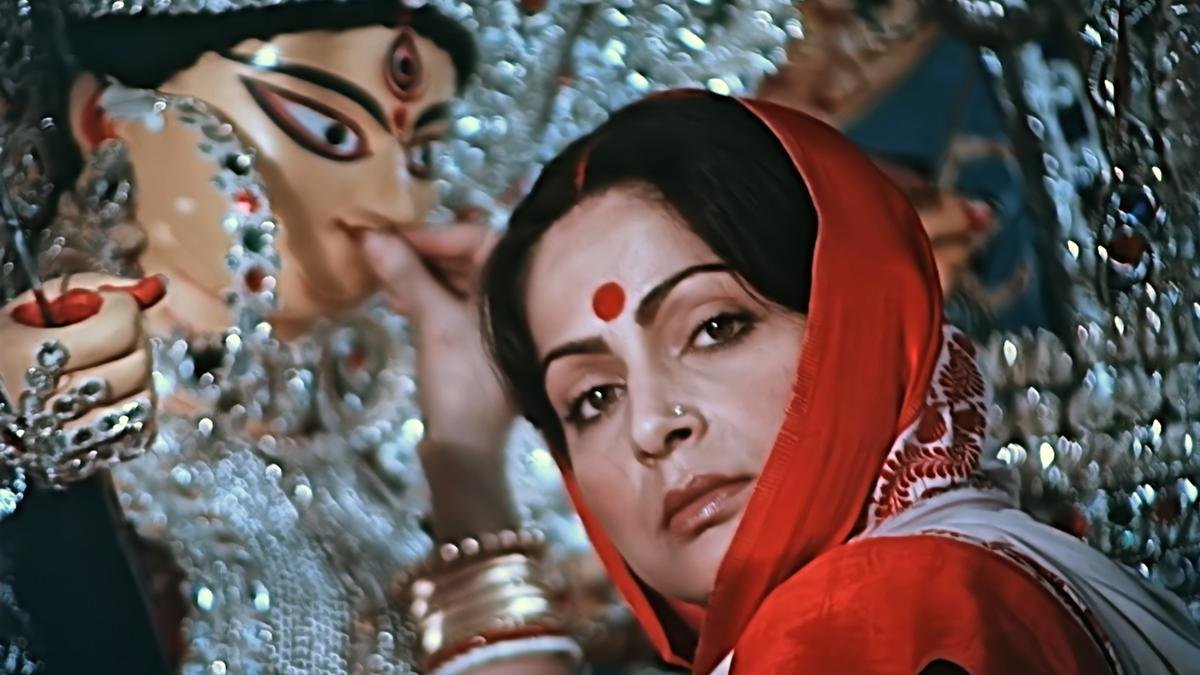
    In Aparna Sen’s Parama (1985), the goddess appears before the story has properly begun. Cinematographer Ashok Mehta’s camera approaches Durga’s face through a viewfinder, then slowly pulls back to reveal the idol. Soon after, we encounter Rakhee Gulzar as Parama, a middle aged woman whose domestic life is unsettled by an affair.

    The visual association is suggestive. The goddess’s face is composed and confident; Parama’s, framed by a red-bordered sari and vermilion bindi, carries a similar presence. As cinematographer Supratim Bhol observes in the Bengal Film Archive’s essay Idol Watch, the opening establishes a visual relationship between the goddess and a woman who will insist on her right to desire, independence and a life beyond domestic expectation. Though the Puja recedes, its imagery lingers as a way of looking at Parama.

    A poster of Aparna Sen’s Parama Parama ( 1985)

    A poster of Aparna Sen’s Parama Parama ( 1985)
    | Photo Credit:
    Special Arrangement

    The comparison is not that Parama is divine, but that the film places the two faces in conversation. The goddess, conventionally invoked as a figure of feminine power, becomes a counterpoint to the restrictions imposed on an ordinary woman. Does her image liberate Parama from judgement, or sharpen the contradiction between the power celebrated in the goddess and the freedom denied to women? The film leaves the tension unresolved.

    The idol at the centre of a divided family

    In Rituparno Ghosh’s Utsab (2000), Durga becomes the still centre around which a family’s fractures emerge. An extended family gathers for its ancestral Puja, but beneath the celebration lie resentments, strained marriages, financial anxieties and the prospect of selling the ancestral home.

    Rituparna Sengupta in Ritiparno Ghosh’s Utsab (2000)

    Rituparna Sengupta in Ritiparno Ghosh’s Utsab (2000)
    | Photo Credit:
    Special Arrangement

    Bhol points to the contrast in cinematographer Avik Mukhopadhyay’s visual language: wide-angle compositions establish the completeness of the idol, while tighter shots of family members make them appear like separate islands within the same home. The goddess embodies togetherness; the people gathered around her struggle to sustain it.

    Ghosh also complicates the way cinema looks at the festival. Joy, a young family member, records the celebrations on a camcorder. His footage becomes a film within the film, drawing attention to the familiar visual vocabulary of Durga Puja — red and white saris, rituals and carefully composed images of Bengali identity. The camera watches the watchers. What appears harmonious in an image may conceal a different emotional reality.

    Prof. Sanjoy Mukhopadhyay, former dean of the Department of Film Studies at Jadavpur University, places this relationship between the goddess and the social world within the wider history of Bengali cinema. “For filmmakers such as Satyajit Ray and Ritwik Ghatak, Puja was not merely a religious occasion but a cultural space where different classes and communities could mingle.In Satyajit Ray’s Pather Panchali (1955), the village’s social world is shaped by such encounters, with rich and poor coming together before the goddess’s image. In Ghatak’s cinema, the goddess assumes a more mythic and political resonance. Prof. Sanjoy points to the climactic tribal dance in Jukti Takko Aar Gappo, whose imagery evokes collective consciousness amid political upheaval, connecting individual lives with agrarian revolution, social struggle and belonging,” say Sanjoy.

    A still from Satyajit Ray’s Pather Panchali (1955)

    A still from Satyajit Ray’s Pather Panchali (1955)
    | Photo Credit:
    Special Arrangement

    The goddess also offers women a figure through whom to imagine power. In Mrinal Sen’s Akaler Sandhane, Prof Sanjoy recalls, Sreela Majumdar’s character stands before a Durga mandap and identifies with the all-powerful Mother. Women may resonate with the goddess’s strength, he suggests, while privileged men remain preoccupied with the social pleasures surrounding the festival.

    This contradiction runs through Ray’s Devi, Ghatak’s Meghe Dhaka Tara and Ghosh’s Utsab. In Devi, a young woman is forced to believe she is an incarnation of the goddess. In Meghe Dhaka Tara, Nita sustains her family at the cost of her own aspirations.

    “Both women are made to perform the role of the great mother. One has to look after the entire family; the other is made to believe she is the goddess. In Devi, the young woman attempts to escape into the mustard fields. In Meghe Dhaka Tara, Nita cries, ‘Dada, ami banchte chai’ (‘Brother, I want to live’), as the camera closes in on her. It is then that the viewer realises she has died, revealing the human cost of the sacrifice demanded of her. Hindu patriarchy always places women either as a goddess or as a victim,” says Prof. Sanjoy. “For a woman, facing both is very difficult,” notes the professor.

    A still from Ritwik Ghatak’s Meghe Dhaka Tara (1960)

    A still from Ritwik Ghatak’s Meghe Dhaka Tara (1960)
    | Photo Credit:
    Special Arrangement

    When devotion becomes a prison

    In Ray’s Devi (1960), the relationship between the human and the divine becomes disturbing. The film opens with the face of a clay goddess taking shape through the act of idol-making. Bells, fireworks and the sounds of Puja animate the world around it.

    Doyamoyee, played by Sharmila Tagore, is declared an incarnation of the Mother Goddess by her father-in-law. The household begins to worship her, trapping the young woman inside an identity imposed by other people’s faith.

    Soumitra Chatterjee and Sharmila Tagore in Satyajit Ray’s Devi ( 1960)

    Soumitra Chatterjee and Sharmila Tagore in Satyajit Ray’s Devi ( 1960)
    | Photo Credit:
    Special Arrangement

    Ray’s camera and Subrata Mitra’s cinematography make this transformation unsettling. Lamplight falls across faces as shadows gather in the corners of rooms. Doyamoyee is repeatedly framed within the architecture of worship, her living body visually associated with the sacred image. Her confinement becomes visible before she can articulate it.

    The goddess’s image becomes a means through which patriarchal authority is exercised. The tragedy lies in the gap between the power attributed to the divine feminine and the helplessness of the woman made to embody it. Where Parama allows the goddess’s image to suggest a woman’s right to self-determination, Devi shows how the demand that a woman become divine can erase her humanity.

    The violence behind the beautiful image

    Rituparno Ghosh’s Antarmahal (2005) turns the scrutiny towards the household that commissions the goddess. Set in colonial Bengal, the film follows a zamindar obsessed with producing an extravagant Durga idol and securing a male heir. His desire to replace the goddess’s face with that of Queen Victoria transforms the image into an instrument of status and colonial aspiration.

    In a striking visual gesture, the face of Jashomati, played by Soha Ali Khan, is composed to resemble the idol. As Bhol notes, the close-up makes a human face echo a sacred one. But this is no uncomplicated elevation of womanhood. The zamindar’s obsession with the goddess’s appearance coexists with his attempts to control the women in his household. The idol becomes an extension of his vanity, while the women bear the cost of his ambitions. The image that signifies feminine power is appropriated by a system that denies women agency.

    What remains outside the frame

    The goddess need not dominate a film’s composition to shape its emotional world. In Ray’s Joy Baba Felunath (1979), the approach of Puja is established through idol-making, but the camera initially directs attention to Mahishasura, then the attacking lion and the face of the child Ruku. The festival gathers dramatic force through these surrounding details before the central mystery unfolds.

    Sound can establish a similar presence. In Devi, bells, chants and ritual noises do more than create religious atmosphere: they become part of the machinery through which Doyamoyee’s deification gathers force. The world around her grows louder even as her ability to speak for herself diminishes.

    A still from Satyajit Ray’s Pather Panchali (1955)

    A still from Satyajit Ray’s Pather Panchali (1955)
    | Photo Credit:
    Special Arrangement

    Durga’s presence can inhabit the space between a ritual and a quarrel, public celebration and private sorrow. She may be worshipped as the destroyer of evil, the daughter returning home, or the embodiment of feminine power. Cinema complicates these meanings: sometimes her image offers a language for resistance; sometimes it exposes the violence concealed beneath devotion.

    The goddess does not have to intervene in the story. Her stillness allows us to see the people around her differently. In the space between her unblinking gaze and their restless lives, Bengali cinema turns the camera towards us, and the audience takes a leap inwards.


    READ ALSO

    Max Richter in India: On the melancholia of ‘On the Nature of Daylight’ and the art of making audiences weep

    ‘Jailer 2’: Why Moorthy Anna is our spirit animal


    Source link

    Related Posts

    Max Richter in India: On the melancholia of ‘On the Nature of Daylight’ and the art of making audiences weep
    India

    Max Richter in India: On the melancholia of ‘On the Nature of Daylight’ and the art of making audiences weep

    October 25, 2026
    ‘Jailer 2’: Why Moorthy Anna is our spirit animal
    India

    ‘Jailer 2’: Why Moorthy Anna is our spirit animal

    October 25, 2026
    Mysuru Dasara: When tradition meets novelty
    India

    Mysuru Dasara: When tradition meets novelty

    October 24, 2026
    In Delhi’s Titarpur, Ravana mirrors the politics of the day
    India

    In Delhi’s Titarpur, Ravana mirrors the politics of the day

    October 24, 2026
    Over 2,000 attend TAUK’s handloom-themed Bathukamma, Dasara celebrations in London
    India

    Over 2,000 attend TAUK’s handloom-themed Bathukamma, Dasara celebrations in London

    October 24, 2026
    Mysore Dasara 2026: The story behind the howdah bearers
    India

    Mysore Dasara 2026: The story behind the howdah bearers

    October 24, 2026
    Next Post
    Maulvi Qudratullah Jamal: The ongoing affairs of the country should be well reflected and shared with the countrymen on time.

    Maulvi Qudratullah Jamal: The ongoing affairs of the country should be well reflected and shared with the countrymen on time.

    POPULAR NEWS

    2026 Regional and International Conventions of Jehovah’s Witnesses

    2026 Regional and International Conventions of Jehovah’s Witnesses

    July 7, 2026

    All posts

    July 23, 2026
    Thaksin, Yingluck and Paetongtarn meet Indonesian President Prabowo for investment talks

    Thaksin, Yingluck and Paetongtarn meet Indonesian President Prabowo for investment talks

    July 13, 2026
    This is how Nicolás Maduro and Cilia Flores reappeared in their hearing

    This is how Nicolás Maduro and Cilia Flores reappeared in their hearing

    July 24, 2026
    No deliverance: when gig workers fall prey to road accidents

    No deliverance: when gig workers fall prey to road accidents

    July 25, 2026

    EDITOR'S PICK

    Wives swap kidneys to save their husbands’ lives

    October 23, 2026
    Live: Luxon arrives in Wellington ahead of ‘urgent’ caucus meeting, dodges questions from media

    Live: Luxon arrives in Wellington ahead of ‘urgent’ caucus meeting, dodges questions from media

    August 11, 2026

    404 Page Not Found | The Star

    July 16, 2026
    Cavalier guard against slide | Sports

    Cavalier guard against slide | Sports

    October 25, 2026

    Recent Posts

    • Other Sports: Rallying-Dakar Rally 2027 will not be held in Saudi Arabia, organisers say
    • Azerbaijan approves net-zero emissions strategy by 2060
    • Within two years, mini-football grounds are planned to be built in all villages of Kyrgyzstan
    • Thank you for breaking up with me. Why did I think for so long that this was true love? It wasn’t. The best thing I experienced was when the relationship ended. By Katja Lewina

      © 2026 Agentially - Navigating shifting sovereignties and global risk .

      Welcome Back!

      Login to your account below

      Forgotten Password?

      Retrieve your password

      Please enter your username or email address to reset your password.

      Log In
      No Result
      View All Result
      • HOME
      • AMERICAS
        • Argentina
        • Brazil
        • Canada
        • Chile
        • Colombia
        • Costa Rica
        • Cuba
        • Dominican Republic
        • Ecuador
        • El Salvador
        • Greenland
        • Guatemala
        • Honduras
        • Mexico
        • Nicaragua
        • Panama
        • Paraguay
        • Peru
        • United States
        • Uruguay
        • Venezuela
      • ASIA-PACIFIC
        • Australia
        • Brunei Darussalam
        • Cambodia
        • China
        • Federated States of Micronesia
        • Fiji
        • Indonesia
        • Japan
        • Kiribati
        • Laos
        • Malaysia
        • Marshall Islands
        • Mongolia
        • Myanmar
        • Nauru
        • New Zealand
        • North Korea
        • Palau
        • Papua New Guinea
        • Philippines
        • Samoa
        • Singapore
        • Solomon Islands
        • South Korea
        • Taiwan
        • Thailand
        • Timor-Leste
        • Tonga
        • Tuvalu
        • Vanuatu
        • Vietnam
      • CARICOM
        • CARICOM – Non-English
          • Haiti
          • Suriname
        • CARICOM Associates
          • Anguilla
          • Bermuda
          • British-Virgin-Islands
          • Cayman-Islands
          • Curacao
          • Turks-and-Caicos
        • CARICOM English
          • Antigua and Barbuda
          • Barbados
          • Belize
          • Dominica
          • Grenada
          • Guyana
          • Jamaica
          • Montserrat
          • Saint Kitts and Nevis
          • Saint Lucia
          • Saint Vincent and the Grenadines
          • The Bahamas
          • Trinidad and Tobago
      • EURASIA
        • Armenia
        • Azerbaijan
        • Balarus
        • Georgia
        • Kazakhstan
        • Kyrgyzstan
        • Moldova
        • Russia
        • Tajikistan
        • Turkmenistan
        • Ukraine
        • Uzbekistan
      • EUROPE
        • Albania
        • Andorra
        • Austria
        • Bosnia and Herzegovina
        • Bulgaria
        • Croatia
        • Cyprus
        • Czech Republic
        • Denmark
        • Estonia
        • Finland
        • France
        • Germany
        • Greece
        • Holy See
        • Hungary
        • Iceland
        • Ireland
        • Italy
        • Kosovo
        • Latvia
        • Liechtenstein
        • Lithuania
        • Luxembourg
        • Malta
        • Monaco
        • Montenegro
        • Netherlands
        • North Macedonia
        • Norway
        • Poland
        • Portugal
        • Romania
        • San Marino
        • Serbia
        • Slovakia
        • Slovenia
        • Spain
        • Sweden
        • Switzerland
        • United Kingdom
      • MIDDLE EAST AND NORTH AFRICA
        • Algeria
        • Bahrain
        • Egypt
        • Iran
        • Iraq
        • Israel
        • Jordan
        • Kuwait
        • Lebanon
        • Lybia
        • Morocco
        • Oman
        • Palestinian Territories
        • Qatar
        • Saudi Arabia
        • Syria
        • Tunisia
        • Turkey
        • United Arab Emirates
        • Western Sahara
        • Yemen
      • SOUTH ASIA
        • Afghanistan
        • Bangladesh
        • Bhutan
        • India
        • Maldives
        • Nepal
        • Pakistan
        • Sri Lanka
      • SUB-SAHARAN AFRICA
        • Angola
        • Benin
        • Botswana
        • Burkina Faso
        • Burundi
        • Cabo Verde
        • Cameroon
        • Central African Republic
        • Chad
        • Comoros
        • Cote d’Ivoire
        • Democratic Republic of the Congo
        • Djibouti
        • Equatorial Guinea
        • Eritrea
        • Eswatini
        • Ethiopia
        • Gabon
        • Gambia
        • Ghana
        • Guinea
        • Guinea Bissau
        • Kenya
        • Lesotho
        • Liberia
        • Madagascar
        • Malawi
        • Mali
        • Mauritania
        • Mauritius
        • Mozambique
        • Namibia
        • Niger
        • Nigeria
        • Republic of the Congo
        • Rwanda
        • Sao Tome and Principe
        • Senegal
        • Seychelles
        • Sierra Leone
        • Somalia
        • South Africa
        • South Sudan
        • Sudan
        • Tanzania
        • Togo
        • Uganda
        • Zambia
        • Zimbabwe

      © 2026 Agentially - Navigating shifting sovereignties and global risk .

      This website uses cookies. By continuing to use this website you are giving consent to cookies being used. Visit our Privacy and Cookie Policy.