BANGKOK — The global economy has weathered successive international crises better than expected, but the economic resilience of many countries is under increasing pressure. Wars, trade conflicts, high government debts and disruptions to international supply routes threaten economic stability. Developing countries and vulnerable economies in particular are at risk of falling further behind. The International Monetary and Financial Committee (IMFC), the main policy advisory body of the International Monetary Fund (IMF), warns about this.
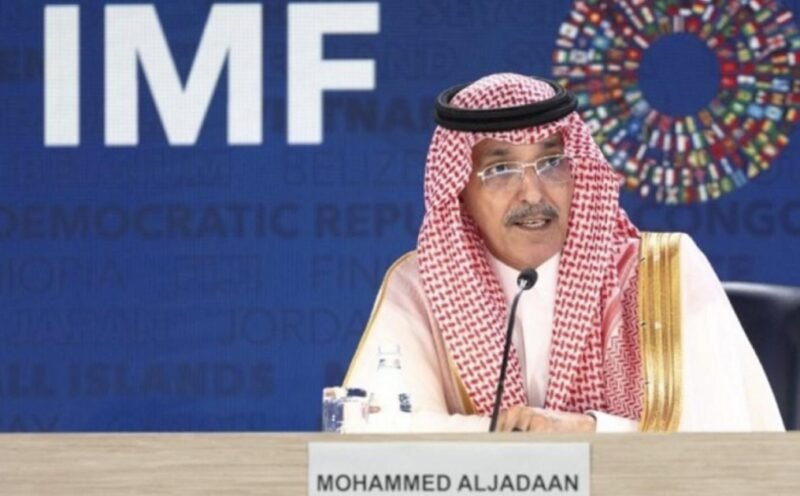
In a statement Saturday in Bangkok, Thailand, during the 54th meeting of the IMFC, IMFC chairman and Saudi Arabia’s Finance Minister Mohammed al-Jadaan called on governments to put their public finances in order, keep debts manageable and strengthen international cooperation.
According to the committee, global economic growth has remained relatively stable so far, despite the successive shocks that countries have faced. However, this stability masks significant differences between economies. While some countries benefit from technological developments and increasing investments, others struggle with high debts, limited financial reserves and rising energy and food costs.
Wars and trade tensions
The IMFC is particularly concerned about the economic consequences of ongoing wars and geopolitical tensions. In addition to the great human suffering, conflicts cause disruptions in international trade flows and production chains. This could cause prices to rise further and make it more difficult for countries to access essential goods.
According to the committee, a further escalation of conflicts and trade disputes could disrupt important trade routes. This could put pressure on the prices of raw materials and refined energy products in particular. For countries that are highly dependent on imports, this can lead to higher costs of living and increasing food and energy insecurity.
In addition, high government debt worldwide poses a growing risk. In several major economies, government bond yields are rising, forcing governments to pay more to borrow money. This development could also have consequences for other countries, especially if they need to refinance existing debts.
The committee points out that the financial reserves and other buffers that countries built up during previous crises have now shrunk. This makes it more difficult to absorb new economic shocks.
Getting government finances in order
Against this background, the IMFC calls for credible fiscal policies and measures to make public debt sustainable in the longer term. According to the committee, countries must reduce their budget deficits and rebuild financial buffers.
The committee emphasizes that cuts should not come at the expense of the most vulnerable population groups. Investments that promote productivity and economic growth must also be protected as much as possible.
Central banks are called on to maintain price stability. Their policies must be aligned with current economic data and clearly communicated. The committee also underlines the importance of independent central banks, because political interference can undermine confidence in monetary policy.
Reforms that stimulate private investment and entrepreneurship also remain necessary, according to the IMFC. Economic growth should not depend exclusively on government expenditure, but should be supported primarily by a strong private sector.
Extra attention for debtor countries
An important part of the declaration concerns the debt problems of developing countries. The IMFC wants countries with serious debt problems to receive help more quickly and in a better coordinated manner.
The committee advocates further improvement of international debt restructuring procedures. Creditors and countries with payment problems must be able to reach agreements more quickly on, for example, extending repayment terms, adjusting interest obligations or other debt measures.
According to the committee, private creditors should also be more open about outstanding debts and financial obligations. According to the IMFC, a lack of transparency makes it difficult to find sustainable solutions.
Special attention is requested for low-income countries, vulnerable middle-income countries and small developing states. These countries generally have less financial capacity to absorb international shocks.
The committee also wants countries with a sustainable debt burden, but temporary financing problems, to receive support more quickly. This requires the joint approach of the IMF and the World Bank, known as the 3-Pillar Approachbe implemented more expeditiously.
It also calls for sufficient resources for the Poverty Reduction and Growth Trust, the IMF financing mechanism that allows poor countries to borrow on favorable terms.
Artificial intelligence offers opportunities
In addition to the risks, the IMFC also sees economic opportunities. In particular, the rapid development of advanced intelligence technologies, including artificial intelligence, can increase productivity and stimulate new investments.
According to the committee, these technologies are already having a positive impact on investments and international trade. At the same time, there is uncertainty about the consequences for economies and financial markets.
Countries must therefore develop policies that allow them to reap the benefits of digitalization, without losing sight of the associated risks. The IMFC emphasizes that the economic benefits of technological progress must be widely shared in society.
The so-called Bangkok Blueprint was also welcomed during the meeting. This initiative should contribute to better security of digital financial services, greater resilience against cyber attacks and international cooperation in the fight against digital fraud.
Reform of the IMF
The Committee further reaffirms its support for reforms within the IMF. The organization must be better equipped to identify economic risks at an early stage and support member states in case of financial problems.
It calls for the early completion of national approval procedures for the increase in IMF quotas agreed during the Sixteenth General Quota Review. These quotas determine, among other things, how many financial resources member states contribute to the fund.
The IMFC also wants the discussion on the future distribution of quotas and control within the IMF to continue.
Furthermore, the organization must improve its monitoring of national economies, debt analysis, lending and technical support. According to the committee, the reforms must be implemented in a fair and consistent manner for all Member States.
International cooperation necessary
The IMFC emphasizes that individual countries cannot independently solve current economic challenges. International cooperation remains necessary to reduce trade conflicts, protect financial stability and address global economic imbalances.
The committee calls on countries to avoid trade-distorting measures and make international supply chains more resilient. Safe energy transports and free shipping are also considered essential for the global economy.
According to the committee, the end of wars and conflicts remains an important condition for sustainable economic growth and long-term stability.