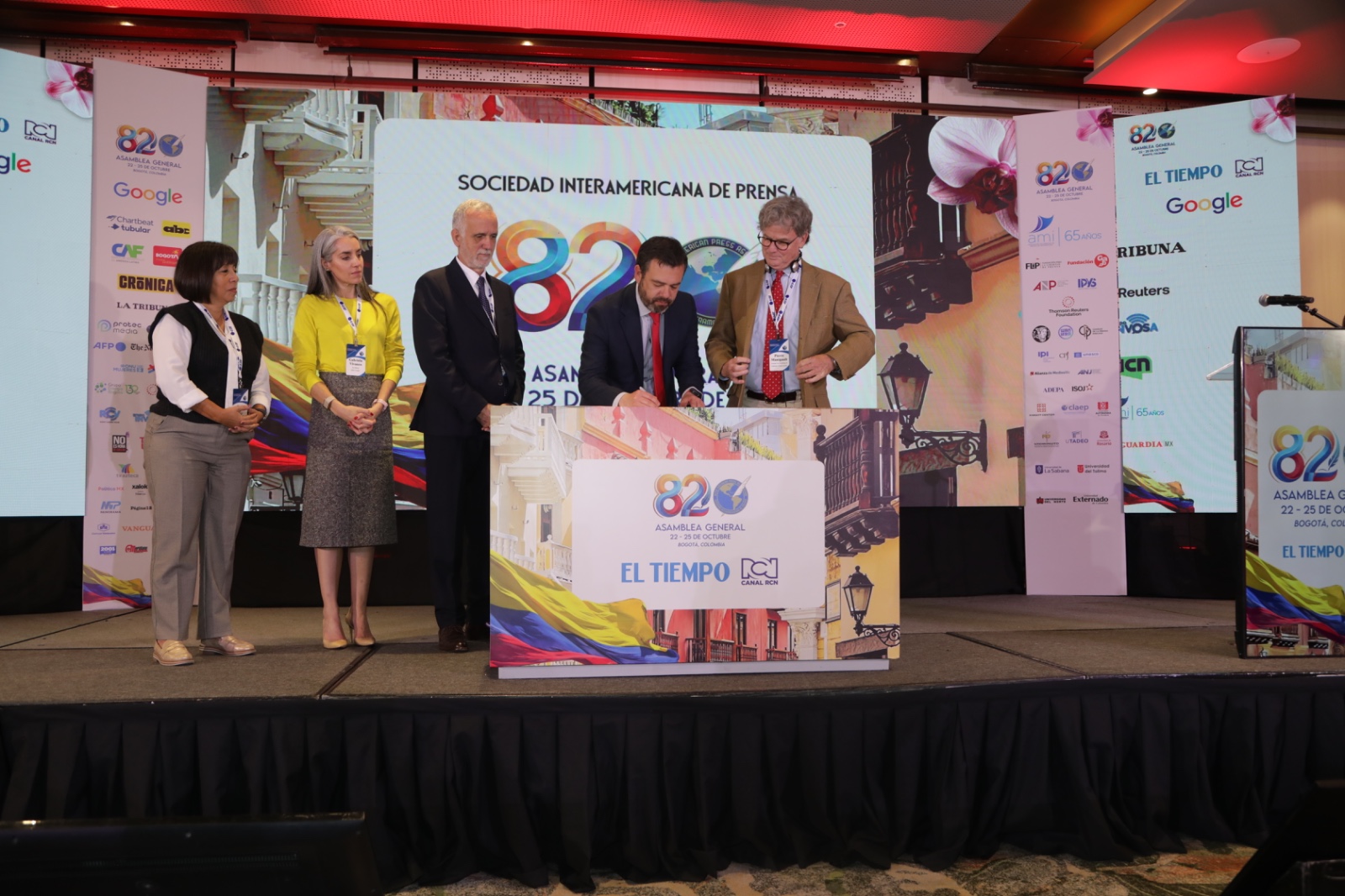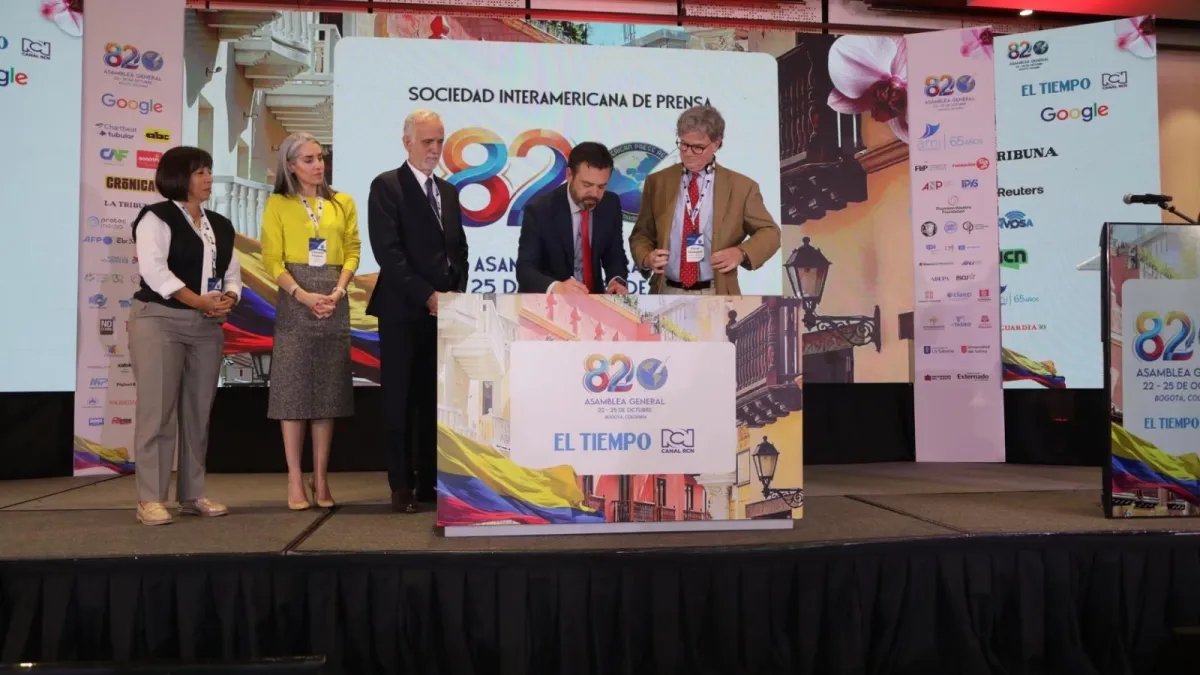
On the afternoon of this Thursday, October 22, the inauguration of the 82nd edition of the General Assembly of the IAPA (Inter-American Press Association) took place. which until next Sunday, October 25, will bring together the directors of the main newspapers and media in America at the Hilton Bogotá Hotel.
READ ALSO
Throughout a packed agenda, attendees will witness top-level talks and discussions that will combine the analysis of the situation of press freedom with discussions on the use of artificial intelligence, digital transformation, the challenges of new business models, intellectual property, the safety of journalists and the evolution of audiences.
The inauguration of the assembly included the presence and interventions of mayor of Bogotá, Carlos Fernando Galán, the general director of El Tiempo, Andrés Mompotes, the president of RCN, José Antonio de Brigard, and the president of the IAPA, Pierre Manigault.
It is expected that in the coming days important figures from the region’s journalism will also participate, such as Marc Lacey, editorial director of ‘The New York Times’; Luis Fernández, executive president of NBCUniversal Telemundo Enterprises; Ron Suskind, winner of the Pulitzer Prize and founder of Sourcebase.ai, and Emilio García-Ruiz, editor in chief of the ‘San Francisco Chronicle’, among other important names in the continent’s press.
During the inauguration, one of the most anticipated moments was the intervention of Pierre Manigault, president of the IAPA. During his words, with which he opened the assembly, He reflected on the role of journalism in the defense of democracy and the right of citizens to be truthfully informed, which is considered at risk in a large part of the countries of the continent.
“Across the Americas, press reporting is under pressure. The erosion of press freedom is not limited to countries with fragile institutions. Even consolidated democracies show worrying signs of regression. The United States deserves particular attention. For generations, the First Amendment has been a powerful expression of the principle that the government shall not interfere with a free press. However, “Public attacks on journalists, legal pressure against news organizations and restrictions on access to official information remind us that this principle should not be taken for granted.”Manigault noted.
READ ALSO
For the president of the IAPA, these pressures translate into a threat to democracy that, furthermore, is exercised by the bodies of power that the media are called upon to monitor: “These are not abstract concerns. When journalists must go to court simply to defend their ability to seek information from public institutions, when access is conditioned or restricted, and when the enormous power of the government is used to hinder independent scrutiny, we should all pay attention.”
According to Manigault, today press freedom is at risk, and part of this is due to the violence of which journalists in the region are victims: “In Latin America, the situation is particularly alarming. Violence against journalists remains one of the greatest threats to press freedom. In countries such as Mexico, Ecuador, Peru, Colombia and Guatemala, reporters continue to face threats, intimidation and deadly attacks, often for investigating corruption, organized crime or abuses of power. Behind every martyred journalist is a devastated family, a community deprived of essential information and a warning to others who dare to investigate.”
“An attack on the freedom of one threatens the freedom of all,” he stated.
Given this, the businessman also called on all media outlets to work together to overcome all these challenges: “Cooperation gives us the scope to act. It allows us to exchange practical solutions, build alliances and speak with greater authority when the future of independent journalism is at stake. That is one of the IAPA’s most enduring strengths, and one that we must continue to develop. However, no technology, regulation or business model can replace the quality of journalism itself.”
Artificial intelligence and financing
During the inauguration, Andrés Mompotes, director of EL TIEMPOalso referred to the different threats that journalism faces: “Good journalism knows how to listen. It is capable of hearing the crushing winds of history, the clamor of the victims of the abuses of power and the whisper of the people who demand the truth. That wonderful virtue of the reporter is what we are invited to put into practice today.”
The director of this newspaper took advantage of his intervention to warn about the great challenges facing the profession in these times, especially misinformation and the emergence of new technologies: “Today, the algorithmic force of disinformation is added to the old threats against press freedom. The economic deterioration of the media and the artificial intelligence revolution, which will be a source of incredible achievements for humanity, but which also advances with a speed that many of our institutions still cannot understand.”
READ ALSO

And he added: “Artificial intelligence models greedily and shamelessly feed on the content that the media has produced for years with teams of journalists trained in the human interaction that makes the best reporting possible.(…). The media of the Americas have to seek common strategies, learn from the experiences that are emerging in different countries and jointly defend the intellectual property and economic value of professional journalism.”
Likewise, he called to end violence against journalists: “In our region, freedom of the press needs to be a total and definitive conquest. The murders, threats, exiles and increasing cases of judicial harassment against journalists are a wound that remains open. In Colombia, criminal bullets continue to be the most serious problem for the exercise of the profession that García Márquez defended. Since 2022, an annual average of two Colombian journalists have been murdered. “A single journalist who falls for doing his duty should shake any democracy.”
In addition, José Antonio de Brigard, president of RCN, took the opportunity to reflect on the delicate financial situation that the media in the region are going through: “Behind reliable news there is a professional structure that someone has to finance. And here I want to dwell on an issue that I consider fundamental. In recent years, advertising investment has undergone a profound transformation. To a large extent, it stopped being a decision about the media and environments where brands wanted to be present, and became a financial operation for purchasing audiences. Today you buy impressions, clicks, views and reach. Algorithms are optimized, costs are compared and efficiency indicators are pursued.”
And he added: “As a society, we demand reliable information, independent journalists and media capable of investigating and monitoring power. But, at the same time, a growing part of the resources that historically supported this work are moving towards platforms that do not necessarily assume the same editorial responsibilities. “We are economically weakening those who demand that they become increasingly stronger.”
Likewise, he joined the voices that warn about the challenges for journalism posed by the emergence of artificial intelligence: “We live in a world in which we have never had so much information available and, paradoxically, it has never been so difficult to distinguish what is true from what is false. News, opinions, images and videos circulate at an extraordinary speed. And today, with artificial intelligence, it is possible to produce increasingly convincing content, even when it is completely false.”
And he added: “Technology has democratized information, but it has also put at risk something essential for any society: trust. Trust in what we read, in what we listen to, in institutions and, finally, in ourselves.”
Bogotá signs the Chapultepec Declaration
During the event, the mayor of Bogotá, Carlos Fernando Galán, was one of the protagonists in adhering the capital to the Declaration of Chapultepeca decalogue on freedom of expression, which also measures the state of press freedom in the region. In addition, He also signed the Salta Declaration, in defense of freedom of expression and the press in the digital age.
In his speech, the mayor explained the physical, cultural and social transformations in which the city is advancing under his administration. Likewise, in his analysis of the media and its relationship with power, Galán said that he understands the role of the press that today faces threats and difficulties in Colombia, which is why rulers who understand and respect the role of journalism are necessary, even in difference.
“Count on Bogotá to protect and promote freedom of expression and freedom of the press. I am clear that when this city opens its doors to journalism, it also opens spaces for critical thinking, the diversity of voices and democracy throughout the country,” said Galán.
The most beautiful job in the world
After completing the inauguration ceremony, the discussion ’30 years of “The Best Job in the World”’ took place, in which media leaders and journalists reflected on the validity of these words spoken three decades ago by Gabriel García Márquez at the IAPA General Assembly in 1996, in Los Angeles, in times when artificial intelligence entered the scene, while an atmosphere of polarization and misinformation reigns.
This dialogue, moderated by Andrés Mompotes, included the participation of the general director of the Gabo Foundation, Jaime Abello, the director of the Knight Center for Journalism in the Americas, Rosental Calmon Alves, and the director of the Latin American Center for Journalistic Research (CLIP), María Teresa Ronderos.
READ ALSO