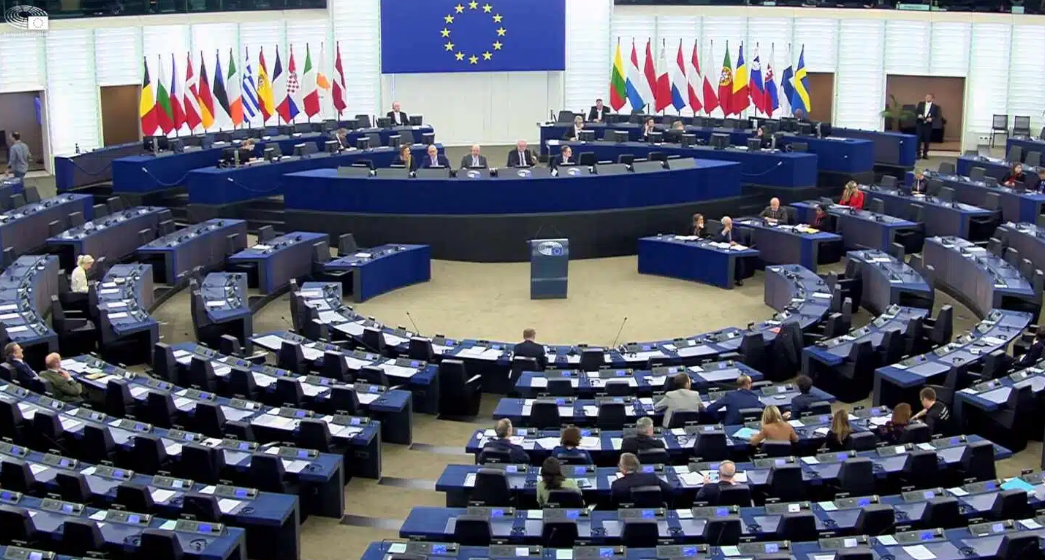
The actions of the Venezuelan regime in relation to arbitrary detentions and forced disappearances have not been exclusive against Venezuelans. Foreigners of different nationalities have also been victims of the excesses of the dictatorship, which is why last Tuesday, October 13, it was presented before the European Parliament a proposal that seeks to approve a resolution to protect Europeans arbitrarily detained abroad.
One of the victims who appeared before the organization to give his testimony was the Spanish Miguel Moreno, a journalist and sailor who was detained in international waters near Venezuela on June 11, 2025, while working on a Panamanian-flagged ship.
He was imprisoned in El Rodeo I prison for seven months and was released after the United States military incursion into Venezuela on January 3. Three days after those events in which Nicolás Maduro and Cilia Flores were captured to take them to the United States under arrest, it was Alexander Granko Arteaga himself who looked for him in prison and Diosdado Cabello himself took him to the Spanish Embassy in Caracas.
Now his story is one of those that serves as testimony to support this initiative presented by the French MEP Jean-Marc Germain, together with other MEPs and with the collaboration of the SOS Otages association.
This initiative aims to legally recognize arbitrary detention so that the 27 Member States have adequate support mechanisms for those who are detained; and, secondly, the appointment of a special representative of the European Union who is responsible for diplomatic coordination in cases of arbitrary detentions.
The document released by those who presented the initiative indicates that, since 2010, at least 149 citizens of the European Union have been arbitrarily detained by regimes such as those of Venezuela, Russia or Iran, where the average time of detention has been 1 year and 11 months and in 25% of the cases of Europeans arbitrarily detained, the victims had dual nationality.
Lawyer Juan Carlos Gutiérrez, partner of the Spanish firm Cremades & Calvo-Sotelo and defender of one of the victims, said in an interview for The National that this mechanism is absolutely necessary, because arbitrary detentions in the case of European citizens go beyond political reasons: in many cases, those who are victims of these detention mechanisms are used as bargaining chips to exert economic or extortion pressure, which in most cases constitute crimes against humanity.
Miguel was released on January 6, but before that he spent seven months with more than 100 foreigners imprisoned in the El Rodeo I prison: without being able to communicate with the family, without access to a lawyer, without a reasonable cause to justify his detention and without knowing what was happening in the diplomatic sphere to seek his release. “Europe failed us when the doors were closed and disappeared when they opened them,” Moreno told The National in a telephone conversation after having presented his testimony before the European Parliament.
According to his story, the situation of foreigners and political prisoners in El Rodeo I was very different, because the authorities of the Venezuelan regime were clear about the value of keeping foreigners in good conditions. However, remember that the fact of being foreigners did not exclude them from being tortured; Although they did not suffer physical torture that put their lives at risk, they were victims of psychological torture.
“The Venezuelan regime knew very well that if something happened to a foreign prisoner they would get into trouble; that is why the food was different, the care was different, the torture was different,” said Moreno.
After the presentation of this initiative, a consultation process begins so that at the beginning of 2027 the proposal can be debated and defended by the different parliamentary groups. Those who are promoting this project hope that it will be approved, at the latest, by the middle of next year.
One of the most important benefits that the approval of this parliamentary proposal will bring is that it will guarantee care not only for the victims of arbitrary detentions once they regain their freedom, but also for their families during the time the detention is prolonged.
In the documents presenting the initiative, the proponents consider it unacceptable that European citizens become instruments of diplomatic pressure between States and maintain that arbitrary detention is not only a diplomatic problem, since when this occurs the lives of people, their families and their professional careers are altered, and can leave lasting consequences after release.
The European Union, according to the promoters, must be able to mobilize to bring back its citizens and accompany them and their families before, during and after their release.
“This will be a mechanism to strengthen diplomatic actions for releases, where the embassies of the countries of the detained citizens are activated, but also the diplomatic representations of Europe. If approved, an official will be appointed who will have that function: to pressure, open diplomatic channels and strengthen actions that ensure that those arbitrarily detained can regain their freedom and there is subsequent reparation and rehabilitation. What cannot happen is that the States do nothing; Europe has sought freedoms, but these mechanisms must be reinforced with other types of actions,” said lawyer Juan Carlos Gutiérrez.