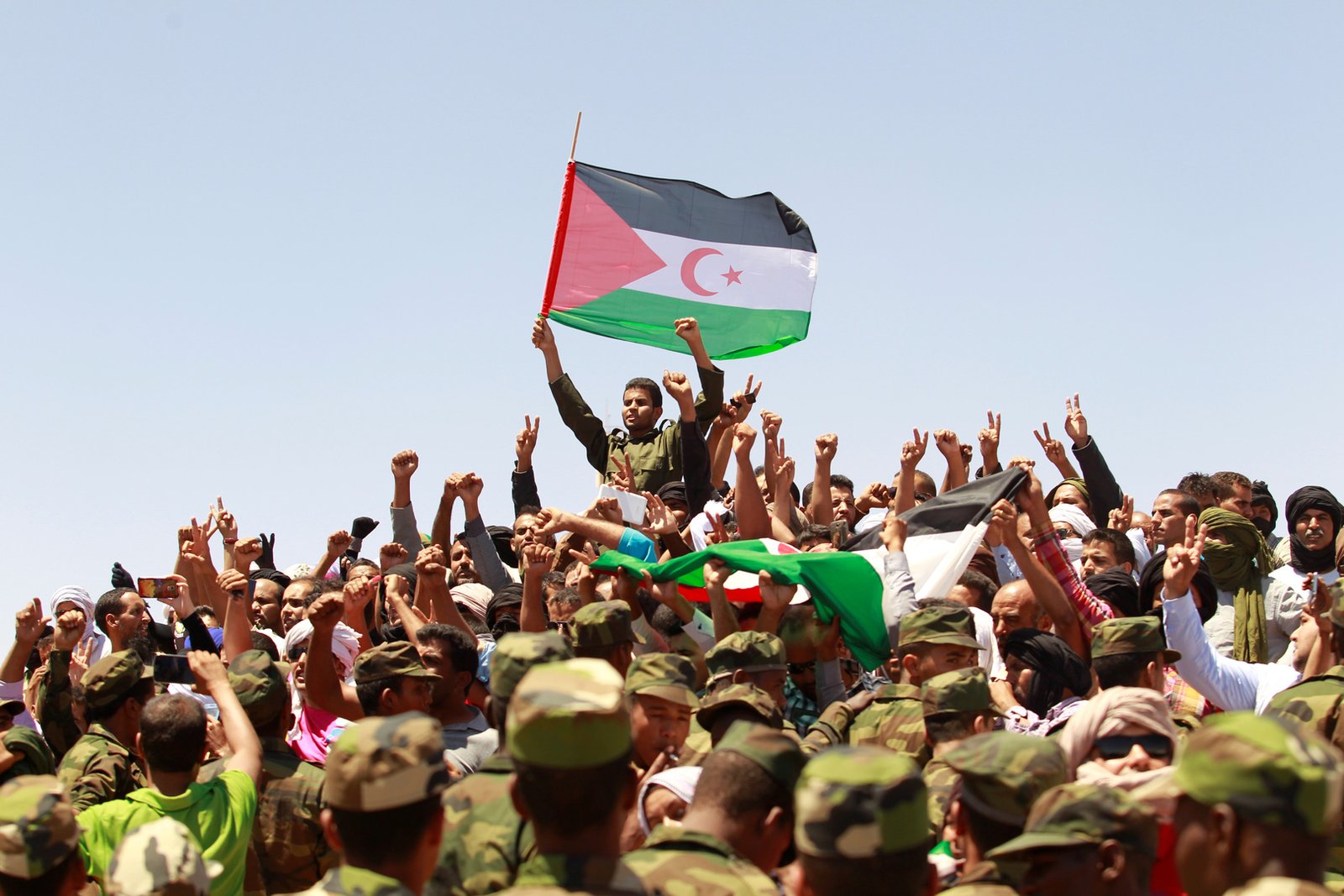
The International Crisis Group warned that attempts by the United States to impose the Moroccan autonomy proposal as the sole basis for settling the conflict in Western Sahara, or to bypass the Polisario Front and search for alternative Sahrawi parties, may lead to deepening the crisis and undermining the chances of reaching a sustainable political solution, stressing that settling the conflict, which has exceeded five decades, requires maintaining an open negotiating framework and respecting its political complexities, rather than applying pressure aimed at extracting quick concessions.
The group’s report, issued on October 9, 2026, entitled “The United States and the United Nations will need more patience to resolve the Western Sahara conflict,” explained that the talks that brought together Morocco and the Polisario Front, with the participation of Algeria and Mauritania, reached a dead end after the American and UN mediators tried to move quickly from exploratory discussions to negotiations centered around the Moroccan proposal, which collided with the Front’s refusal to give up the right of the Sahrawi people to self-determination.
The report’s author, Riccardo Fabiani, director of the North Africa Project at the International Crisis Group, said that the United States and the United Nations are required to slow down the pace of their movements and be more patient if they want to reach a consensual settlement, warning that insisting on imposing a quick solution may deepen the lack of trust that has hindered negotiations for years.
Polisario rejects the imposition of self-rule as the sole basis for negotiation
The report highlighted that the resumption of direct talks between Morocco and the Polisario Front, during three rounds hosted by Washington and Madrid between January and February 2026, was based on a formula that allowed the parties to discuss the possibilities of a settlement without requiring any of them to previously abandon their positions on sovereignty, autonomy, and self-determination.
He explained that this negotiating framework began to be shaken after the United States and the United Nations repeatedly called on Polisario to submit its observations regarding the expanded Moroccan autonomy plan, in preparation for moving to more detailed negotiations.
The report quoted an official in the Polisario Front as saying that the Front “did not accept the Moroccan autonomy plan as a basis for negotiations, and the UN Security Council does not oblige us to accept it.”
Warnings against marginalizing the Polisario Front and searching for alternatives
The report highlighted American moves to study the possibility of involving other Sahrawi parties in the negotiations, including the “Sahrawis for Peace” movement. The Spanish press, citing Spanish intelligence, confirms that Moroccan intelligence was behind the establishment of this organization that only repeats Rabat’s theses.
The report indicated that Washington may seek to introduce amendments to the diplomatic framework that would allow expanding the circle of participants, which could open the way for other Sahrawi representatives instead of being limited to the Polisario Front.
However, the group warned that bypassing the front would not guarantee a viable settlement, but could lead to an agreement that would lack popular acceptance and increase regional tensions.
The report quoted a Polisario official responding to attempts to promote alternative Sahrawi parties, saying: “American officials should come to the field to see who truly represents the Sahrawis.” Polisario comes from the people and continues to represent them. The groups they want to promote represent nothing.”
The report stressed the need for the United States to stop suggesting the possibility of replacing the Polisario Front with other Sahrawi representatives in the main negotiations.
The Security Council resolution does not close the door to other options
The report stopped at the UN Security Council resolution issued in October 2025 regarding the renewal of the mandate of the United Nations Mission for the Referendum in Western Sahara (MINURSO), explaining that the final wording was less decisive than the first American draft, which described autonomy as the “basis” for future negotiations and “the most viable solution.”
He pointed out that consultations among Council members led to a softening of the wording, leaving the way open for discussion of other proposals, despite the support the resolution gave to the Moroccan autonomy plan.
The report explained that the Polisario rejected the resolution, considering it the final version better than the first draft, and the Front adhered to the demand to hold a referendum for self-determination.
In this context, he pointed out that Massad Boulos, the US President’s senior advisor for Arab and African affairs, clarified after the vote that Washington’s support for self-rule does not mean ruling out any other solution that the parties can agree on.
The report quoted a Polisario official as saying at the time that “Paul’s language is more neutral than the UN Security Council resolution,” indicating that there was room for diplomatic action away from imposing a predetermined outcome.
Moroccan-Israeli normalization in Rabat’s calculations regarding Western Sahara
The report linked Moroccan moves to strengthen relations with the administration of US President Donald Trump and Rabat’s efforts to obtain more clear American support for the autonomy proposal.
In this context, he referred to the meeting that brought together Moroccan Foreign Minister Nasser Bourita, Israeli Foreign Minister Gideon Saar, and US Ambassador to the United Nations Michael Waltz in New York on September 15, during which the three parties agreed to advance Moroccan-Israeli relations, in parallel with affirming their support for Moroccan sovereignty over Western Sahara and the autonomy plan.
The report quoted a Moroccan expert as saying that the tripartite agreement constitutes an essential part of Morocco’s approach to Western Sahara, adding that improving relations with Israel represents a step directed at Washington, in light of Rabat’s need for US support before the next Security Council meeting.
A warning against ending MINURSO and the dangers of expanding the confrontation
The report warned that reducing the tasks of the “MINURSO” mission or ending its presence may raise the risks of military escalation, in light of the continuing tension between Morocco and the Polisario Front since the collapse of the ceasefire in 2020.
He explained that the mission had already undergone reductions that included eliminating 23 civilian jobs, reducing flying hours, and reducing its budget by 11.5 percent, amid fears that Washington would push for further reductions or ending the mission.
Despite the decline in the mission’s political role, the report stressed that its continued presence remains necessary to maintain stability and monitor the military situation, warning that withdrawal from the buffer zone may open the door to broader confrontations whose repercussions extend to Algeria and Mauritania.
The group called on the Security Council to ensure that any review of the mission’s tasks does not weaken its role in military oversight, considering that its presence represents one of the few remaining mechanisms to contain the risks of the conflict expanding.
James Baker’s plan to get out of the impasse
In a proposal to break the diplomatic impasse, the International Crisis Group called on the Polisario Front to present a new negotiating scenario based on the 2003 James Baker Plan, which stipulates the right to self-determination.
He pointed out that the Polisario accepted the plan while Rabat rejected it, considering that relying on it may provide a basis for relaunching negotiations and bringing viewpoints closer.
The report also called on Morocco to show greater flexibility and not treat autonomy as a final result that can be imposed or accelerated, stressing that a sustainable settlement requires discussing the terms of any future agreement with the Polisario Front, instead of presenting the Moroccan proposal as an irreversible fait accompli.
Rebuilding trust is a condition for a sustainable settlement
The report concluded that addressing the current impasse requires Washington and the United Nations to abandon betting on a quick settlement, and focus instead on practical measures to rebuild confidence between the parties.
He proposed resuming family visits between Sahrawi refugee camps in Algeria and the occupied regions of Morocco, after the suspension of the program in 2014, allowing the reconnection of families separated by the conflict and providing room for humanitarian cooperation.
Morocco also called for the release of Sahrawi prisoners who were arrested in connection with the Gdeim Izik protests in 2010, or to respond to requests to transfer them to prisons closer to their families.
The report stressed the importance of organizing visits by American and UN officials to the Sahrawi refugee camps in Tindouf, to meet with the leadership of the Polisario and listen directly to the refugees’ demands.
He also called on Washington to maintain balanced relations with Algeria and Morocco, and avoid giving the impression that it is siding with Rabat.
The International Crisis Group stressed that the Western Sahara conflict, which has exceeded five decades, cannot be resolved by coercion alone, warning that intensifying pressure on Polisario and its supporters to impose rapid acceptance of Moroccan autonomy may lead to counterproductive results and deepen the crisis instead of ending it.
The report highlights, in its entirety, that bypassing the Polisario Front or imposing a preconceived outcome on the negotiations will not guarantee a settlement of the conflict, and that maintaining an open negotiating framework, rebuilding confidence, and respecting the right of the Sahrawi people to self-determination remain essential elements for any political path that is intended to lead to a sustainable solution.