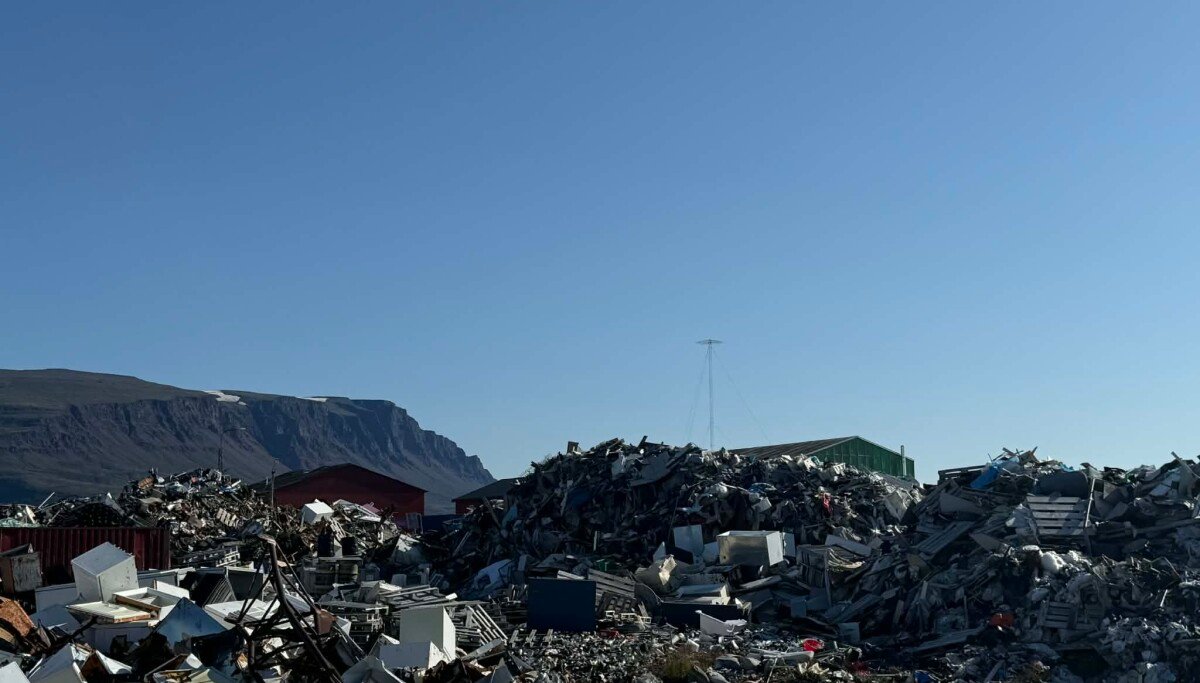
The waste area is one municipal area of responsibility, and while the municipal councils still cannot agree on which solution models should be used, in the meantime chaos has arisen in many landfills in cities and settlements in the five municipalities.
Bulky waste, which lies outside ESANI’s area of responsibility, and thus is not picked up by the waste company’s bulk ship, piles up in large quantities in several places, and some municipalities are in doubt as to how the problem should be handled. Therefore, the Self-Government should ask Denmark for help with waste management, a researcher believes.
The waste area is one municipal area of responsibility, and while the municipal councils still cannot agree on which solution models should be used, in the meantime chaos has arisen in many landfills in cities and settlements in the five municipalities.
Bulky waste, which lies outside ESANI’s area of responsibility, and thus is not picked up by the waste company’s bulk ship, piles up in large quantities in several places, and some municipalities are in doubt as to how the problem should be handled. Therefore, the Self-Government should ask Denmark for help with waste management, a researcher believes.
A societal problem
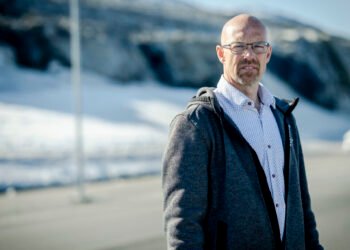
Kåre Hendriksen, who is an external lecturer at the Technical University of Denmark, DTU, and who, among other things, has written the PhD thesis “Greenland settlements, economy and development dynamics”, believes that it is a big problem if a municipality has not prepared a waste action plan.
He also believes that it is a problem if the municipal councils cannot agree among themselves on which solution models are needed to overcome the serious waste problems in the municipalities.
According to Kåre Hendriksen, the current waste problems in several towns and villages, where bulky waste, iron scrap and the like pile up in large quantities, are a societal problem.
– The problem is that the waste task has been delegated to some geographically huge municipalities with many large tasks, but which do not have the finances to solve the tasks, he says.
Denmark must take responsibility
The lecturer also believes that Denmark also has a responsibility in relation to the current waste problems.
– Historically, a large part of the dumps were established by Denmark. Therefore, Greenland should articulate this to Denmark and say that Denmark has not done it properly in terms of handling waste before home rule was introduced in 1979.
– So the Self-Government should contact Denmark and say that they want help to solve the waste problem, because they cannot solve the task themselves, says Kåre Hendriksen, who believes that it is important that this discussion is raised.
Not ESANI’s responsibility
The joint municipal waste company ESANI A/S operates the incineration plants in Nuuk and Sisimiut and transports combustible waste from the owner municipalities to the two plants. The company’s director Nicolai Odgaard Jensen states that the collection of daily waste in cities and towns and the operation of the landfills are the municipalities’ responsibility, not ESANI’s.
– A municipal landfill is not a pile that can just be driven away. First, the waste must be sorted on site. Today, ESANI is approved to transport combustible waste from the daily renovation, clean wood, sorted construction waste and tires, he says.
Combustible waste is pressed into bales or packed in big bags so that ESANI can pick it up and ship it to the facility in Sisimiut.
Outside Greenland
The director says that the transport of waste that does not originate from daily waste disposal requires permits, and points out that iron, metal, hazardous waste and electronics must be sent to recipients outside Greenland. And the rest, which can neither be burned nor recycled, must be deposited somewhere.
– If there is no place to use the residual fraction, the piles will build up again. It is therefore important to have a plan for how you will continuously process the waste after cleaning up a municipal landfill, before you get started.
– Each type of waste such as iron and metal, hazardous waste such as oil, chemicals and batteries, electronics and white goods, and a residue that can neither be burned nor recycled, has its own way forward, and sorting is the heavy part of the work, because the waste has been mixed up for many years.
– Next, the fractions must be packed so that they can be transported. Iron, metal and hazardous waste have their own requirements for packaging and documentation and will have to be shipped for treatment abroad, says Nicolai Odgaard Jensen.
A special task
If iron, metal or hazardous waste is to be sent out of the country for recycling or treatment, the rules on cross-border waste transport come into play, and there must be a receiver abroad who will accept the cargo in the quality and purity it has, he states.
– A load may be rejected on arrival if the requirements and documentation are not met.
– All links in that chain cost time and money, and they must fit together in the right order. That is why emptying a municipal landfill is a special task, he says.
The ESANI director emphasizes that the company assists the municipalities with the task when they can, and that they contribute with their operating experience from Nuuk and Sisimiut.
Greenland is part of the Stockholm Convention through the Commonwealth. The Convention is a global treaty to protect human health and the environment against chemicals that remain intact in the environment for a long time, spread geographically, accumulate in adipose tissue of humans and wildlife, and have harmful effects on human health or the environment. The convention is therefore precisely the reason why municipalities that want to establish their own smaller incineration plants do not meet the requirements of the convention.