Senior Political Reporter
A motion brought by Opposition Chief Whip Marvin Gonzales to debate ongoing disruptions in the country’s water supply collapsed in the House of Representatives yesterday, after he failed to formally move it before the expiry of his allotted speaking time.
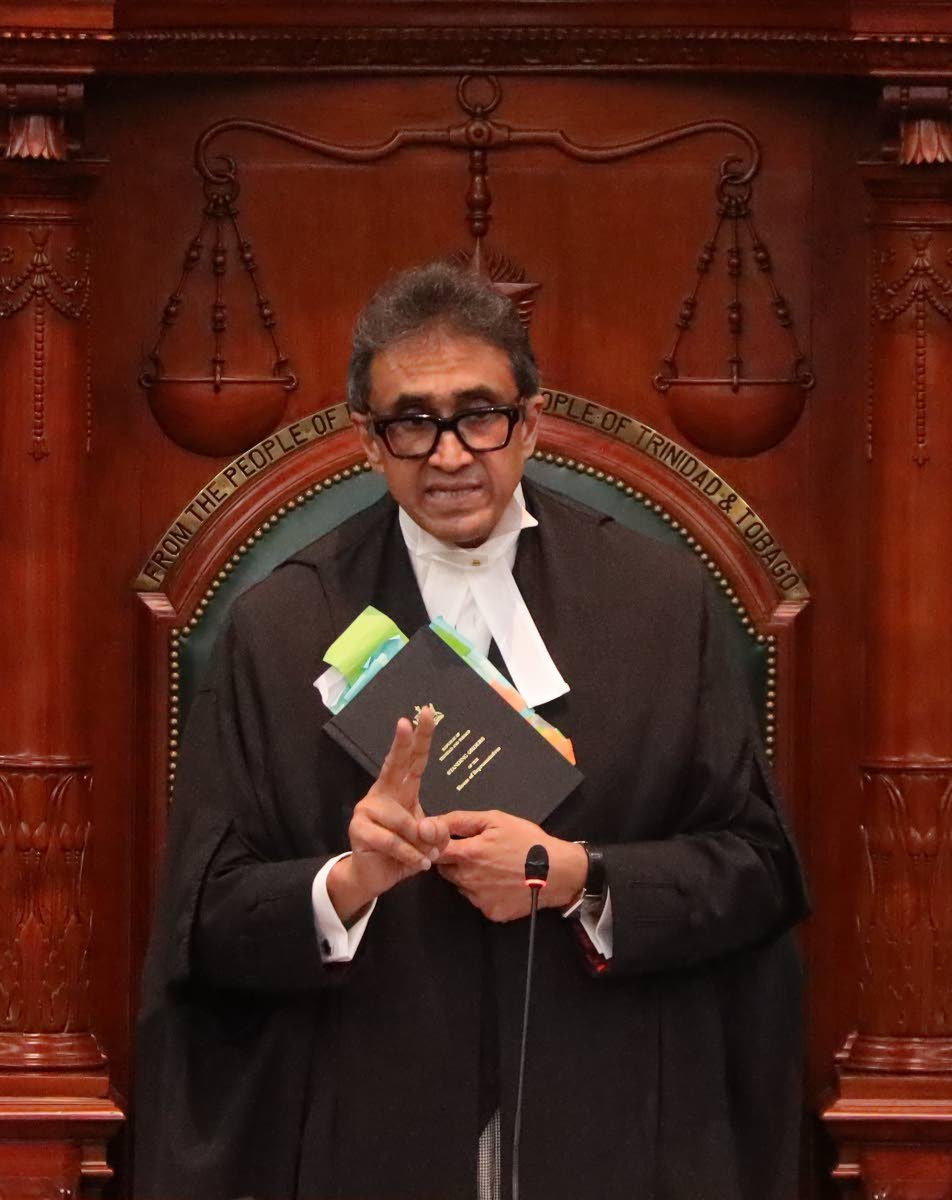
House Speaker Jagdeo Singh ruled that Gonzales had committed a procedural error by not uttering the customary phrase, “I beg to move,” at the end of his 45-minute presentation.
Gonzales had piloted the motion on water supply problems across Trinidad and Tobago, calling on the United National Congress (UNC) Government to outline measures being taken to address the issue. He blamed the situation on what he described as the Government’s failure to continue investing in water supply improvement systems introduced under the previous People’s National Movement (PNM) administration.
Gonzales said even his own constituency had been affected by disruptions and urged urgent action in light of what he described as a growing water supply crisis linked to worsening El Niño conditions.
However, after concluding his presentation, Gonzales took his seat without formally moving the motion. PNM MP Colm Imbert then rose to second it.
“We have a serious procedural problem here. MPs have to be disciplined,” Singh said.
Gonzales attempted to rise again, but Singh said his allotted time had expired.
The Speaker explained that members have 45 minutes to present a motion and said he had repeatedly signalled to Gonzales that his time was running out.
“You never begged to move your motion,” Singh told Gonzales, noting any attempt to do so came only after his speaking time had expired.
Singh suspended the sitting for 15 minutes to review the Standing Orders and determine whether the motion could still proceed.
When the House resumed, the Speaker said the Standing Orders were clear.
“At four and a half minutes, the member enquired of me how much time he had. I said, ‘You have four and a half minutes.’ At 20 seconds before the expiration of the time, I said to the procedural clerk, loud enough for the member to hear, that he had 20 seconds remaining. Whether he heard me or not isn’t my concern.”
Singh said two issues arose.
“The time expired. The MP failed to move his motion in time. He then took his seat. Then the MP for Diego Martin North East attempted to stand to second a motion which hadn’t been moved.”
He added: “The broad conceptual issue is whether a motion that has failed, and has not been moved, survives. The answer is a plain and obvious no.”
Singh said the circumstances would be reflected in the Hansard record.
“The member knew his time was almost up. The member sat without moving his motion. This procedural debacle isn’t my creation,” Singh said.
He stressed that the ruling should not be interpreted as an attempt to stifle debate on water shortages.
“I want to repeat it for the benefit of the public looking on, so I’m not accused of suppressing a debate on a legitimate area of public concern. Water is something that touches all citizens’ lives. But I don’t have the discretion to extend time.”
Singh noted that Standing Order 122 allowed members to suspend the Standing Orders by vote and permit the motion to proceed.
Gonzales, however, challenged the ruling, asking where the Standing Orders specifically stated that the phrase “I beg to move” had to be uttered within the 45-minute period.
According to Gonzales, the Opposition’s interpretation was that the 45 minutes applied to a member’s contribution and that formally moving the motion was separate from that time limit.
Singh rejected the argument.
“It stands to reason that a mover of a motion has 45 minutes to speak and must move the motion within that period. Otherwise, the laissez-faire interpretation you’re seeking to impose on the Standing Orders can be subject to serious abuse. There would be nothing to stop MPs speaking beyond their allotted 45 minutes.”
Reiterating his position, Singh said: “The failure to move the motion renders it null and void.”
He again offered members the option of suspending the Standing Orders to allow the motion to proceed.
However, Government House Leader Barry Padarath said the Government would not support what he described as an infraction of the Standing Orders.
“That being the case, the motion having failed to be moved, there’s nothing to second,” Singh ruled. “I think that concludes the business of the House.”
As Padarath moved to announce the adjournment of the House until next Wednesday, PNM MPs protested loudly. Singh nevertheless adjourned the sitting.
Padarath blames PNM
In a subsequent media release, Padarath accused the Opposition of displaying “ignorance, incompetence and a lack of understanding of the Standing Orders.”
He said it was particularly troubling that the error had been made by a former minister, experienced MP and the PNM’s Chief Whip.
“The Government was fully prepared to respond and, more so, demonstrate our track record as well as our commitment to improving the national water supply,” Padarath said.
He added that the Government was bound to respect the Speaker’s ruling and uphold parliamentary procedures.
“The Speaker’s ruling was not based on any action, decision or request by the Government. It was based on the principles of Westminster parliamentary democracy.”
Padarath also noted that this was the second occasion on which the Opposition had been unable to bring its own Opposition business to completion.
“The Government cannot and will not compensate for the Opposition’s irresponsible lack of understanding or regard for parliamentary procedures,” he said, accusing the PNM of “lazy, inept and abhorrent parliamentary behaviour.”