Text and image Ivan Cairo
HANGZHOU — Artificial intelligence and digital trade offer enormous economic opportunities, but should not lead to greater inequality or loss of human control. That message sounded on Thursday at the opening of the Fifth Global Digital Trade Expo in Hangzhou, China, where Chinese Premier Li Qiang called for open international cooperation and his Malaysian counterpart Anwar Ibrahim pointedly asked the question: “Do we control AI, or does AI control us?”
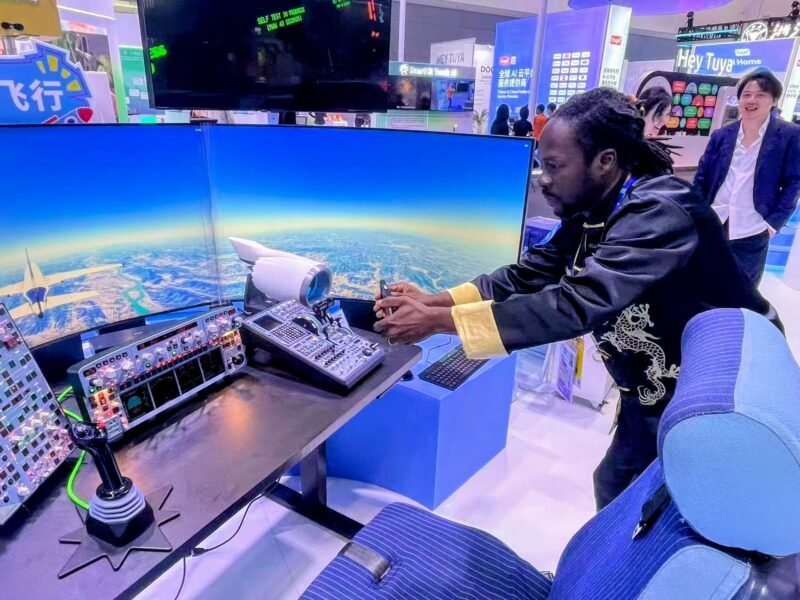
This year the expo, which lasts until September 27, is entirely dedicated to artificial intelligence under the theme “Meet the AI Future at GDTE”. The opening ceremony was attended by more than 1,000 guests. More than two thousand companies are presenting at the fair and about half of the exhibitors are active in the field of AI. International technology companies such as Apple, Amazon and Google are also represented.
Nearly ten thousand international buyers have registered, approximately 50 percent more than last year. Expected international purchase orders exceed US$940 million, more than half of which relate to AI. Malaysia and Hungary are the special host countries this year and have their own pavilion.
Li wants more openness
Premier Li Qiang described digital trade as a “vast blue ocean” for the global economy. At the same time, he warned of new development gaps, trade barriers and the lack of adequate international regulations. “We need to strengthen digital connectivity and promote more free trade, with mutual recognition of standards,” he said.
According to Li, the digital divide must be reduced by, among other things, providing developing countries with more support in technology, infrastructure and training. He also advocated strengthening international digital governance, with a central role for the World Trade Organization (WTO). The Chinese Prime Minister turned against bloc formation and exclusive trade arrangements.
China itself wants to further stimulate digital consumption, including through “AI+consumption”. Beijing also wants to expand market access, support cross-border e-commerce and expand international cooperation in the digital sector.
Li further emphasized that China continues to pursue an open source path in AI technologies. At the same time, the country wants to work on further standardization of digital trade and improvement of regulations and supervision around data.

Anwar: who controls who?
Malaysian Prime Minister Anwar Ibrahim placed a stronger emphasis on the social and ethical implications of the rapid advance of AI. He warned that technological progress could further widen existing disparities between rich and developing countries. He called inequality and unfair trade practices due to the digital divide “real and urgent problems”.
That is why, according to him, not only technological progress is needed, but also an ethical framework within which AI is developed and applied. He also advocated an open, rules-based trading system, so that developing countries can actually benefit from new technology.
Anwar asked the question that he believes should be central to the further development of artificial intelligence: “Do we control AI, or does AI control us?”
He expressed appreciation for China’s willingness to share technology and said Malaysia is open to Chinese investment in digital technology. He pointed to, among other things, his country’s multilingual workforce and rules-based economy.
Anwar concluded his speech in Chinese by saying “one flower alone does not make spring; only when many flowers bloom will the garden be full of spring.” His message was that technological progress means little if the benefits only accrue to a few countries or elites.
During a bilateral meeting, Anwar and Li also discussed AI. Both agreed that the technology should remain under human control.
Kyrgyzstan seeks cooperation
Kyrgyz Prime Minister Adylbek Kassymalyev described digital trade as the foundation for a new infrastructure of the global economy. He expressed support for the Chinese initiative to establish a World Organization for Cooperation in Artificial Intelligence. According to him, Kyrgyzstan is one of the first founding countries.
Kassymalyev mainly sees opportunities for cooperation in the areas of e-commerce, digital logistics and payments. He also mentioned digital support of the China-Kyrgyzstan-Uzbekistan railway project, AI applications for small and medium-sized enterprises and joint development of data centers and technology transfer centers.
In addition, Kyrgyzstan wants to focus on training specialists. According to Kassymalyev, the geographical location of his country is not an obstacle. “In the digital world, distance is not an obstacle. AI and digital commerce are rapidly changing the world. Our job is to use them for the benefit of our people.”
The Fifth Global Digital Trade Expo runs until September 27 in Hangzhou.