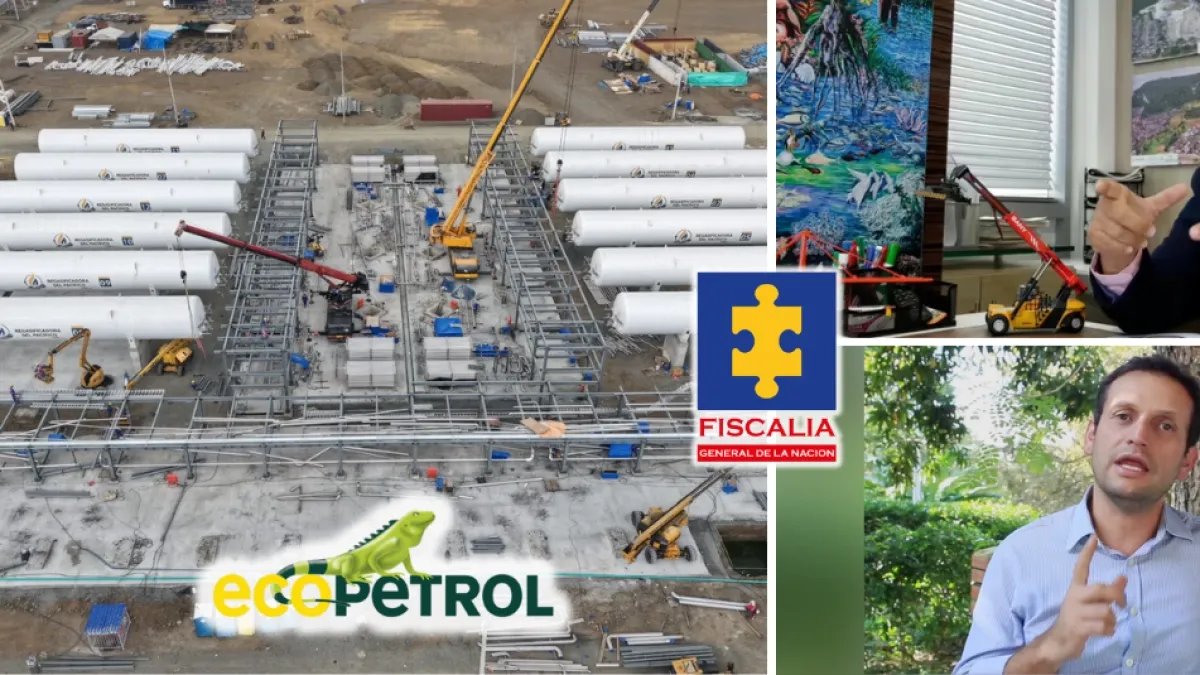
According to marine traffic platforms, ‘Tura’, the gas transport ship, key to putting the Pacific Regasification Plant into operation and help avert a possible blackout in Colombia, is located near the coast of California, heading to Buenaventura.
It is estimated that the project will come into operation in mid-November. with the gas molecule that Ecopetrol is negotiating.
But the Investigative Unit of EL TIEMPO established that, along with the works, an investigation is progressing, filed by Ecopetrol itself, on September 2 in the Prosecutor’s Office, in which it is requested to investigate the way in which, in the times of Petro and Ricardo Roa, the project was awarded. –valued at 172 million dollars– to Ports, Investments and Works (PIO SAS).
READ ALSO
Delays and coincidences
Pacific Regasification Plant. Photo:Courtesy
That is one of the chapters of the macro cases that the internal audit carries out. What they seek to establish or rule out is whether there was irregularity in the awarding of the business, which should have started operating on August 1. Besides, if there was alleged influence peddling, conflict of interest or some type of pre-contractual or contractual modification and even omission of fines for delays.
The case began to move 6 months ago, when EL TIEMPO revealed a swarm of firms linked to Bayron Triana, the then vice president of Energies for Transition at Ecopetrol, close to Roa. One of these sealed a contract with Einstein Mauricio Gómez Machado, an engineer who also appears in the Regasificadora del Pacífico.
The Investigative Unit of EL TIEMPO consulted Óscar Isaza, owner and founder of PIO SAS, and his attorney, the well-known criminal lawyer Fabio Humar, about the complaint, and they began for pointing out that PIO won a contest in compliance with the principles of efficiency, equality, morality, effectiveness, economy, speed, impartiality and publicity.
The renowned criminal lawyer Fabio Humar. Photo:Private file
“I beat more than one. We offered the best price per million cubic feet, the best technical proposal and the shortest delivery time without advance payment”assured Isaza.
Regarding the delays of almost two months, without penalty ($200,000 per day, which is deducted from the invoices), he said that the delays are not attributable to PIO: “The war in Iran has generated a disruption in terms of logistics; the earthquake left the port of Buenaventura disabled for 5 days, there were road closures and a typhoon in China where ‘Tura’ was located. And the ship that brought the tanks was supposed to arrive in May, but it arrived on July 22 and we disembarked on August 19 due to congestion in the port.” And he explained that they are only 45 days late, because the contract establishes that they have two months of wages without fine.
READ ALSO

‘They didn’t ask for bribes’
Cali businessman Óscar Isaza Benjumea. Photo:Juan Pablo Rueda / EL TIEMPO
However, Ecopetrol He has only accepted two days of the 45 and, if PIO does not prove the rest, fines and arbitration would follow.
EL TIEMPO also asked Isaza about the version that Ecopetrol demanded bribes for the award of the contract (4 cents of a dollar for every million cubic feet negotiated): “They have never demanded anything from me. I have an impeccable track record. Let them come in and investigate. There is no shadow of a doubt about the project.”
And about his advisor Mauricio Gómez, he said: “In 2016, he was on the Commission for the Regulation of Energy and Gas (Creg) and I went to present a regasification project in Buenaventura (Puerto Solo) with gas pipelines. Later, he left the Creg and set up the Regulatory Consulting firm.”
He also said that, in 2019, following Creg guidelines, Upme opened a tender for the project in Buenaventura: “But I did not participate because they demanded a guarantee of 70 million liquid dollars.”
Finally, regarding his participation and obtaining the contract in Ecopetrol, Isaza said that, in 2024, David Riaño, then vice president of Energies for the Transition, called him, told him about the project and invited him to participate.
At that time, Gómez was looking to be commercial vice president of the state company: “I told Mauricio to exclude himself from the tender. Later I learned that he was not named.”
In this regard, Riaño assured that there was no such call to Isaza and that it was from the presidential staff, headed by Roa, that they asked him to attend (on August 16, 2024) a group of businessmen who had projects in the Pacific and the Atlantic: “I didn’t call anyone, I just listened. Two weeks later, the process was opened, which was in charge of the Transition project management, where Bayron Triana was in charge, and was awarded by the Logistics Vice Presidency.”
READ ALSO
‘Zero decisions’
Einstein Mauricio Gómez Machado, CEO of the Regasificadora del Pacífico. Photo:Social networks
The question that arises is whether Mauricio Gómez, in the different positions he has held (creg commissioner, in 2012; PIO advisor in 2018; candidate for commercial vice president of Ecopetrol in 2024; Creg contractor, in 2024; and current CEO of Regasificadora del Pacífico, since 2025), could have incurred a conflict of interest. Gómez was Bayron Triana’s boss at the Creg and his firm, Regulatory Consulting, had a contract (2025) with a company linked to Triana: E-Nlighten SAS.
And Gómez himself admitted to EL TIEMPO that, after his failed entry into Ecopetrol, he provided advice to the Creg for nearly 1,000 million pesos, where he mentioned the Pacific regasification project and even the failures that, in his opinion, the Upme process had had.
Despite this crossover between entities, roles and times, Gómez is emphatic that he never intervened in decisions linked to the regasification company that he advises today: “On June 8, 2012, the Creg issued a resolution on the need to import gas through the Pacific and the Caribbean. I entered on July 19,” said Gómez.
Regarding Triana, he assured that he met him like many other Ecopetrol officials, because the sector is very small. And when asked who recommended him to enter the state, he said: “I don’t know who shared my resume. A head-hunter called me and I had several tests. The vice president of human talent, Victoria Sepúlveda, called me to talk to me about the position. But after consulting with friends, I did not accept to be in that Ecopetrol.”
EL TIEMPO asked him if his failed entry process was linked to an ethical alert due to a criminal case against him: “It had nothing to do with it, it is a case that is not final and of which I myself gave notice”. And he concluded by saying that he joined the Pacific Regasification project when it was already awarded.
Bayron Triana has also denied any irregular conduct on his part and has attributed the anonymous reports and complaints against him to a smear campaign for not having given in to pressure from Casa de Nariño. so that the purchase of a gas molecule was signed through the Houston office when the Petro government was about to expire.
The Prosecutor’s Office investigates.
INVESTIGATIVE UNIT
u.investigativa@eltiempo.com
@UinvestigativaET
Follow us now on Facebook