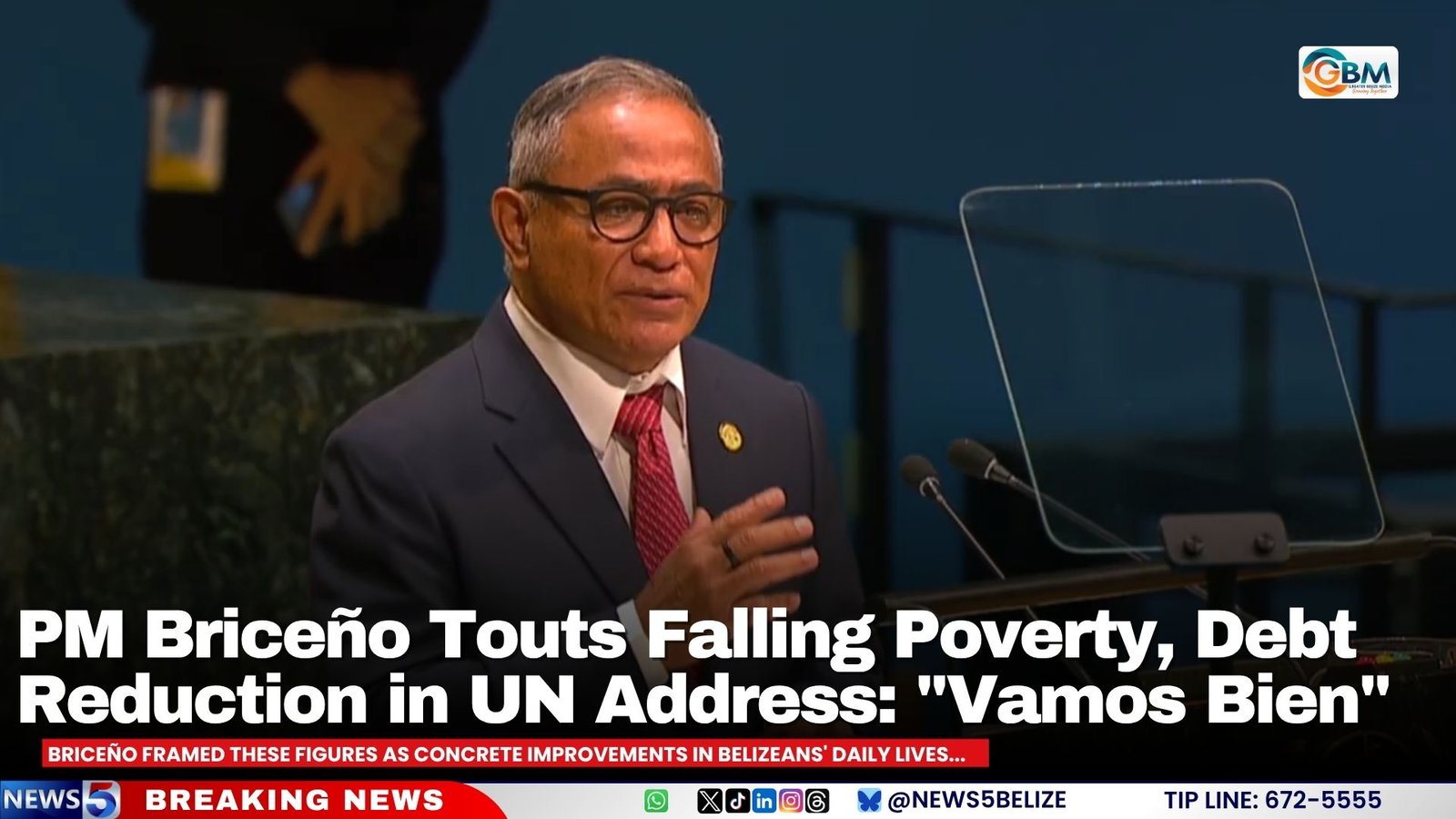
Prime Minister John Briceño highlighted Belize’s recent economic gains during his address to the UN General Assembly. He pointed to falling poverty and unemployment alongside a reduced debt burden as evidence of measurable progress toward the Sustainable Development Goals.
“We are committed to the Sustainable Development Goals, and we’re making measurable progress. Multidimensional poverty stands at 19.1 percent and unemployment at 1.9 percent. Public debt has been brought down to 66.6 percent of GDP, and for the first time in a generation, it is on a path of sustainable development.”
Briceño framed these figures as concrete improvements in Belizeans’ daily lives. “These figures are not abstractions. They are Belizeans at work, families with greater purchasing power, and a government with room to invest in the future. Vamos bien. We are doing well, but we have farther to go.”
He pointed to the next phase of Belize’s national development strategy, Plan Belize 2.0, as the vehicle for continued progress. “That is the purpose of the next phase of our national strategy: to create jobs, reduce vulnerability, reduce exposure to imported energy, protect the ecosystems, and equip Belizeans to compete in a changing economy.”
Briceño also highlighted the Belize Compact, a new grant partnership with the United States. “Alongside it, my government has launched the Belize Compact, a landmark grant partnership with the United States that will strengthen our energy security and build the skills of our young people for the workforce of tomorrow.”
He acknowledged, however, that growing climate risks threaten to complicate that progress. “But the risks are growing. Hurricanes are more intense. Weather patterns are less predictable, which makes anticipatory action more complex. New stressors such as the unprecedented influx of sargassum along our coast have no ready-made responses. Managing them requires innovation, capable institutions, and strategies that are properly financed. Yet even the best national effort will fall short without coordinated international cooperation.”