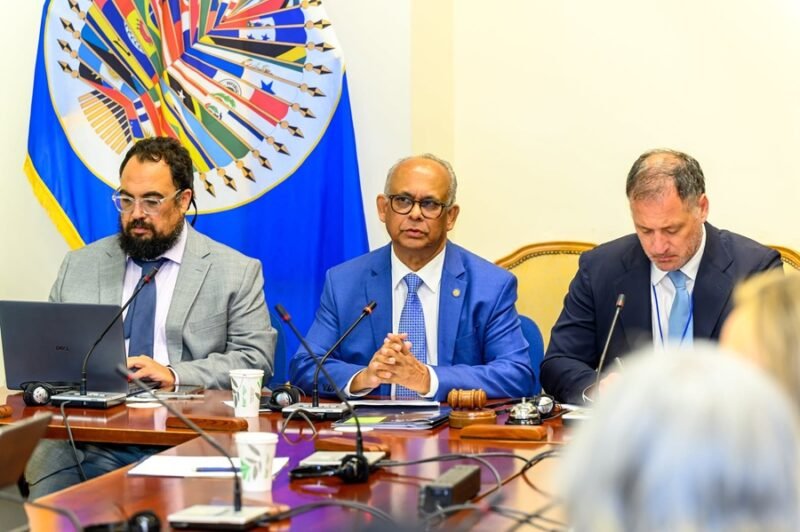
The Organization of American States (OAS) must become stronger, more balanced and less dependent on a single member state, as countries in the Western Hemisphere face organized crime, geopolitical rivalries and increasing pressure on smaller states. This is what OAS Secretary General Albert Ramdin said. In an interview with the True Time he advocates what he describes as ‘Multilateralism 2.0’: an inter-American system that remains firmly anchored in sovereignty, international law and democratic principles, but at the same time becomes more pragmatic and results-oriented.
Text Ivan Cairo
Image OAS
Ramdin warns that too much dependence on one member state will ultimately weaken the regional system. “An inter-American system that is excessively dependent on a single member state is not healthy in the long term,” he says.
“We must be principled, but also constructive“
According to him, responsibilities should be shared more widely. “A stronger and more balanced OAS will give all member states, especially the smaller ones, greater resilience and more confidence in multilateralism.” In doing so, he touches on an important challenge for the regional organization: cooperation with the United States (US), the most powerful member state, while at the same time adhering to the principle that all countries are sovereign equals. Ramdin, the first OAS Secretary General from a Caribbean country, emphasizes that the US is an extremely important member state. However, according to him, the future of the Americas must be shaped together. “The inter-American system is based on sovereign equality. Member countries of the OAS – large and small – have the same rights.”
This sovereignty also plays an important role in the fight against cross-border organized crime. Asked about the US policy of designating more and more Latin American criminal organizations as terrorist organizations and expanding security cooperation, Ramdin acknowledged the seriousness of the threat. “Cross-border organized crime is one of the most serious threats to the Western Hemisphere and governments need effective tools to tackle it.”
However, according to him, combating it requires a multi-dimensional approach. Law enforcement must be combined with stronger institutions, judicial cooperation, prevention and measures against illicit financial flows, arms trafficking and the recruitment of young people.
No new Monroe Doctrine
When it comes to security operations that affect another state, Ramdin draws a clear line. According to him, cooperation must be based on consultation, agreement and respect for the sovereignty of the country concerned. “The border is determined by the principles to which all Member States have committed themselves: international law, sovereignty, territorial integrity, non-intervention and respect for human rights.” According to him, those principles are “not optional.”
When asked whether a unilateral US military operation against an alleged drug cartel on the territory of an OAS member state would be acceptable without government consent, Ramdin does not want to prejudge a hypothetical situation. He emphasizes again that sovereignty, territorial integrity, non-intervention and international law must be respected.
He is also coy about whether the discussion of renewed American strategic dominance points to a modern version of the Monroe Doctrine. “I wouldn’t describe today’s Americas in nineteenth-century terms,” he says.
According to him, the current Western Hemisphere consists of independent states that determine their own national interests and international relations. The OAS must therefore remain a forum in which governments with divergent interests can work together. According to Ramdin, this is especially important for smaller Caribbean countries, which simultaneously face security problems, migration, climate change, energy problems and limited access to financing. “One of the fundamental goals of multilateralism is precisely to ensure that the voice of a small state is heard,” he says. “Sovereign equality must have meaning in practice.”
According to Ramdin, small states suffer from vulnerabilities that are disproportionate to their size. The inter-American system must respond more effectively. “Each state is sovereign in determining its own international relations. The role of the OAS is to maintain space for dialogue, cooperation and peaceful relations, and to help ensure that the Americas remains a zone of peace.”
Democratic standards
The credibility of the OAS is also discussed in the interview. Asked whether countries that have close relations with Washington should be held to the same democratic standards as Cuba, Nicaragua and Venezuela, among others, Ramdin said political relations should not play a role in the application of democratic norms. “The principles of democracy, human rights, constitutional order and the rule of law apply throughout our Western Hemisphere. They should not depend on political solidarity or on whether a government has close ties with one Member State or another.”
According to him, situations should be assessed on the basis of facts and the principles and instruments adopted by the OAS countries. As Secretary General, he sees it as his responsibility to serve the entire organization, to act as an “honest mediator” and at the same time keep the channels for dialogue open.
According to Ramdin, consistency is essential for the credibility of the OAS, although not every situation needs to be addressed with the same diplomatic tool. “We must be principled, but also constructive.”
‘Multilateralism 2.0’
With his ‘Multilateralism 2.0’, Ramdin ultimately wants to achieve a more practical form of regional cooperation. All countries must be heard, regardless of their size, wealth or power. At the same time, the OAS must become more decisive and expand practical cooperation.
“One of the fundamental goals of multilateralism is precisely to ensure that the voice of a small state is heard”
He mentions security, climate resilience, institutional strengthening, connectivity, development and access to partnerships and resources as areas where greater cooperation is needed. According to him, smaller states in particular cannot tackle many cross-border problems alone. That is why responsibility within the OAS must also be shared more widely.
Ramdin envisions a future in which the organization adheres to sovereign equality and non-intervention, but at the same time becomes more balanced and better able to act together. The size, wealth or power of a country should not determine how much weight its voice has within the inter-American system.