Sixty-year-old Surinamese Bidjaikoemar ‘Jerry’ Nanhoe has been officially charged in the United States with smuggling an extensive arsenal of weapons to Suriname. Federal authorities in Miami discovered a large quantity of firearms, ammunition and unfinished gun parts in late August. These were hidden in household goods intended for shipment to Paramaribo.
According to official court documents obtained by the Miami Herald Nanhoe arrived in Miami on August 25, 2026 on SLM flight PY421 from Suriname. The American investigation services, including Homeland Security Investigations (HSI), the Bureau of Alcohol, Tobacco, Firearms and Explosives (ATF) and the Miami Beach police – probably after receiving a tip – kept a close eye on his activities in South Florida.
“The US prosecutor is charging him with ‘smuggling of goods from the United States’, which carries a prison sentence of up to fifteen years“
Two days after his arrival, on August 27, federal agents tracked him to the freight company Seven Winds Shipping in Miami. There he presented his freight, on the customs form he entered household goods that had to be sent to a (as yet undisclosed) address in Suriname, such as storage bins, refrigerators and cool boxes, as well as a chair.
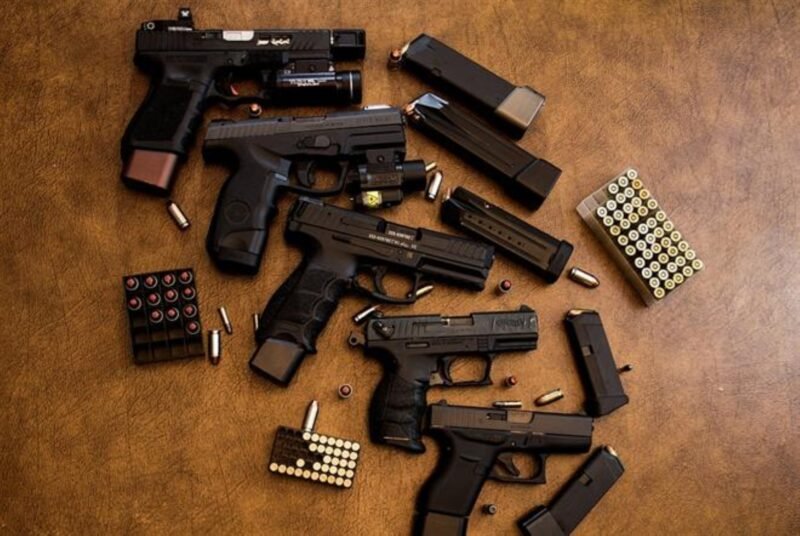
During an inspection of the cargo, agents actually came across nine (assault) rifles, six pistols, eighteen unfinished AR-typelower receivers’ (see box), fourteen complete AR-type ‘upper receivers5,140 cartridges, 59 magazines and various other loose weapon parts. To avoid detection by detection equipment, the firearms and parts were meticulously concealed under lead plates in the plastic storage bins. The thousands of bullets were hidden in the walls and compartments of the refrigerators and cool boxes.
Nanhoe faces severe penalties. The US Attorney’s Office charges him with ‘smuggling of goods from the United States’, which carries a prison sentence of up to fifteen years, ‘illegal trafficking in firearms’ and ‘illegally supplying firearms to a commercial transporter’. These last two offenses carry a prison sentence of five years each. In addition to a possible prison sentence, the judge can also impose fines of up to 250,000 US dollars per charge.
Bail rejected
The Surinamese, through his lawyer David Howard, requested to be allowed to await the trial in freedom on payment of a bail of 250,000 US dollars. However, the magistrate firmly rejected this request due to the serious flight risk and the danger to society and therefore decided to extend his pre-trial detention. The next hearing is scheduled for September 22.
The public documents of the American court do not yet show where Nanhoe purchased this heavy arsenal in Florida. It is also still unclear who the intended final recipient(s) in Suriname would be. However, the documents do mention a ‘Individual 1′referring to an as yet unknown second suspect who was spotted with Nanhoe in South Florida during surveillance. US authorities continue to investigate this extensive smuggling case.
KPS starts investigation
The Suriname Police Corps (KPS) has now been officially informed of the arrest and the intercepted cargo in Miami. Police sources confirm that an in-depth tactical investigation has been launched to uncover the networks behind this shipment. The Surinamese investigative services focus in particular on identifying the local contact persons and the intended end recipients of the firearms and ammunition.
Arms and ammunition imports via cargo shipments from the US are a growing challenge for Surinamese security services. The KPS is working closely with international partners in this case, including the American intelligence services, to exchange information. Given the extensive nature of the smuggling – including heavy automatic rifles and so-called ‘ghost gun‘parts – the police do not rule out arrests on Surinamese territory in the near future.
Among the seized goods were eighteen unfinished so-called AR-type lower receivers. In the gun world, the lower receiver is the central frame of a rifle in which the trigger, magazine holder and stock are mounted. Because this part actually makes the weapon fire, it is considered the official firearm by US law. All other parts (such as the barrel or firing pin) are considered separate accessories. Because this particular one receivers however, were ‘unfinished’ (in the US often lowers mentioned), they were not immediately ready for use. Until recently, these parts could be purchased in the US without a background check or serial number. Buyers can put the finishing touches to the frame at home with a simple drill or milling machine. Once the frame is drilled out and combined with a upper receiver (the top with the barrel), it creates a fully functional assault rifle. Because there is no serial number on them, these weapons are ‘ghost guns‘ (ghost weapons). They are completely untraceable by the police and the judiciary, which makes them extremely popular and dangerous in the criminal circuit. If Nanhoe’s smuggling had been successful, he could have assembled eighteen of these illegal ghost weapons in Suriname in no time.