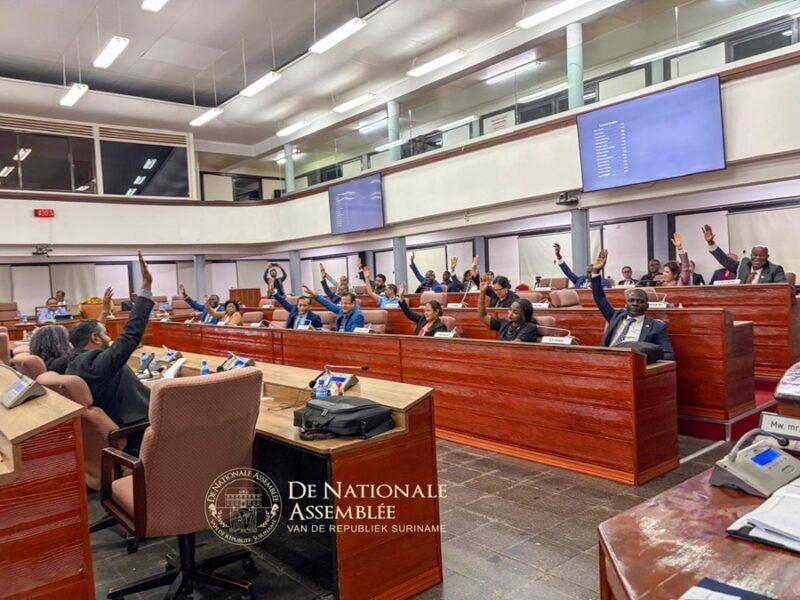
The law on Surinamese citizenship and residency was amended during the night from Monday to Tuesday, meaning that athletes from the Surinamese diaspora can now legally obtain Surinamese nationality. They do not have to submit an application themselves, sign anything and do not have to take an oath or make a declaration. With this construction, the initiators want to prevent diaspora athletes from losing their other nationality because they actively apply for or accept Surinamese citizenship themselves. The amendment to the law was ultimately adopted unanimously by 29 votes.
Image DNA
Initially, some members of the VHP faction objected. They insisted on adjourning the parliamentary debate so that the amendment could be prepared more legally in depth. VHP parliamentarian Mahinder Jogi advocated first consulting experts in the field of nationality law. According to him, the scheme had to be legally closed in such a way that athletes who are helped by it do not unintentionally end up in problems.
“Sport binds a nation”
VHP faction leader Gajadien
Other VHP members also felt that more time should be allocated for careful preparation, but during the lengthy debate the position of the VHP changed. After several moments of consultation and adjustments to the proposal, the faction ultimately supported the change in the law. This allowed it to be adopted shortly after half past two in the morning with a unanimous 29 votes.
Relieved
Initiator Ebu Jones (NDP) expressed relief about the results achieved after the lengthy treatment. “A long debate, we are through it,” he said. According to him, the change in the law makes it easier to deploy sports talent from the diaspora for Suriname.
Co-initiators Steven Reyme (A20/DOE) and Edgar Sampie (Abop) were also satisfied with the compromise. During the treatment, Reyme had expressed appreciation for the VHP faction for its ultimate willingness to cooperate in finding a solution.
Problems with dual nationality
The immediate reason for the change in the law is, among other things, the problems that some players with Dutch nationality encountered after they acquired Surinamese citizenship and played for the national football selection during the World Cup qualification. The way in which they acquired Surinamese nationality turned out to have consequences for the retention of their Dutch nationality.
The construction now chosen must reduce that risk. The athlete does not submit a request for naturalization himself and does not have to formally accept Surinamese status. A signature, oath or statement is also not required. Surinamese nationality is acquired by operation of law on the day on which the president’s decision is taken.
The special arrangement is temporarily limited to athletes. In the original initiative proposal, the target group was broader and persons with special scientific merits could also qualify. After objections and consultation between the factions, it was decided to exclude that category from the scheme for the time being.
According to the explanation, a special provision is necessary for athletes because international sports organizations usually require that someone has the nationality of the country he or she represents.
Not just footballers
The scheme applies to persons who are PSA entitled and have proven or can prove special achievements in the field of sports. They must also be able to provide meaningful added value to the international representation of Suriname.
Although the discussion is mainly inspired by the situation surrounding footballers from the diaspora, the law is not limited to football. Practitioners of other sports may also be eligible if their national sports association is affiliated with the Surinamese Olympic Committee.
An athlete must, among other things, meet the selection criteria of the national coach or international selection criteria for participation in a continental championship, a confederation championship, a world championship or the Olympic Games. A national sports association can also indicate with reasons that an athlete has special added value for Suriname in qualifying competitions or a final tournament.
President makes decision
The president will be given the authority to appoint a diaspora athlete who will become a Surinamese on the basis of this scheme. This is done on the recommendation of the minister responsible for sports matters and in consultation with the minister responsible for nationality affairs. The national sports association involved and the attorney general are also being heard.
DNA does not help decide individual cases. However, parliament must receive a copy of the substantiated presidential decision within thirty days. DNA is thus informed about the grounds on which an athlete obtained Surinamese nationality and parliament can question the government about this.
Afonsoewa: invest in your own youth
NDP member Silvana Afonsoewa, chair of the committee of rapporteurs, made it clear that she supports the change in the law, but at the same time warned that Suriname should not always become dependent on such solutions in order to have sufficient international sports talent. According to her, the country must invest heavily in its own youth, sports development and education. This should prevent the need to repeatedly resort to emergency solutions, including amendments to legislation, in order to make Suriname stronger internationally.
NDP faction leader Rabin Parmessar stated in his voting motivation that “democracy has triumphed”. According to him, the positions were initially strongly polarized, but they could be brought together during various consultation moments.
VHP faction leader Asiskumar Gajadien also emphasized the compromise ultimately reached and the significance of the diaspora. “Sports unites a nation,” he noted. After the treatment, Vice President Gregory Russia noted with satisfaction that the various political parties had ultimately found each other in the national interest.