Australia and Palau are pressing Pacific leaders meeting in Palau today to issue a clear condemnation of China’s July ballistic missile test. Other members, notably Kiribati and Nauru, are resisting a statement that singles out Beijing.
The Pacific Islands Forum wraps up with a leaders’ retreat at a residence belonging to the family of Palau’s president, Surangel Whipps Jr. The argument is over a People’s Liberation Army Navy submarine that fired a dummy-warhead missile more than 7,000 kilometres from the South China Sea into the Pacific, landing just outside Tuvalu’s exclusive economic zone.
Several Pacific governments criticised the launch at the time. A joint statement at last month’s foreign ministers’ meeting stalled when Kiribati and Nauru refused to sign on, frustrating Canberra and Wellington. Ministers settled for a brief communiqué line calling for “transparency and reassurance” and noting that some countries had raised concerns.
Kiribati’s President Taneti Maamau told parliament his government had raised the test with Beijing but that it would be unfair to criticise China while the United States still fires missiles into waters around the Marshall Islands.
“We are trying to be fair,” he said. “America has been bombing, and testing its bombs … in the Marshall Islands, islands near us, and why don’t we ask questions or criticise America?”
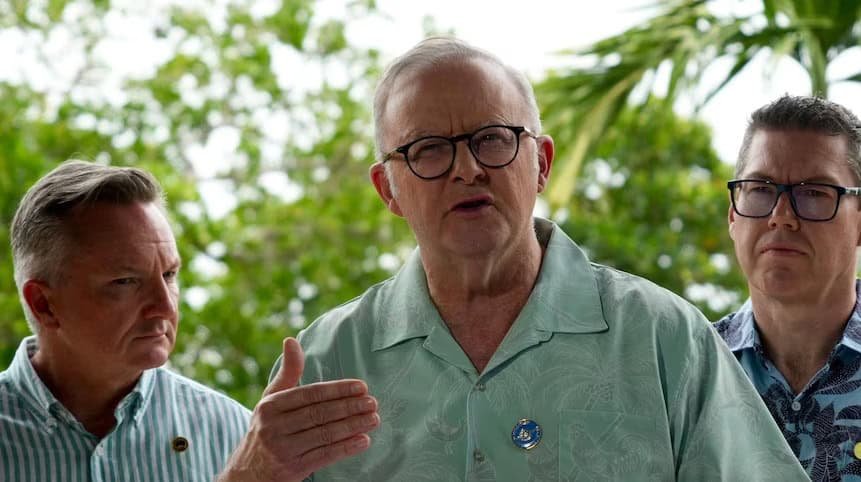
Prime Minister Anthony Albanese, in Palau, rejected the comparison.
“The situations are very different,” he said. “The US gives proper notice, has an agreement with the Marshall Islands. What we saw with the Chinese test was a firing of a missile with very little notice, certainly not what is expected internationally, from a submarine which went across and landed in the Pacific, near Nauru, near Tuvalu, with no respect for those nations.”
Whipps Jr, the region’s most outspoken critic of China, said the Pacific needed a united front and that the Marshall Islands analogy did not apply.
“The United States has an agreement with the Marshall Islands. They notify, and they say it’s going there. What about the rest of us in the Pacific? Don’t we deserve the same?”
He argued the trajectory itself looked provocative. “There’s a lot of space between Japan and Guam — why don’t you send it there? Why does it have to come to the middle of the Pacific? We don’t want our backyard, our homes, to be threatened and really disrespected.”
China’s foreign ministry spokesman Guo Jiakun accused Palau of sensationalising the test and of trying to hold other Forum members “hostage” to its position.
“Its intentions are sinister, and its scheme will not succeed,” he said. “China never engages in military expansion. We are willing to work together with South Pacific countries to contribute to maintaining peace and stability and promoting development and prosperity in the South Pacific.”
Australia has grown more pessimistic that leaders will agree on a strong joint line. Negotiations continue today. Whether the Forum produces a condemnation, a fudge, or silence will show how far China’s July test has opened a split in the Pacific — and how far Australia and Palau are willing to push it.