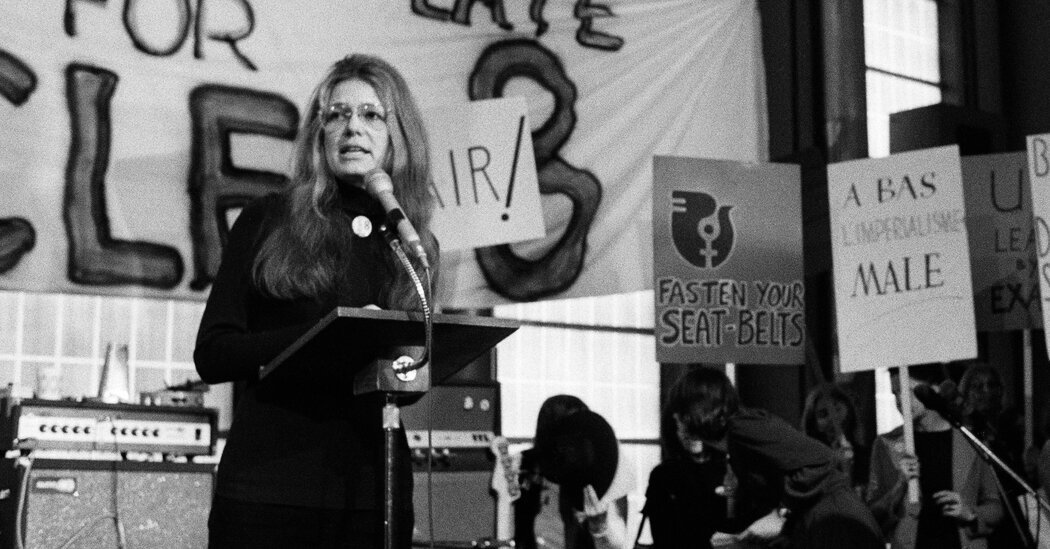
Gloria Steinem, the feminist crusader who, in galvanizing the modern women’s movement, helped millions of women develop a sense of self-worth and gain a measure of equality at home, at work and in society at large, died on Wednesday in New York City. She was 92.
Her death was announced in a post on social media, which did not give a cause. It said Ms. Steinem had died peacefully at home, surrounded by loved ones.
Calling herself “an entrepreneur of social change,” Ms. Steinem helped usher in sweeping cultural transformations across virtually every facet of American life, from the boardroom to the courtroom to the bedroom.
For more than half a century, she personified the women’s movement and became its most enduring symbol; her tinted aviator glasses and curtain of streaked-blond hair parted in the center made her one of the most recognizable women in the world.
She was an unlikely revolutionary. Growing up a transient in the Midwest, she was 10 when her parents divorced and she was left to mother her mentally anguished mother — a formative experience that reverberated throughout her life. She had scant formal education until sixth grade; her big dream, as a budding tap dancer, was to become a Rockette.
But she read voraciously, graduated from college with honors and believed fiercely that women should be able to live whatever life they chose.
Her own feminist awakening didn’t come until her mid-30s, when, as a journalist in 1969, she attended a “speak out” of women discussing their illegal abortions. Charismatic, articulate, media savvy, deeply empathetic and a workaholic, she evolved into a political and cultural force.
She led protests and consciousness-raising sessions, wrote essays and delivered speeches, delved into political organizing, helped establish rape crisis centers and shelters for battered women, founded numerous groups that promoted women and had the Midas touch when it came to raising money for their causes.
And she and a cadre of feminists had the audacity to start a publication that flew in the face of traditional women’s magazines, examining topics like abortion, domestic violence and equal pay for equal work. The first glossy national periodical to be created, owned and run entirely by women, Ms. magazine, founded in 1971, sought to capture and channel a rising sense of female empowerment and eradicate the sexist assumptions that permeated the culture.
The magazine served as the movement’s manifesto, an incubator for social transformation and a blueprint for action. As such, it helped embolden women as they fought blatant discrimination and harassment in the workplace and unspoken oppression, and sometimes outright abuse, at home.
“When we started, there was not even a term for sexual harassment,” Ms. Steinem often said. “It was just called life.”
Decades after the movement dissipated and progressive women faced renewed setbacks, Ms. Steinem continued to push for their rights and equality. Indefatigable, she wrote essays and lectured into her 90s, and the news media never stopped seeking her opinion. She was the author of nearly a dozen major nonfiction books; her latest, “An Unexpected Life,” is scheduled for publication in late September.
Despite her fearless public persona, Ms. Steinem was somewhat diffident, initially terrified of speaking in public and wrestled with a lack of self-esteem.
She was also insecure about her looks. She said in an interview for this obituary in January 2026 that she wore her large aviator glasses and cloak of long hair partly to hide her face. “What I felt like inside,” she wrote in “Revolution From Within,” her 1992 book about self-esteem, “was a plump brunette from Toledo, too tall and much too pudding faced.”
Even as she personified the women’s movement, Ms. Steinem defied the stereotype of “women’s libbers” as sexless, humorless and dateless. She led a glittering social life and enjoyed relationships with many high-voltage men, including Mike Nichols, the director, and Mort Zuckerman, the real estate and publishing mogul. In the 2026 interview, she called Franklin A. Thomas, the pathbreaking president of the Ford Foundation, the love of her life, the man with whom she felt most in sync.
But she spurned marriage (mostly) and remained child free, a choice she said she never regretted.
“Not for a millisecond,” she said at 82. “Not everybody with a womb has to have a child, like not everybody with vocal cords has to be an opera singer. It’s a choice, and it’s a wonderful choice, but if everybody has to do it, it’s no longer a choice.”
Her lifestyle and unapologetic feminist beliefs made her a lightning rod, adored (though not always) by liberals, demonized (always) by conservatives. She and other single women were caricatured as man-hating, bra-burning lesbians intent on upending the social order and destroying the American family. When Ms. Steinem appeared on “Larry King Live” in 1990, a female caller memorably told her to “rot in hell” for what she had wrought.
Much of the hostility toward her was public and overt — especially with the rise of the religious right and the conservative activist Phyllis Schlafly — but it was also woven into the fabric of her everyday life.
While the male-dominated news media all but anointed Ms. Steinem as the movement’s spokeswoman (to the annoyance of its many other leaders and of the decidedly anti-hierarchical Ms. Steinem herself), it simultaneously patronized and marginalized her as a rebel with a pretty face.
When she was first job-hunting in New York, an editor at Life turned her away. “We need a reporter,” he told her, “not a pretty girl.” An editor at The New York Times Magazine propositioned her, she said. Clay Felker, the editor of New York magazine and Ms. Steinem’s mentor, said he gave her an assignment because she had “great legs.”
She broke through with a witty exposé, “A Bunny’s Tale,” for Show magazine in 1963. Squeezing into a too-small, electric-blue satin corset, with a bow tie at her throat and a pair of satin rabbit ears bobbing on her head, she worked undercover as a cotton-tailed waitress at the Playboy Club in New York. Her article was praised for revealing the degrading work conditions in that male-fantasy cocoon. But she regretted writing it, for a time anyway, because some used it to dismiss her as frivolous.
One was the journalist Gay Talese. In her 2015 memoir, “My Life on the Road,” Ms. Steinem recalled that Mr. Talese said of her in 1964: “You know how every year there’s a pretty girl who comes to New York and pretends to be a writer? Well, Gloria is this year’s pretty girl.”
But it was as a writer — journalist, columnist, essayist, author — that Ms. Steinem made her name. She also had a knack for pointed aphorisms.
“The truth will set you free,” she liked to say, “but first it will piss you off.” (Variations on this theme have existed since the Bible; Ms. Steinem popularized this one and used it as the title of a 2019 collection of essays.)
Another: “Self-esteem isn’t everything — it’s just that there’s nothing without it.”
One of her best-known quips was about aging.
When a reporter remarked, “Oh, you don’t look 40,” she responded with characteristic bluntness: “This is what 40 looks like! We’ve been lying for so long, who would know?”
Some of the achievements of the women’s movement — greater economic independence, more legal rights and protections, inroads into all levels of virtually every profession, more men sharing domestic responsibilities — may be taken for granted today. But they were unimaginable when the movement began.
And for Ms. Steinem and many others, that struggle never ended.
Women still earn less than men for the same work (81 cents for every dollar made by a man, according to the 2024 census). The Equal Rights Amendment, prohibiting discrimination on account of sex, was belatedly ratified but is still not part of the Constitution. The 1973 Supreme Court decision legalizing abortion, a central goal of the movement, was overturned in 2022; some states went on to reverse or curtail other hard-won reproductive rights. No woman has been elected president. Anti-female bias remains entrenched.
“I feel proud, and I feel mad as hell,” Ms. Steinem told The Times in 2022. “We are still dealing with the same issues.”
‘The Big Click’
Ms. Steinem, who grew up in the Midwest, began her career in New York as a freelance writer in 1960. By 1968, she had become a co-founder of New York magazine. Writing a monthly political column, “The City Politic,” she found her voice.
Her column led to political advocacy. She marched with Cesar Chavez, the head of the United Farm Workers, who was revered until reports emerged in 2026 that he had sexually abused girls and women. She served as treasurer of the legal defense fund for Angela Davis, the revolutionary Black feminist who was in prison awaiting trial for murder, and was later acquitted. Ms. Steinem supported Norman Mailer in his losing campaign for mayor of New York in 1969 and briefly considered running for city comptroller on the ticket with him. (Despite Mr. Mailer’s notorious sexism, she did not regard him at that point as an enemy of the women’s movement.)
She was jolted into feminism that year when she reported on a group of women in Greenwich Village discussing their illegal abortions. Angered that they had been made to feel like criminals, Ms. Steinem, who had had a secret abortion in England in 1957, wrote her first openly feminist essay, titled “After Black Power, Women’s Liberation.”
At that moment, she viewed herself as part of something bigger than herself. “It was the big click,” she said in “Gloria: In Her Own Words,” a 2011 HBO documentary. “It transformed me.”
Her essay appeared just as the women’s movement, sparked by Betty Friedan’s “The Feminine Mystique” (1963), was gaining steam. The book, which alerted society to women’s frustrations and stifled ambitions, was an instant best seller.
Three years later, Ms. Friedan co-founded the National Organization for Women, whose statement of purpose said, “The time has come for a new movement toward true equality for all women in America.”
Women were second-class citizens, with few legal rights, little financial independence and no autonomy over their bodies. They needed a man’s signature to get a credit card or a bank loan. States had a “marital exemption” that allowed a husband to rape his wife without fear of legal consequences.
In 1971, a powerhouse group of feminists — Ms. Friedan, Ms. Steinem, Representatives Bella Abzug and Shirley Chisholm, both Democrats from New York, and others, including Jill Ruckelshaus, a prominent Republican activist — founded the National Women’s Political Caucus to advance the Equal Rights Amendment and elect women to public office.
Activist women were starting to gather in small groups all over the country, including at Ms. Steinem’s shared one-room walk-up apartment on the Upper East Side of Manhattan. (She eventually bought the unit, which occupied the second floor of an 1880s brownstone; she acquired other floors over time and lived there for the rest of her life.)
It was in her living room that she held some of the first organizational meetings for Ms. magazine. She and several like-minded women wanted to create a publication that would speak to women’s lives in a way that the women’s magazines, devoted mainly to tips on beauty, how to catch a man and 25 exciting ways to make a hamburger, did not.
The magazine’s founders did not invent the term “Ms.,” an honorific that signified a woman’s individual identity regardless of her marital status. It had been seeping slowly into usage since the early 1900s. But by branding their magazine with it, they elevated the title into the nation’s lexicon and gave women a calling card.
The first issue was published in December 1971 and ran as an insert in the year-end issue of New York, thanks to Mr. Felker, who financed and promoted it.
The first full stand-alone issue came out in January 1972, again with Mr. Felker’s backing. The cover article, “The Housewife’s Moment of Truth,” explored the conflicts inherent in juggling work and home life. It also notably featured a signed list of 53 well-known women who acknowledged that they had sought illegal abortions — among them, the tennis star Billie Jean King, the singer Judy Collins, the playwright Lillian Hellman and the historian Barbara Tuchman.
Though the magazine appeared on newsstands in January, it was labeled “Spring” so that if it didn’t sell, it wouldn’t look stale. But all 300,000 copies sold out in eight days, thousands of letters from grateful readers poured in, and Ms. began publishing monthly that July.
Skeptics abounded. Harry Reasoner, a prominent television news anchor, dismissed the whole enterprise, saying, “I’ll give it six months before they run out of things to say.” (He subsequently apologized.) President Richard M. Nixon denigrated the term “Ms.,” wondering aloud to Henry Kissinger, “How many people really have read Gloria Steinem and give one shit about that?”
The magazine attracted prominent writers, including Alice Walker, Adrienne Rich, Toni Morrison and Vivian Gornick. It covered a range of topics, including sisterhood, gender-neutral child rearing, battered wives and maternity leave. It rated political candidates by their stands on issues that were important to women.
For a time, Ms. thrived. But the expanding women’s movement — never a monolith — splintered into factions and faced backlashes (see the divisive feminist sex wars over pornography in the 1980s). Schisms divided the magazine, too. Anger was often directed at Ms. Steinem, whom some saw as a fence-sitter, trying to please everyone. More radical women and some women of color found the magazine wishy-washy and not inclusive enough, and they broke away.
Among the messier dramas of the period was one that developed between Ms. Friedan and Ms. Steinem.
The two shared certain goals, including equal pay, more women in public office and legalized abortion. But Ms. Steinem also sought broader cultural and social change that included liberating women from media stereotypes and recalibrating the power dynamic between men and women. Significantly, she also wanted to expand the movement beyond the white, middle-class housewives of its early days — those inspired by “The Feminine Mystique” — to include younger women, working women and women of color, as well as lesbians and other marginalized groups.
Ms. Friedan saw the focus on sexual politics as a distraction and famously warned that including lesbians (the “lavender menace”) threatened the movement’s goal of achieving mainstream acceptance. (She later supported lesbian rights.)
But the real tension between them was personal. Ms. Friedan, 13 years older and widely acknowledged as the “mother” of second-wave feminism (the first wave was driven by suffrage), was being eclipsed by the more popular and photogenic Ms. Steinem, a media darling, and Ms. Friedan resented it.
“There is more than one voice in this movement,” Ms. Friedan said icily at one point. She began attacking Ms. Steinem publicly, calling her a feminist “chauvinist,” accusing her of trying to profit from the movement and dismissing her abilities, saying: “The media tried to make her a celebrity, but no one should mistake her for a leader.”
Ms. Steinem told HBO in 2011 that Ms. Friedan had resented “anybody who threatened her ownership of the movement.” Ms. Friedan, she said, “didn’t really identify down, she identified up,” ignoring the needs of poorer, working-class women.
Their souring relationship was examined by Nora Ephron in a 1972 essay in Esquire that depicted Ms. Friedan as unhinged by her jealousy of Ms. Steinem, to the point that she no longer cared how her animosity hurt the movement.
Ms. Ephron, squarely on Team Steinem, cast Ms. Friedan as being on the wrong side of history.
Gloria Marie Steinem was born in Toledo, Ohio, on March 25, 1934, the daughter of Leo and Ruth (Nuneviller) Steinem. Her free-spirited father, whom she adored, was a peripatetic antiques dealer, a big dreamer with no money.
“He was always going to make a movie, or cut a record, or start a new hotel, or come up with a new orange drink,” Ms. Steinem told Time magazine in 1969.
For years, the family spent summers in Clarklake, a tiny rural town in southern Michigan, where her father ran a small dance pavilion and booked musical acts. When fall came, they traveled to warmer climes in a house trailer, stopping in towns along the way while her father peddled antiques.
Ms. Steinem grew up an itinerant with no full year of formal schooling until sixth grade. She said she learned to read from road signs along the highway and buried herself in books.
Her mother had been one of the first female reporters and editors at The Blade of Toledo. She loved the work and had continued doing it for a decade after marriage — after all, someone had to pay the bills. She also had an affair, and then a nervous breakdown, became addicted to a sedative and spent two years in a sanitarium, all before Gloria was born.
When Gloria was about 10, her parents divorced, and her 19-year-old sister, Susanne, left for Smith College in Massachusetts. Gloria and her mother moved into a condemned farmhouse in East Toledo where Ruth had once lived. Gloria’s life was consumed by caring for her mother, by then a meek and fearful woman who was addicted to sodium thiopental. She was “an invalid,” Ms. Steinem later wrote, “who lay in bed with eyes closed and lips moving in occasional response to voices only she could hear; a woman to whom I brought an endless stream of toast and coffee, bologna sandwiches and dime pies.”
Gloria shopped, prepared meals and tended to Ruth for seven years, until her senior year of high school, when they sold the house, saving the money for Gloria’s college tuition. Gloria spent her senior year living with her sister in Washington, D.C., while Ruth went to California, where she was cared for by her ex-husband.
While Gloria’s formal education had been severely lacking, she compensated for it by devouring books and reveling in words and ideas. She followed in her sister’s footsteps to Smith (also Ms. Friedan’s alma mater), where she majored in government. She graduated magna cum laude and Phi Beta Kappa in 1956.
Caring for her mother shaped much of her life, consciously and otherwise. This included her decision not to rush from New York to her father’s side in California after he was in a serious car accident in 1961.
“I felt a cold stab of fear that if I went to California, I would become my father’s caretaker, as I had been my mother’s — and never come back to my own life,” she wrote in her memoir. By the time she realized he was dying, it was too late. “I will never stop wishing I had been with him,” she wrote.
Her dysfunctional youth — mothering her mother — also colored her view of marriage and children, both of which she viewed as a trap. That fear kept her from settling down. By her own estimate, she spent half of her life on the road for more than four decades.
She kept quiet about the trauma of her childhood for years. Given her upper-crust manner of speaking and precise diction, she sounded like a child of privilege; in fact, she lived in fear of hitting the skids at any moment.
“I had always worried that I might have inherited something,” she told The New Yorker. “That I’d start disappearing into the street in my nightgown, the way she had.”
To India and Back
During her senior year of college, Ms. Steinem planned to marry her boyfriend, but then decided against it. She would have been settling down and having children, she realized, only because that was what society expected.
She said in the 2026 interview that she saw marriage “not as a beginning but as an end”— an end to her identity, an end to whatever she might want to do with her life. She left her engagement ring under her fiancé’s pillow — “This was not an act of courage,” she said — and “fled,” in her words, to India in early 1957.
On her way, she stayed in London while awaiting her visa and discovered that she was pregnant. She managed to get an abortion. The alternative, she said, would have been going home, marrying the wrong person and living a life that wasn’t hers.
She was drawn to India, just a decade into its independence, by the legacy of Mahatma Gandhi. She had won a Chester Bowles Asian fellowship to study there, but she quickly abandoned her classes. Wearing a sari and carrying only a towel, a cup and a comb, she walked through southern India with followers of Gandhi, absorbing lessons about “talking circles” and grass-roots organizing.
After returning to the United States, she spent a year in Cambridge, Mass., as a director of the Independent Research Service, a nonprofit educational foundation that recruited and provided government support for American students to attend Communist-run youth festivals in Europe. The magazine Ramparts subsequently reported that the foundation had been partly funded by the Central Intelligence Agency, and Ms. Steinem came under criticism from the left. She dismissed the entire venture as harmless, telling The Times in 2016 that no one in the C.I.A. had ever told her what to do or say and that she had never reported to the agency.
She moved to New York in 1960 and began working as a freelance journalist. At the time, women were not taken seriously as writers; she wanted to cover politics but was stuck with celebrity profiles and fashion.
Still, she was prolific. Her articles appeared in Vogue, Cosmopolitan, Esquire, Family Circle and Life, among other magazines. She was a contributing editor at Glamour and New York.
As her profile rose and she became increasingly visible, she wrestled with an unexpected problem: an almost pathological fear of public speaking. She dreaded standing at a podium alone, afraid that her mouth would go dry. Her solution was to bring speaking partners with her. One was Dorothy Pitman Hughes, a forceful activist who ran a child-care center and expounded on issues of race, class and motherhood in roiling debates about feminism. A 1971 photograph of the two, their fists raised in solidarity, became an iconic image of the era.
At the same time, Ms. Steinem moved comfortably in the sophisticated milieu of New York’s intelligentsia and dated powerful men. In addition to New York stars like Mr. Nichols, Mr. Zuckerman and Mr. Thomas, they included J. Stanley Pottinger, a prominent civil rights lawyer in the Nixon and Ford administrations. Most remained her devoted friends and public supporters long after the romances faded.
In 2000, Ms. Steinem overlooked her antipathy toward marriage and wed David Bale, a social justice activist born in South Africa (and the father of the actor Christian Bale). She was 66. She initially denied rumors that she had married him because he needed a green card, but years later conceded that this had been the case. The marriage lasted for three years before he died in 2003, at 62, from brain lymphoma.
Ms. Steinem had faced her own recurring battle with cancer (breast), starting in 1986, after which she suffered from total exhaustion and depression and underwent psychoanalysis. She then spent several years writing and rewriting “Revolution From Within: A Book of Self Esteem.”
It was her first long public look at herself, and it disappointed some feminists, who saw her introspection as a retreat from much-needed social activism. The writer and editor Deirdre English, reviewing it for The New York Times Book Review, wrote: “The strategic vision of social revolution here has all but been replaced with a model of personal recovery.”
Interviewers were nonplused that a woman as seemingly self-confident and purposeful in public as Ms. Steinem was beset by a lack of self-esteem.
“I was a neglected child, so I guess I didn’t think I existed,” she explained to the BBC. “And if you’re treated badly, you come to feel you’re a bad person, and to some extent, even a very good thing like being a social activist can be a drug, you know, that keeps you from going back and looking at yourself. You keep trying to fill up this emptiness, which, of course, can’t be filled up with anything external.”
“Revolution From Within” wasn’t the only time that she disappointed her natural allies.
Over the years, her defense of Bill and Hillary Clinton landed her in political hot water. In an opinion column in The Times in 1998, she defended President Clinton against numerous sexual allegations, saying that his advances toward various women had not been unwelcome or coercive.
She enraged many again during the 2016 Democratic presidential primaries, when she said in a television interview that young women were supporting Senator Bernie Sanders of Vermont over Mrs. Clinton because “when you’re young, you’re thinking, ‘Where are the boys? The boys are with Bernie.’” She eventually apologized and said she had misspoken.
Writing and Organizing
Ms. Steinem devoted much of her life to writing. One of her best sellers was “Outrageous Acts and Everyday Rebellions” (1983), her first collection of essays. Other books included “Marilyn: Norma Jean” (1986), a sympathetic portrait of Marilyn Monroe, whom she found fascinating in her vulnerability and complexity, and “Doing Sixty and Seventy” (2006), a reflection on women and aging.
She hated wasting time and rarely did. Having cared for her mother for so long, she said, she felt a compulsive need to be useful. But as a writer, she said, she should have challenged herself more.
“I continued for too long to do things that I already knew how to do,” she told HBO. “Or to write stories that I was assigned instead of fighting for stories that I couldn’t get, or doing ones that I thought were important on my own. The wasting of time is the thing I worry about the most. Because time is all there is.”
But writing, she knew, was not a waste of time. “Writing is the only thing that, when I do it, I don’t feel I should be doing something else,” she said.
She spent a great deal of time tending to Ms. magazine. It reached its peak circulation in 1989, with 540,000 subscribers, but its finances were constantly in peril, and it went through a series of owners. In less than a decade, its circulation fell to 200,000, and the owner threatened to close it.
That was more than Ms. Steinem could bear. Cobbling together a group of venture capitalists and entrepreneurs, she formed Liberty Media for Women, which acquired Ms. for $3 million. In 2001, the Feminist Majority Foundation took over and kept the magazine alive, though its influence — and its brand of feminism — had waned significantly; the magazine now publishes quarterly.
Over time, Ms. Steinem traveled less, and her apartment became more of a home. For years, it was simply a place where she dropped her suitcase. But after she acquired another floor in the brownstone, she brought in comfortable furniture, painted the walls a deep, warm yellow and festooned the space with accent pillows. She covered nearly every available inch with framed photographs, posters and memorabilia, making her walls a showcase of a life spent on the front lines of the women’s movement. Architectural Digest published a feature on her home in 2024.
“Gradually, the rooms that I had used mostly as an office and a closet were filled with things that gave me pleasure,” she wrote in her memoir. “I had a kitchen that worked, a real desk to spread papers on, and a welcoming room where visiting friends could stay, something I’d always wanted as a child when I was living with my mother in places too sad to invite anyone.”
Ms. Steinem is survived by what she called her “chosen family” — her close friends. Her mother died in 1981, and her sister, Susanne Steinem Patch, in 2007.
Her home is part of her permanent legacy. Ms. Steinem put it in a trust with Gloria’s Foundation, which acquired another floor of the brownstone, so that women could continue to meet, organize, write and stage “talking circles” there, as Ms. Steinem often did. The foundation’s website says that the home and its contents will remain “a living organ of the feminist movement.”
That movement was repeatedly declared passé during Ms. Steinem’s lifetime. Nevertheless, she persisted.
“At my age, in this still hierarchical time, people often ask me if I’m ‘passing the torch,’” she wrote in “Outrageous Acts and Everyday Rebellions.” “I explain that I’m keeping my torch, thank you very much — and I’m using it to light the torches of others.”
Deirdre Carmody contributed reporting.