Lead Editor – Newsgathering
The Caribbean’s oceans are deeply connected to the lives of the people who call this region home. That connection is both historic and contemporary. Nobel laureate Derek Walcott famously wrote that “the sea is history” when speaking about these islands. Today, the oceans continue to play a crucial role in Caribbean life, sustaining food security, fisheries, tourism and transportation.
Yet, few people give much thought to what lies thousands of metres beneath the surface, and even fewer truly understand what exists on the Caribbean seabed.
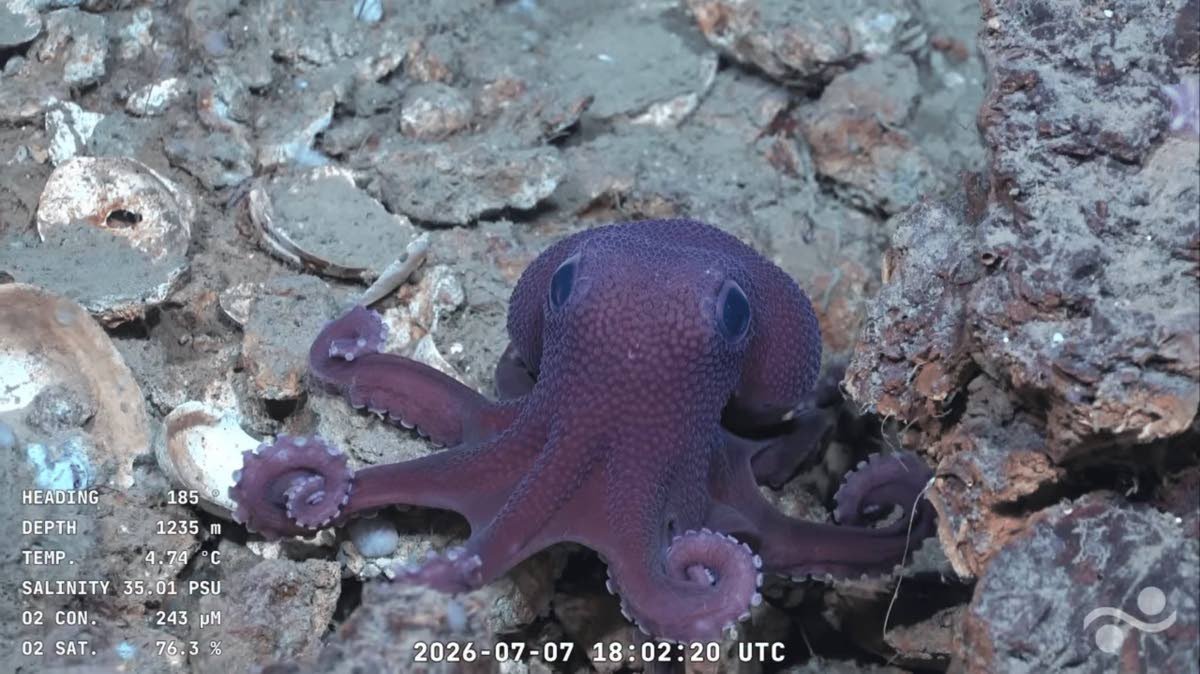
In July, a deep-sea expedition led by Trinidad and Tobago marine biologist Dr Diva Amon gave the country an unprecedented glimpse into ecosystems that had rarely, if ever, been seen. Scientists descended thousands of metres below the surface, exploring what was once considered a dark and largely unexplored frontier. The expedition transmitted images of remarkable biodiversity, including a previously unknown deep-sea octopus draped in shades of purple and several other fascinating species.
At the same time, more than 1,000 miles away in Kingston, Jamaica, governments gathered for the 31st Council meeting of the International Seabed Authority (ISA) to debate a very different future for the deep ocean: whether, and under what conditions, its mineral resources could one day be mined.
With major issues still unresolved, including environmental safeguards, liability, compliance, scientific uncertainty and benefit-sharing, the council once again failed to agree on a final deadline for completing deep-sea mining regulations. Pressure nevertheless remained to complete the rules in a “timely” manner.
The decision meant there is no fixed political deadline that could force countries to approve incomplete regulations. However, the council did not introduce additional safeguards or preconditions that would need to be met before exploitation contracts could be considered.
As a council member, T&T pushed for stronger legal requirements governing inspectors, including provisions on confidentiality, impartiality and restrictions on financial interests in mining operations. The country also sought clearer obligations for contractors to supervise subcontractors and remain accountable for the goods and services they procure. In addition, T&T helped lead discussions aimed at preventing monopolisation of activities in the international seabed area.
With countries such as T&T and Jamaica sitting on the council, it is important to recognise that Caribbean states are not merely observers in the deep-sea mining debate. As ISA members, they are helping to shape the rules that could determine whether the industry is eventually approved and, if so, how it operates.
Why should T&T care?
Physically, deep-sea mining remains a distant prospect for T&T and much of the Caribbean, despite the ISA being headquartered in the region. At present, industry attention is focused on the Clarion-Clipperton Zone in the Pacific Ocean, where efforts are centred on mining in international waters.
This raises an important question: Why should the Caribbean care about an industry that may never operate within its own waters?
The answer is simple. The regulations now being developed will determine whether and how deep-sea mining proceeds globally. It is therefore critical that Caribbean priorities, concerns, safeguards and potential benefits are reflected in the decisions shaping the industry.
Khadija Stewart, senior campaigner at Rise Up for the Ocean, said although the Caribbean is not currently being targeted for deep-sea mining, the region should still be concerned.
“There have been no polymetallic nodules found in the Caribbean, so deep-sea mining is not currently targeted to take place here,” she explained.
“However, there are hydrothermal vent systems along the Mid-Atlantic Ridge that can be associated with mineral-rich sulphide deposits containing metals such as copper, zinc, gold and silver.
“As we know from history, once you start an industry, it can create a domino effect with potentially devastating environmental impacts. It becomes a race to mine, and more countries and companies are going to want a piece of the pie.”
That warning was echoed by T&T’s former permanent representative to the ISA, Deryck Murray.
“Once mining starts, it’s going to be a free-for-all,” Murray told the Sunday Guardian.
“Economic interests and material value take over, and you can’t turn that back.
“Look at quarrying on land. Look at countries struggling to preserve their natural resources. We are already seeing species such as tigers and sharks becoming extinct. How do you reverse that? If you open the door and say, ‘Let’s start digging up the seabed,’ how do you stop it if, 10 years later, we realise it was the wrong decision?”
The question inevitably arises: Is this another case in which history could repeat itself, much like the fossil fuel industry?
Murray, who also served as T&T’s high commissioner to Jamaica, acknowledged that some countries see deep-sea mining as a potential development opportunity. However, he stressed that comprehensive regulations must first be established.
Achieving a unified Caribbean position, however, may prove to be one of the region’s greatest challenges. Asked whether Caribbean leaders could find common ground on the issue, Stewart said the region remains divided.
“Every Caribbean country is approaching deep-sea mining from its own national priorities,” she said. “Some are calling for a moratorium, others support a precautionary pause or precautionary approach, while others are focused on completing the regulations because they believe the industry is coming and the region needs to be prepared.
“That range of positions makes it harder for the Caribbean to engage collectively and speak with a stronger regional voice on how we protect an ocean that does not recognise national borders.”
Minister: Data will guide approach
Giving some insight into the Government’s position on deep-sea mining legislation, Minister of Planning, Economic Affairs and Development Dr Kennedy Swaratsingh insisted that any legislative framework must be guided by evidence.
“We have to look at what the data really tells us,” he said. “There is often an assumption that certain industries will have a deleterious effect. We need to find an approach where development and environmental protection can coexist.
“Far too often, we assume that one interest must be sacrificed for another to thrive. The approach this administration has always advocated is balance.”
The Caribbean’s ocean future thus hangs in the balance. Between dazzling scientific discoveries and looming industrial ambitions, what was once out of sight is becoming increasingly difficult to ignore. Whether nations choose precaution or exploitation, the decisions made today will echo for generations.
For Stewart, the issue ultimately comes down to the legacy the Caribbean chooses to leave behind. “How are we willing to seal the region’s fate?” she asked.
“As a place where deep-sea mining was approved to benefit a select few, or as a region that protected the deep ocean and all the ecosystem services it provides?”
Protecting history, biodiversity and livelihoods may ultimately prove to be the Caribbean’s greatest test beneath the waves.