Senior Reporter
Defence Minister Wayne Sturge has confirmed that this year’s Independence Day Parade will proceed as planned despite a series of bomb threats that placed security agencies across Trinidad and Tobago on high alert on Wednesday.
The Trinidad and Tobago Police Service (TTPS) and Trinidad and Tobago Fire Service (TTFS) responded to 11 bomb threats across the country, including threats targeting eight magistrates’ courts from Sangre Grande to Point Fortin, Valpark Plaza, the Ministry of Rural Development and Local Government in Port-of-Spain, and the Judicial Complex in Bacolet, Tobago.
The threats were received between 1 pm and 1.40 pm and triggered an immediate emergency response from both agencies.
Asked yesterday whether the parade would still take place in light of the incidents and the ongoing State of Emergency, Sturge replied: “Yes.”
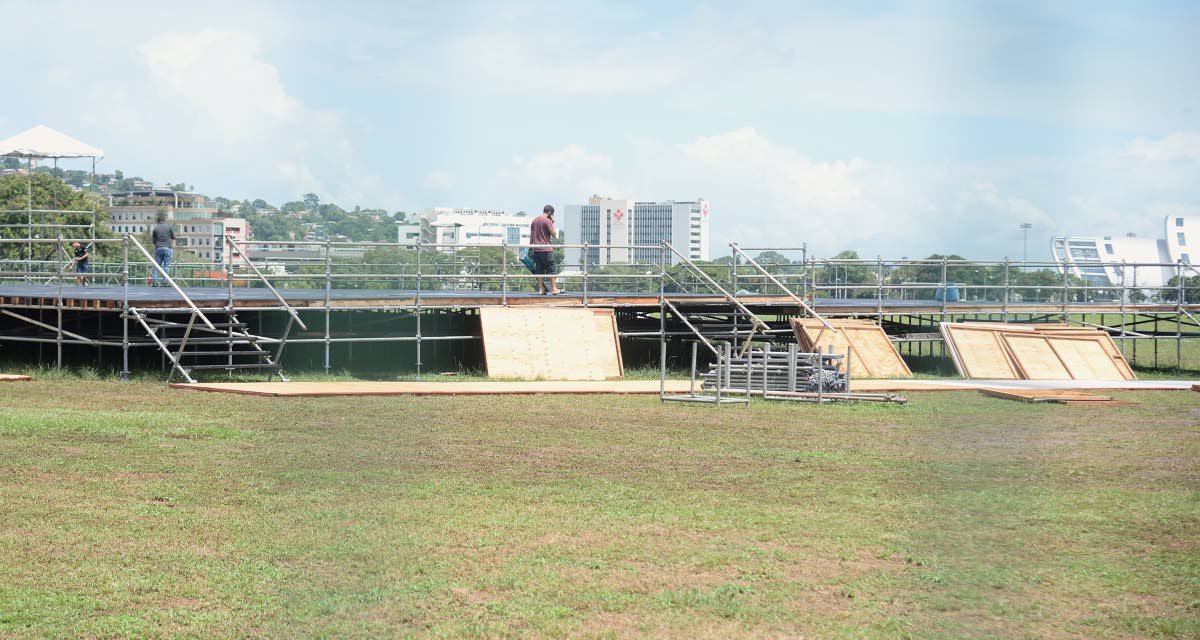
The minister also dismissed concerns that the relocation of this year’s parade to the northern end of the Queen’s Park Savannah could damage the environmentally sensitive area.
The event is being moved from its traditional location at the Grand Stand on the southern side of the Savannah to a new site facing President’s House.
However, the move has sparked concerns about the impact of the works on the Savannah, including claims that a major natural aquifer lies beneath the area and could be affected.
Asked specifically about concerns regarding infrastructural damage and the potential impact on the aquifer, Sturge said simply: “They needn’t worry.”
He was also asked whether the paved area being created for the parade would be removed after the Independence Day celebrations.
“Yes,” he responded.
Lee Sing voices opposition
Former Port-of-Spain mayor Louis Lee Sing, however, has strongly criticised the decision.
Speaking with Guardian Media yesterday, Lee Sing described the relocation as unacceptable, arguing that the Savannah is one of the last major green spaces remaining in the capital city.
“Like all serious-minded citizens of this country, I must have concerns about what is proposed and what is now being executed for the parade in the uppermost part of the Queen’s Park Savannah,” Lee Sing said.
He argued that the country was doing itself “irreparable harm” by using the Savannah for the parade and questioned whether the temporary works would actually be removed once the event is over.
“It is one thing to pave or to pitch or to throw blue metal on the surface of the Savannah, and it’s another thing to take it up,” he said.
“I do not believe they are going to take it up. Once they put it down, as they have done with the North Stand, they are going to leave it on the ground.”
Lee Sing also questioned whether the relocation aligns with the original intent governing the use of the Savannah.
He said that, based on a document he has seen relating to the land, the area was intended to remain an open space where members of the public could recreate and exercise.
According to Lee Sing, the original charter envisioned a field free of erected structures, although he acknowledged that successive administrations had constructed facilities, including the Grand Stand and North Stand. Nevertheless, he argued that those developments should not be used to justify further permanent alterations to the Savannah.
He further maintained that there is no requirement for the Independence Day Parade to be held at the Savannah and suggested several alternatives, including King George V Park or a temporarily designated section of the Mucurapo Foreshore.
Lee Sing said traffic management measures could be implemented to facilitate the parade at another venue without disturbing the Savannah.
“My feeling is that nobody has thought out an alternative to the Savannah because they feel that that’s where the parade should be. But that is not where the parade should be,” he said.
He added that the issue extends beyond this year’s Independence Day celebrations, arguing that the Savannah must be preserved for future generations.
Lee Sing said the space should remain available for children to play cricket and football, fly kites and enjoy one of Port of Spain’s most important recreational and green areas.
“These are considerations that must be more costly considerations than wanting to have the soldiers and the sailors and the parade in the Savannah at the expense of all those other things,” he said.
He also urged citizens who share his concerns to speak out against what he described as the “paving of the Savannah.”
“When they go and pitch that and defile it and desecrate it, God knows what is going to happen, but that is only step one. Are they going to say as step two, we going to erect something else in the Savannah? I think the good citizens, with good intentions, should stand up and say no from now until Independence.”