Ubiquitous retailers lean into food, sports while turning to AI for long game
Since their arrival in South Korea in the late 1980s, convenience stores have operated on a simple logic that more locations bring more customers.
That premise seems to have run its course, however, as reflected in a decline in store numbers from 54,852 in 2024 to 53,266 last year. Sales growth across the four major chains — CU, GS25, Emart24 and 7-Eleven — has slowed in tandem, falling from 8 percent in 2023 to 3.9 percent in 2024 and just 0.1 percent in 2025.
In response, the industry is reckoning with a shift from scale to focus.
“The era of competing on store count alone is over,” said one industry official, adding that the next phase of competition will center on the purpose built into each space.
Food has long been at the heart of convenience stores’ appeal, and as Korean cuisine travels further afield, some are beginning to bring those flavors to the fore.
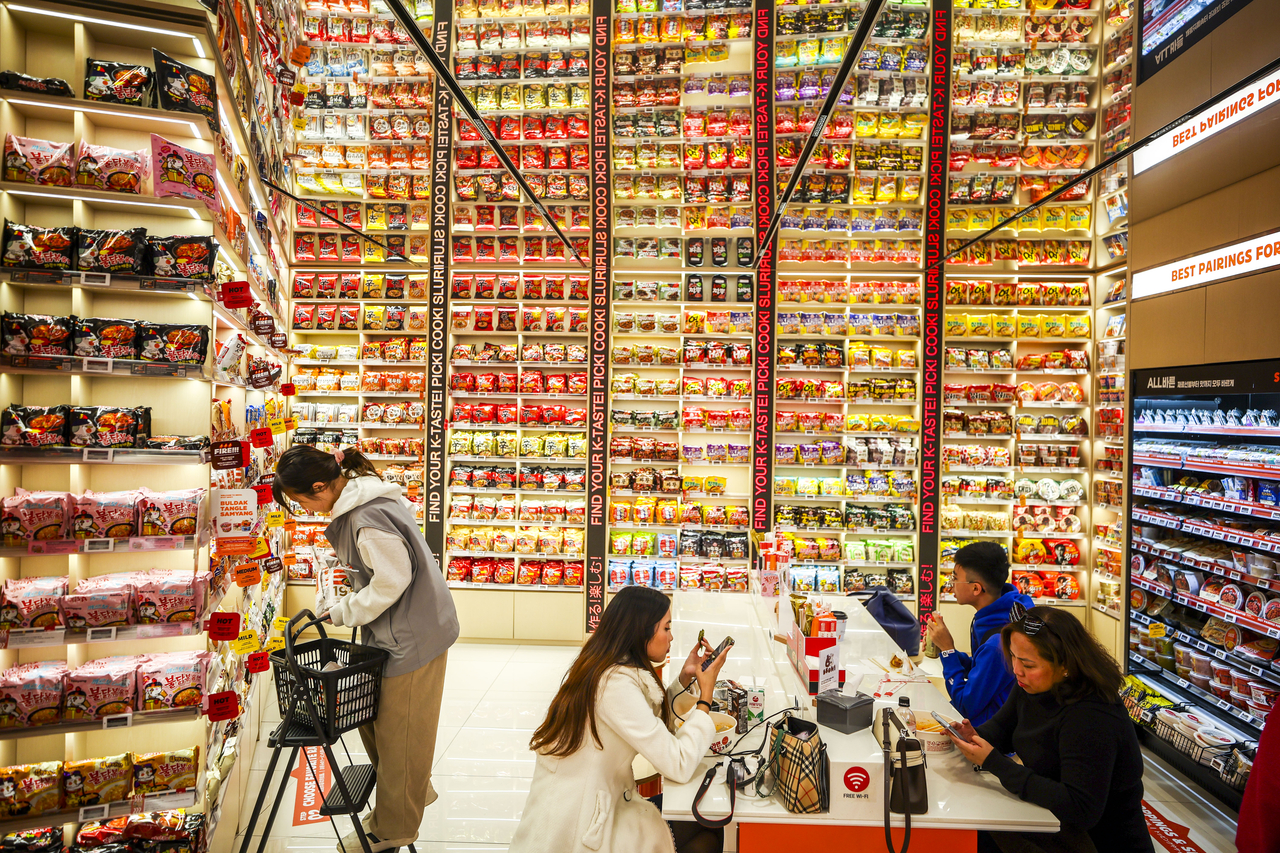
Just last month, Emart24 turned to ramyeon with “K-Food Lab,” a two-story outlet in Myeong-dong, Seoul, conceived as a curated immersion in Korean culture, with a particular focus on noodles.
The first floor houses K-beauty products, K-pop merchandise and K-food gift sets in one space. Upstairs, the store’s most striking feature comes into view: a floor-to-ceiling display stretching 2.8 meters high and stocked with 170 noodle varieties.
Products from major domestic manufacturers sit alongside regional specialties as well as imports from Japan and Indonesia. The noodles are organized by spice level across four color-coded tiers, with signage in Korean, English, Chinese and Japanese.
The company said its selection skews heavily toward packaged ramyeon over cup varieties, for the sake of a more authentic Korean experience. “We wanted to reflect how foreign visitors want to cook ramyeon, the way they’ve seen Koreans do it in dramas,” a company official said.
Away from the tourist-heavy streets of Myeong-dong, Seongsu-dong draws a more trend-conscious crowd where BGF Retail, the operator of the CU convenience store chain, bets on something sweeter.
Seongsu Dessert Park, launched in February, offers a dessert selection roughly 30 percent broader than a standard CU outlet, combining the chain’s top-selling desserts with a dedicated space for customers to assemble their own creations.
Within two months of opening, overseas payment methods accounted for 32 percent of the store’s sales, more than 15 times the nationwide average of 2 percent.
“With global interest in Korean desserts building, the new store underscores CU’s capabilities in product development and trend agility,” said a CU official. “We plan to refine our new dessert offerings and expand exports to markets including Hawaii, Mongolia and Malaysia.”
Sports played, sports followed
Some chains have dared to shed their food-focused identity, instead tailoring stores to activity-driven consumers.
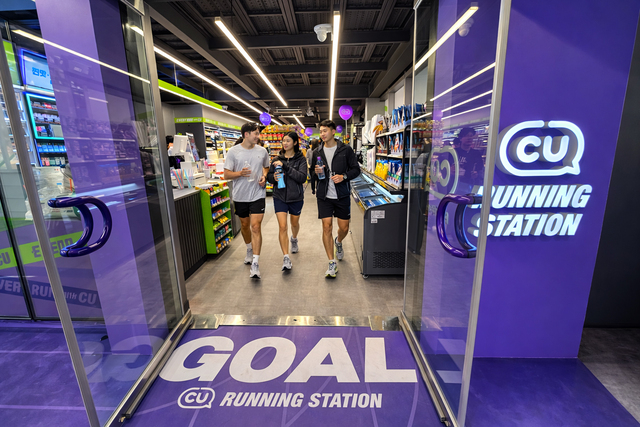
In March, BGF Retail placed a bet on the running boom sweeping Korea’s parks.
Running Station in Han River in Yeouido Park is outfitted not only with the assortment of snacks, but also with lockers, changing rooms and powder rooms for runners on the go.
Running-related products, from energy supplements to protective gear and care essentials, are grouped in a dedicated zone, alongside a sports brand pop-up and a loyalty program that converts mileage into store credit.
As running gathers pace, the company plans to spread the concept across 18 sites along the river, forming a network of hubs along the city’s most popular outdoor route.
If CU is building stations for runners, GS25 is building stadium-like spaces for sports fans.
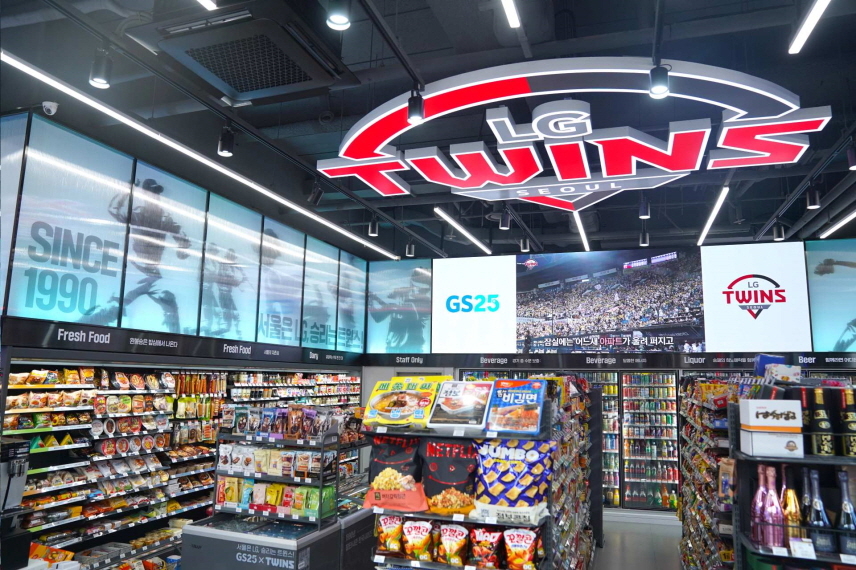
For baseball fans, the company operates two flagship stores themed around the Hanwha Eagles in Daejeon, while a location near Jamsil Baseball Stadium in Seoul has been transformed into an outpost for the LG Twins.
The formula — team colors on the walls, memorabilia on the shelves and highlights on the screen — has proven replicable, and GS25 is applying the same model across football clubs, including Ulsan HD FC and FC Seoul.
“GS25 has been at the forefront of baseball marketing, becoming the first in the industry to open team-themed convenience stores,” a GS Retail official said, adding that it intends to build on that momentum as interest in professional sports grows.
For all the focus on specialty stores, the deeper competition may be unfolding in data centers, with both BGF Retail and GS Retail relying on artificial intelligence to shape what comes next.
Industry officials said AI is essential for convenience store chains in turning data-driven decisions into real performance on the ground.
BGF Retail is pursuing growth through company-wide AI integration.
“We will embed AI capabilities across all areas, including marketing and logistics, and launch company-wide research and development efforts to apply them in practice and deliver tangible results,” said BGF Retail CEO Min Seung-bae at a shareholder meeting in March.
One example is a new AI-powered in-store kiosk that analyzes a customer’s personal color to recommend shades and create customized cosmetics.
GS Retail, meanwhile, is centering its strategy on behavioral data to sharpen decision-making.
“We aim to build a virtuous cycle grounded in real customer behavior data, while expanding investment in AI and digital tools to strengthen our operational competitiveness,” GS Retail CEO Hur Suh-hong said at a shareholder meeting in March.
The company is currently integrating AI-driven systems in store management, including automated ordering for food items.
minmin@heraldcorp.com