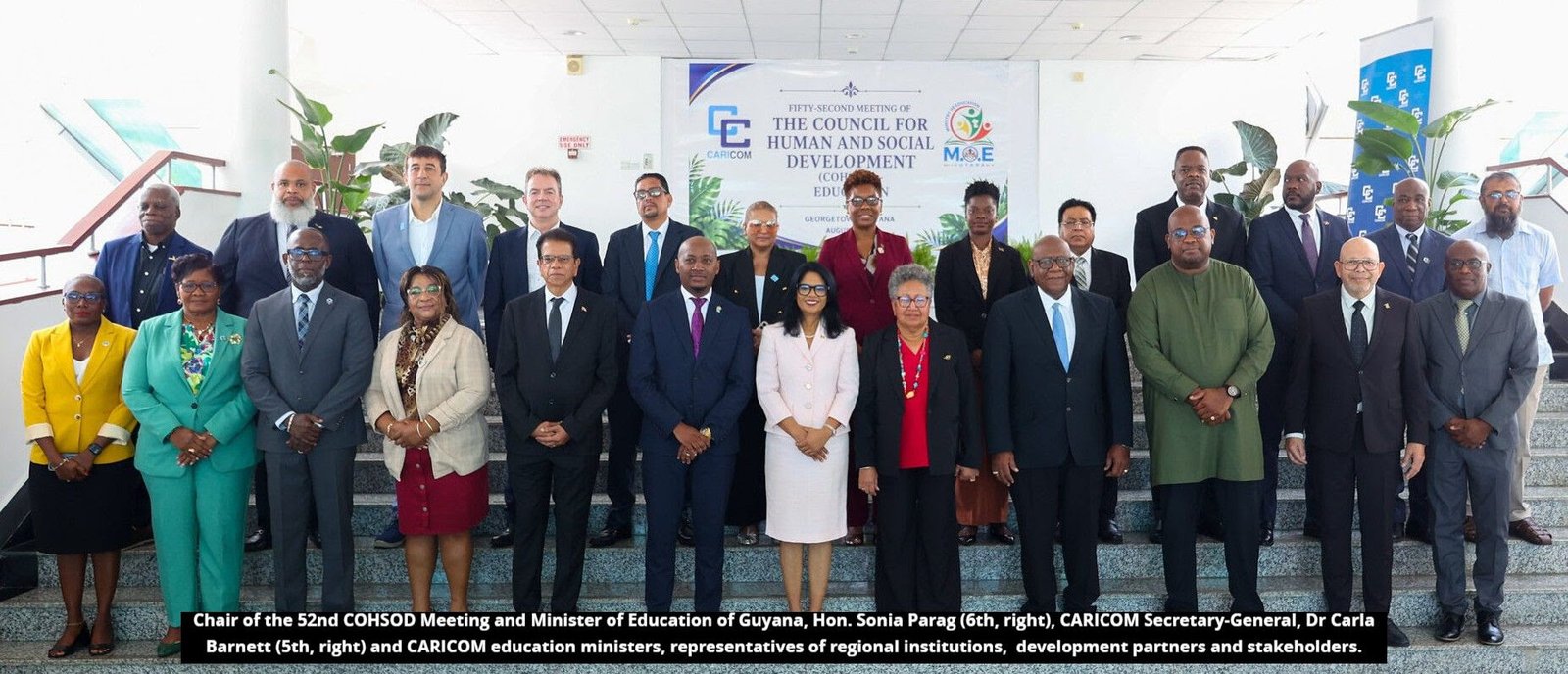

Education must do more than prepare students to pass exams. That was a central message as Caribbean education ministers and regional partners gathered in Georgetown, Guyana, for the 52nd Meeting of the CARICOM Council for Human and Social Development (COHSOD) – Education.
According to a CARICOM press release, the meeting, chaired by Guyana’s Minister of Education, Sonia Parag, is being held under the theme “Educating for life, purpose and Caribbean progress.” Ministers are expected to discuss micro-credentialling, regional assessment, improvements to mathematics programmes at the primary and secondary levels, and ways to strengthen teachers, teaching and the teaching profession.
Opening the meeting, Parag said the theme challenges the region to look at education as more than knowledge acquisition and examination preparation.
“It challenges us to consider whether our education systems are giving every learner the foundation and confidence required to think critically, challenge the status quo, and ultimately, the ability to adapt to a constantly changing world,” she said.
She also pointed to technical and vocational education, apprenticeships, industry-based training and talent development as important parts of education in today’s environment.
CARICOM Secretary-General Dr. Carla Barnett similarly highlighted the growing importance of technical, vocational and digital skills, particularly as Caribbean economies adjust to technological change, economic uncertainty and climate pressures.
“Ministers would be aware that there is a growing demand for technical, vocational and digital skills in the Region. This presents an opportunity to strengthen the connection between education, skills development and employment,” Barnett said.
She noted that TVET can help young people gain practical skills while supporting the region’s resilience and competitiveness. It can contribute to digital transformation, the transition to a green and climate-resilient economy, innovation and productivity, while creating pathways to employment, entrepreneurship and greater economic participation.
Barnett also pointed to the region’s existing skills-development framework, including Caribbean Vocational Qualifications (CVQs), regional qualifications frameworks and the work of the Caribbean Association of National Training Agencies (CANTA). The Caribbean Examinations Council has also expanded into technical and vocational education, while The University of the West Indies is increasing its focus on professional certification and industry engagement.
With International Youth Day also being observed, Barnett said young people need more than education alone. They also require access to decent work, financing and mental health support to live productive lives and eventually help steward the region.
CARICOM said the expressed hope that the meeting would produce policies that strengthen education systems while promoting a shared regional vision—one that values every learner, encourages cooperation among students, teachers and parents, recognizes different pathways to success, strengthens regional integration and equips Caribbean citizens to succeed in a rapidly changing world.