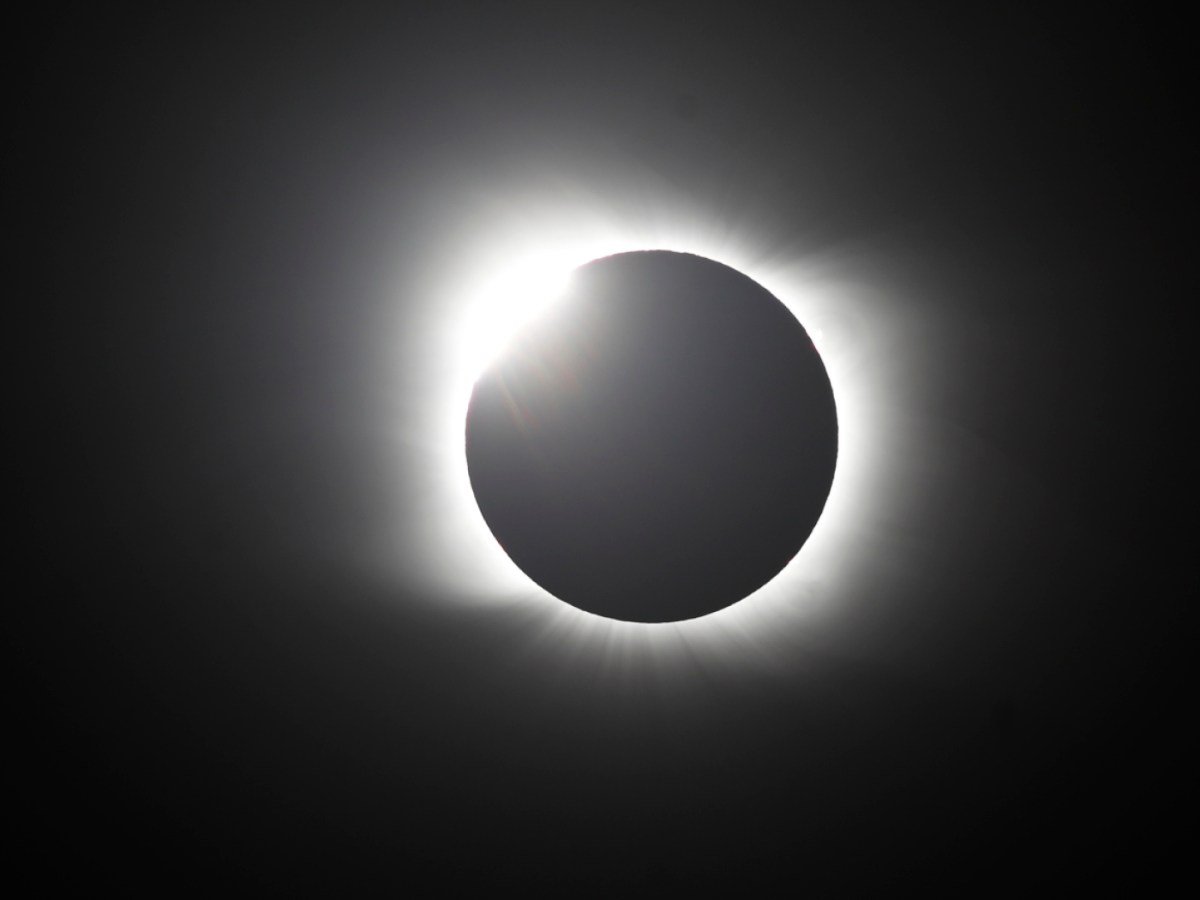

Solar eclipse on Wednesday: the next one in Switzerland won’t be until 2075
Keystone-SDA
On Wednesday evening, the Moon will pass between the Earth and the Sun in a rare astronomical spectacle that has not been seen in Switzerland for 27 years.
The eclipse on August 12 will be partial and will obscure up to 93% of the Sun’s disc as seen from Switzerland.
A phenomenon of this magnitude will not be observable again in Switzerland before 2075, according to the Swiss Astronomical Society (SAG-SAS). The occultation of our Sun will range between 91% and 93%, depending on the location in Switzerland.
The spectacle will begin shortly after 7.20pm and end around 8.45pm, as the Sun sets, reaching its peak between 8.15pm and 8.20pm, when the Moon will almost completely cover the Sun. The phenomenon will be particularly clearly visible from high vantage points with an unobstructed view.
To observe the eclipse in the best possible conditions, it will therefore be essential to have an unobstructed view towards the west-north-west. Alpine valleys will be at a disadvantage, whilst the Plateau, the Pre-Alps or mountain peaks will offer prime viewing spots, provided the view is unobstructed and the weather is favourable, explains SAG-SAS president Marc Eichenberger.
To witness totality, however, it will be necessary to travel to eastern Greenland, western Iceland or Spain – and, more specifically, to the Iberian towns and cities within the central path, such as Zaragoza, Valladolid, Burgos, León, Soria, Segovia, Cuenca, Teruel and Valencia. In these locations, weather permitting, the sun’s disc will be completely obscured for over a minute.
How can you view it safely?
On its website, the Federal Office of Public Health (FOPH) urges the utmost caution. Looking directly at the sun, even if it is almost entirely covered by the Moon, can cause irreversible damage to the retina. Direct observation using binoculars, telescopes or cameras is also extremely dangerous – warns the FOPH – as these devices further concentrate the sun’s rays. It is therefore essential to always fit filters or protective films in front of the device’s lenses.
Sunglasses do not offer adequate protection. To view safely, special lenses specifically designed for this purpose are required. The FOPH reminds anyone interested to ensure they have protective eyewear certified to the ISO 12312-2:2015 standard and bearing the CE mark.
The last partial eclipse of a similar magnitude visible from Switzerland took place in August 1999 (when, in some regions of the country, 99.5% of the Sun’s disc was obscured). Other partial eclipses were visible at our latitudes in 1912 (90%), 1961 (98%) and 2015 (75%).
A total eclipse was last recorded in Switzerland in 1842, clearly visible in the Mendrisiotto and Val Poschiavo or 1724 on the Swiss plateau.
The next total solar eclipse in Switzerland will take place on September 3, 2081.
Solar eclipses are relatively frequent phenomena on a global scale, occurring on average every six months in some corner of the Earth. However, the shadow cast by the Moon is very narrow and covers only a small portion of the Earth’s surface, making these spectacles rare for any given location.
For those who are unable to see it, there are still plenty of astronomical events in August. Following the eclipse, also on the night of August 12–13, the Perseids – the traditional shooting stars associated with the night of St Lawrence – are expected to peak.
Around the middle of the month, the thin crescent of the Moon will appear close to Venus, whilst on August 28 there will be a partial lunar eclipse, visible across much of Europe in the hours leading up to dawn.
+ How we produce English news
Translated from Italian, reviewed by an English Department journalist.