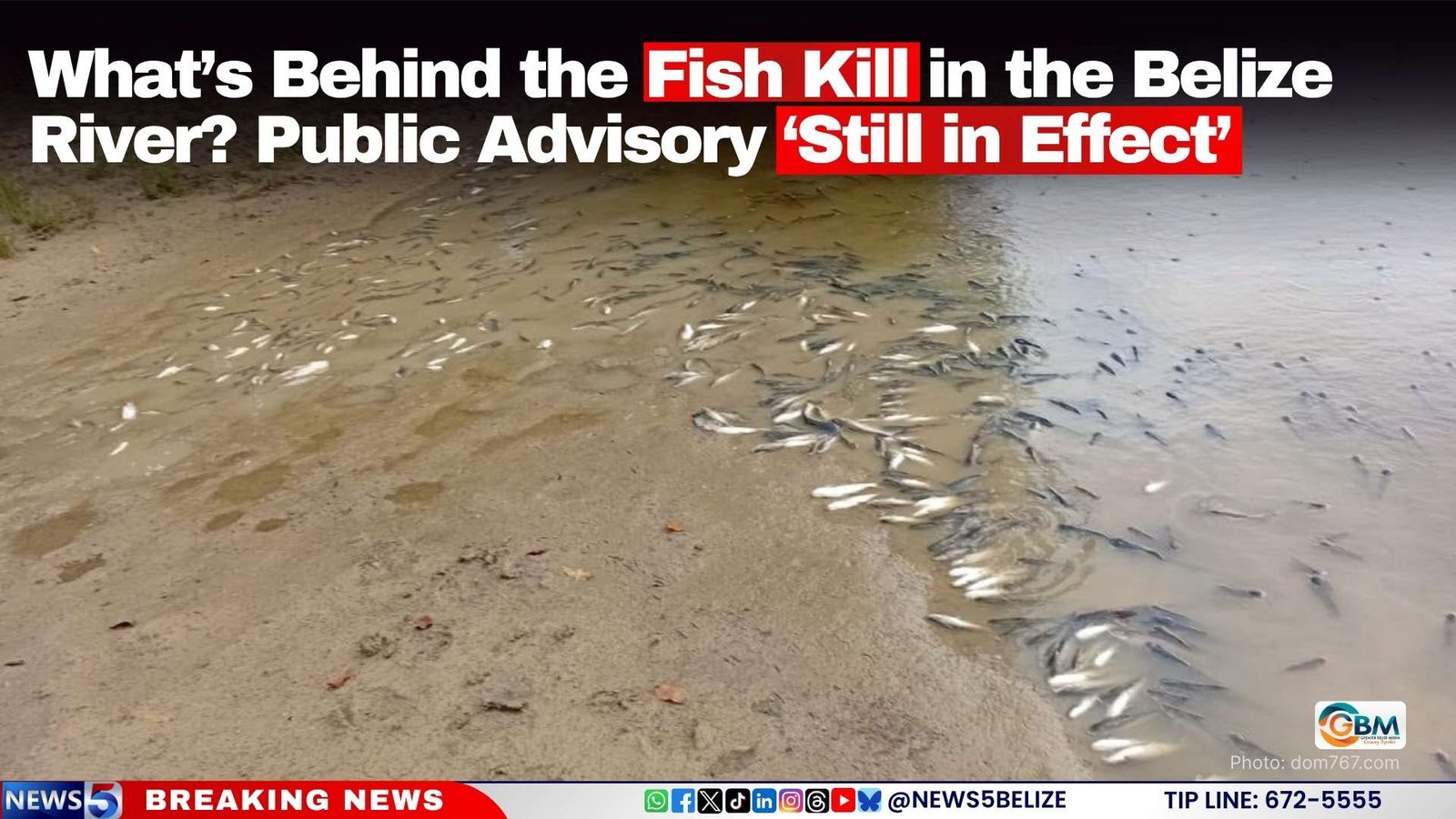
The Department of the Environment has found extremely low dissolved oxygen levels along a 17.5-mile stretch of the Belize River where significant fish mortality was recorded.
“At this stage, the Department has not determined the source or responsible party associated with the fish kill,” the DOE said in its latest statement issued on Friday.
The Department said visual observations and water quality assessments were carried out from near Banana Bank, upstream of Santander Farms, to the Burrell Boom Village bridge. The worst mortality and changes in water conditions were observed between Isabella Bank and Grace Bank.
Preliminary field results also recorded elevated conductivity, chlorophyll-a and turbidity at certain locations, conditions the DOE says can adversely affect aquatic life. Samples have been sent for laboratory analysis.
The DOE has collected water samples from the Santander Farms drainage system and locations downstream, along with fish and sediment samples, to determine whether contaminants contributed to the event.
According to the DOE, satellite imagery is also being reviewed to assess other potential contributing factors.
The precautionary advisory issued on Wednesday remains in effect, including not eating or consuming fish or other aquatic resources from affected areas or using untreated river water for drinking, cooking, food preparation, livestock or pets.
Meanwhile, Santander Sugar Group said it has given the DOE “unrestricted access” to its facilities and operations. The company said its factory runs as a closed-loop system with no routine discharge of high-temperature process water into the river and that its canals are not connected to Labouring Creek. “Process water is recovered, managed, cooled where necessary, and reused within the facility,” it said in a statement on Friday.