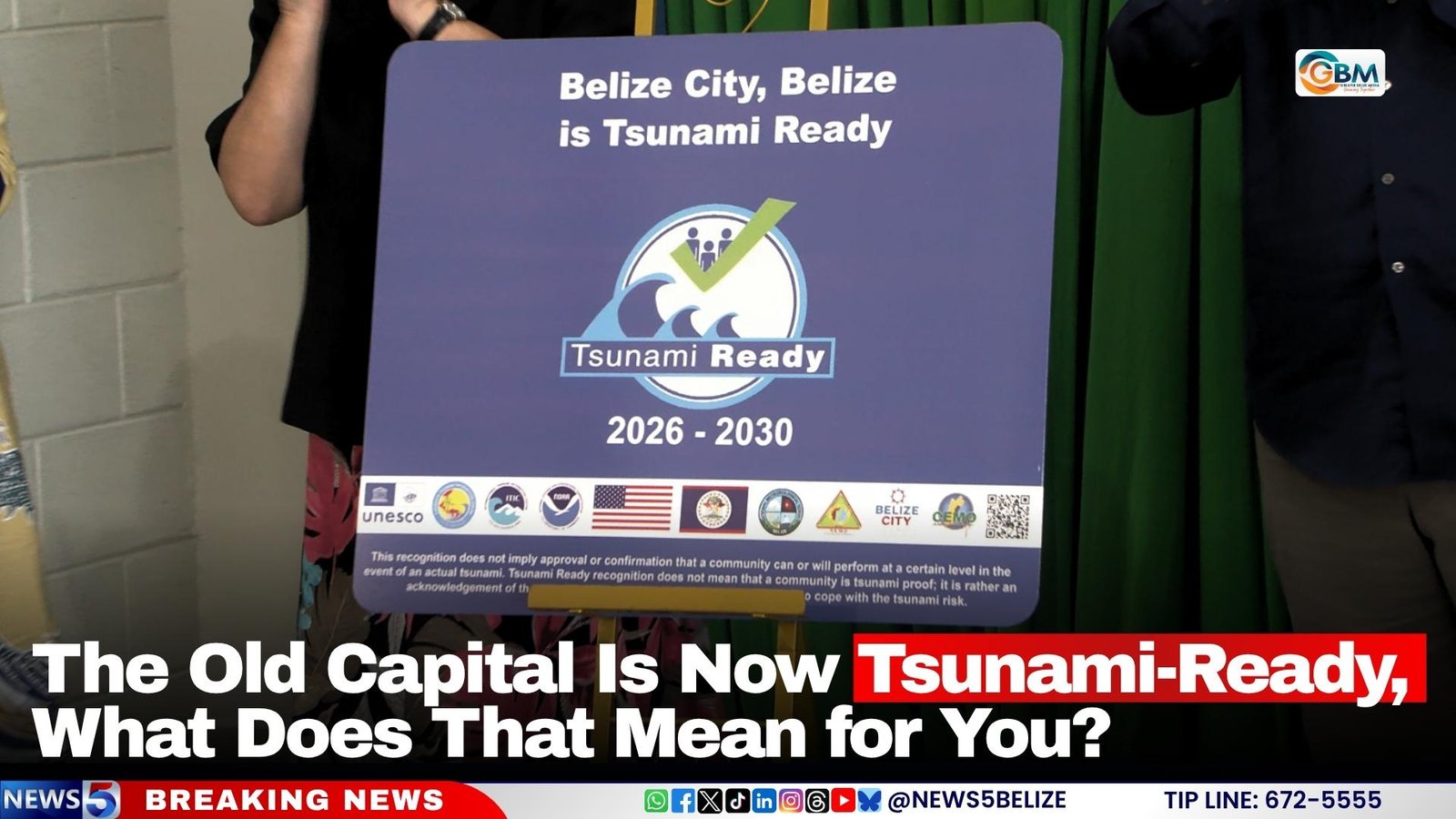
Belize City has officially earned UNESCO’s Tsunami-Ready designation after nearly eight years of planning, training, and public preparedness efforts. The old capital is the 23rd designation in the region to meet the international standard.
But does this mean that Belize is free from tsunami risk?
The minister responsible for Disaster Risk Management, Henry Charles Usher, said that while the recognition reflects an important milestone, “we can’t take these things lightly.”
“It took many years for us to get here, but this is really just the beginning of the process,” Usher said, “because this is all about continuing to be ready, continuing to be prepared, and continuing that community engagement, preparedness, and education and awareness when it comes to tsunami.”
The effort began in 2018 with an evacuation map and initial modelling but stalled before it could be finalised. Christa von Hillebrandt-Andrade, Deputy Director of the International Tsunami Information Center-Caribbean Office, said the delay nearly cost Belize the opportunity entirely. “Things just weren’t happening, and our funding was gonna be lost, U.S. funding, so we decided then to turn our efforts to another country, and their community became tsunami-ready,” she said.
Hillebrandt-Andrade said that it wasn’t until 2024 that the government of Belize, through the National Emergency Management Organisation (NEMO), the National Meteorological Service (NMS), and the Belize City Council, revisited the matter with the National Oceanic and Atmospheric Administration (NOAA) and the National Weather Service.
Evacuation gathering points and signage are now in place across the city. However, what do these evacuation gathering points mean for residents?
“Those are the areas where you might have other persons coming together, and then we would have designated persons from the Belize City Council, from CEMO [City Emergency Management Organization], and even from NEMO if they’re here in the city to be able to move persons,” Usher said. “It doesn’t necessarily mean transportation would be available, but it does mean that persons would be there to guide where you’re supposed to go in the event of an evacuation.”
Preparations are expected to continue beyond Belize City to strengthen disaster readiness nationwide.
“It’s a continuous process, and it’s something that we will continue to do as part of the Ministry of Disaster Risk Management,” Usher added.