SAN FRANCISCO: Nvidia chief executive Jensen Huang said on Friday that the artificial intelligence chip giant and South Korea’s SK Group would unveil business partnerships worth more than $500 billion.
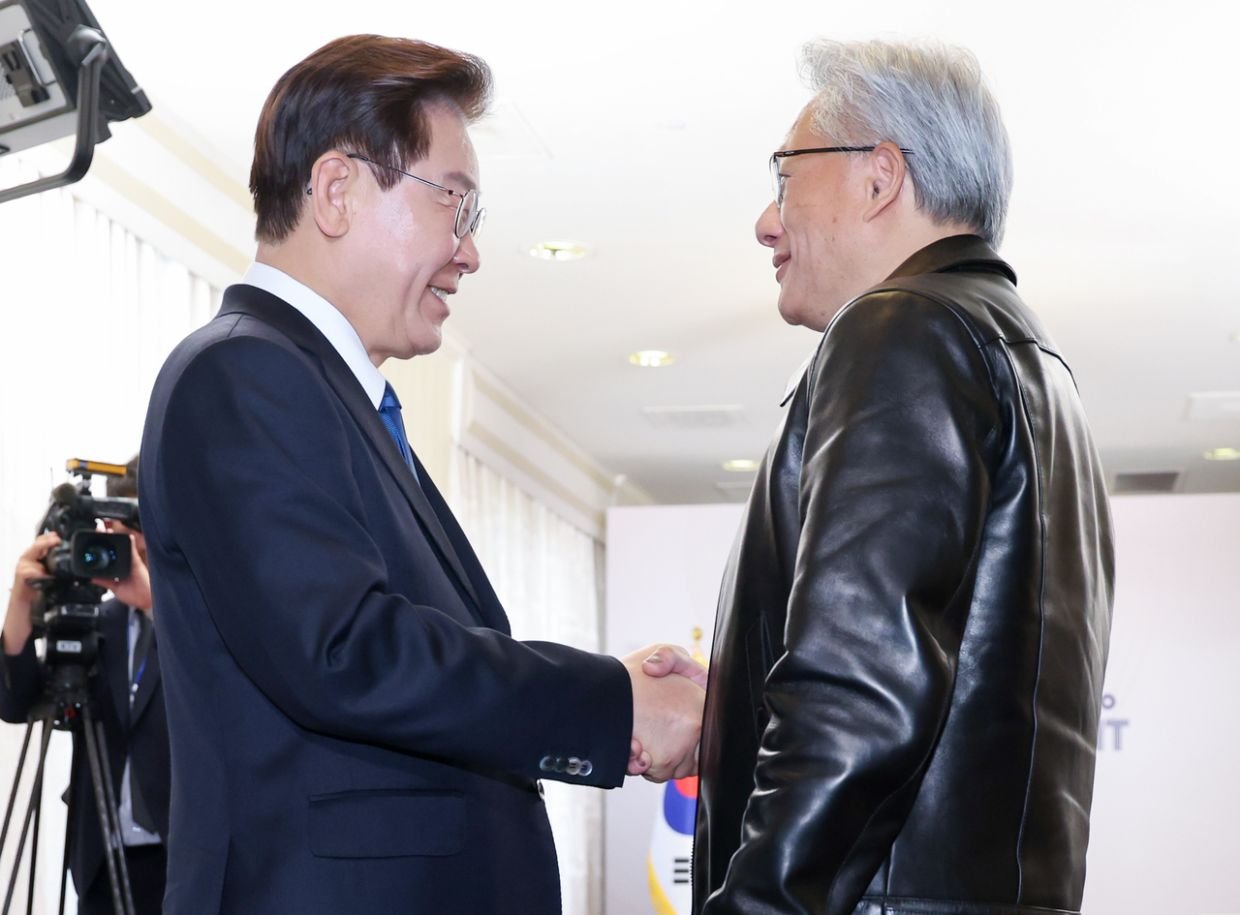
“The SK Group and I are announcing today that our two companies will enter into business partnerships that will represent over $500 billion of business together,” Huang said during a one-on-one meeting with South Korean President Lee Jae Myung in San Francisco.
Huang did not provide details on how the figure was calculated or over what period the partnerships would be carried out.
The announcement forms part of Nvidia’s expanding ties with South Korea’s biggest technology and industrial groups as global demand rises for the computing power and memory needed to develop artificial intelligence.
During the meeting, Huang said Nvidia would work with SK Hynix and Samsung Electronics on chip and memory design. The two South Korean companies are among the world’s largest memory-chip makers and key suppliers of the high-bandwidth memory used in AI accelerators.
“SK Hynix, Samsung and Nvidia are partnering to advance chip design and, of course, memory design,” Huang said.
Nvidia also plans what Huang described as a “major investment” in Naver, one of South Korea’s leading internet and cloud-computing companies.
“Naver, as you know, is Korea’s leading AI cloud company. We are going to partner with them to help them scale up in Korea and also to expand around the world,” Huang said.
The plans extend beyond data centres and semiconductors. Huang said Nvidia would work with Hyundai Motor Group on autonomous Genesis vehicles and robotic systems.
“We’re partnering with Hyundai to build autonomous Genesis vehicles as well as robotic systems,” he said.
Lee noted that Hyundai plans to invest in robotics in the Saemangeum area of North Jeolla Province, saying the project had raised high expectations among young Koreans and local residents.
Huang also said Nvidia was working with LG Group on power-generation systems and robots for factories and homes.
Another part of Nvidia’s push involves establishing an AI Frontier Lab in South Korea.
“We’re starting an AI Frontier Lab in Korea. One of Nvidia’s leading researchers will move from California to Korea,” Huang said.
Nvidia also plans to collaborate with the Korea Advanced Institute of Science and Technology, or KAIST, to build “Korea AI” and develop a Korean large language model.
“We will develop a Korean large language model in Korea, for Korea,” Huang said. “From large companies to startups to research, we have large partnerships with so many companies and so many people in Korea.”
Huang framed the initiatives as part of a broader effort to support Lee’s national AI strategy.
“All of this is aligned with your vision of Korea as an AI-native nation — from building AI chips and physical AI to AI infrastructure,” Huang said.
Huang also credited Lee’s leadership with South Korea’s progress over the past year.
“Under your leadership, Korea has achieved great results in the past year. This is truly the golden age of Korea,” Huang said.
During the meeting, Lee thanked Huang for Nvidia’s support as South Korea prepares for a future centred on artificial intelligence.
“The Republic of Korea is working hard to prepare for a new future — a world entirely different from today, with artificial intelligence at its centre — and you have been of tremendous help,” Lee said.
“Thanks to the smooth supply of GPUs, as you promised at APEC, we are changing very rapidly despite not having been fully prepared,” he added.
Huang first met Lee in late October during the APEC summit, when Nvidia pledged to prioritise the supply of 260,000 advanced AI graphics-processing units to the South Korean government and companies over the next five years.
Lee said his administration had launched three megaprojects after about a year of preparations as part of its efforts to build a new society and country centred on AI.
The Lee administration unveiled the three megaprojects in late June, covering semiconductors, AI data centres and physical AI, and backed by massive investments mainly from Samsung and SK Group companies.
“I expect you to play a major role in that effort,” Lee told Huang.