Homelessness increased in Los Angeles over the past year, according to numbers that will be released by the region’s homelessness authority on Friday, setting up Mayor Karen Bass for a fresh round of criticism amid an already bruising re-election campaign.
The city’s homeless population increased by 3.4 percent from last year, based on the most recent point-in-time count, an annual January census of the region’s homeless population, according to two people who were not authorized to release the data before tomorrow’s announcement.
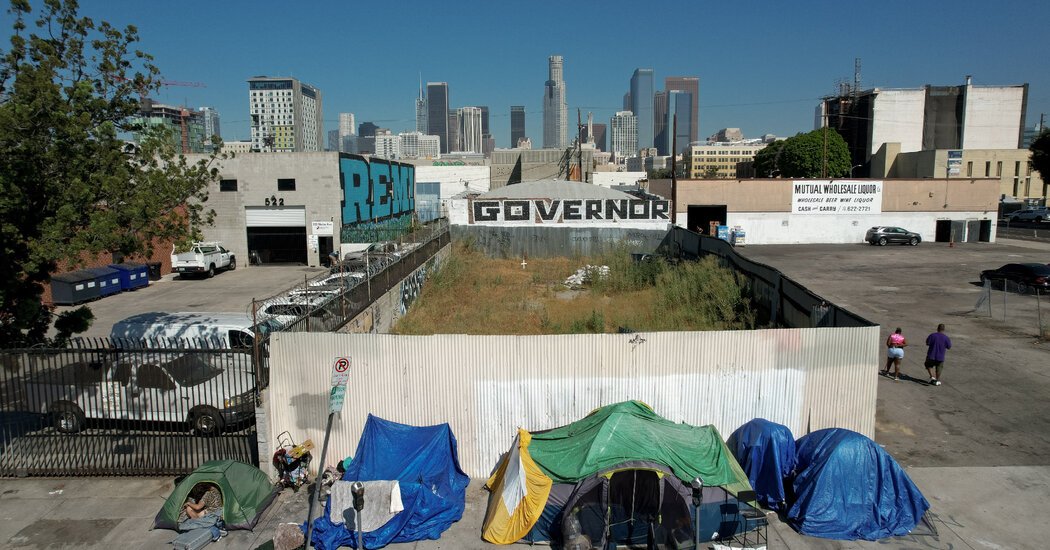
All told, 45,194 people in Los Angeles were counted as homeless this year, a number that includes people in shelters. The number of people sleeping outside in tents, encampments or in vehicles increased by 7.9 percent from last year.
It was an inopportune result for Ms. Bass, who is running for re-election against another Los Angeles Democrat, Councilwoman Nithya Raman. The mayor had previously hailed two years of declines in homelessness, a major accomplishment on a signature issue, but the latest release represented the first full year under her watch in which the homeless count rose.
Across much of Los Angeles County, the numbers increased between 2025 and 2026, although more modestly: The total homeless population in the region served by the count, which includes the city of Los Angeles along with more than 80 other smaller cities, went up by 1.2 percent.
In a statement on Thursday, Ms. Bass blamed a variety of factors outside her purview for the reversal, citing the federal government’s slashing of safety net programs that help people who are teetering on the edge of homelessness. She also said that cuts by the state and ongoing tensions between the city and the county government, which is in charge of mental health care funding, have also been setbacks.
“Despite these headwinds, we have reduced homelessness in Los Angeles by double digits since 2023,” she said, citing the movement of tens of thousands of people into interim housing. She said another 6,000 had been moved indoors through her signature Inside Safe program, which aims to remove some of the city’s most persistent encampments.
The increase was first reported by Fox 11.
Dr. Margot Kushel, director of the Benioff Homelessness and Housing Initiative at the University of California, San Francisco, said that regardless of Ms. Bass’s performance, she would have been surprised if this year’s numbers did not reflect the significant obstacles local leaders faced over the past year.
“There’s no question that the 2026 count reflects what happened in 2025,” she said. “And there’s no question that 2025 was a really hard year, in particular for Los Angeles.”
Although only one of the two wildfires that devastated the Los Angeles region last year happened in the city limits, Dr. Kushel noted that the displacement of people from thousands of homes had sent them looking for housing in an already overstretched market.
And she said that homeless service providers across the country had been racing to replace or do without federal funding that had been suddenly pulled.
She is concerned about the effects of federal rule changes related to who qualifies for Medicaid and who can get food stamp dollars in the next couple of years, she said.
“I see some things that really worry me out of California’s control and certainly out of any local government’s control,” Dr. Kushel said. “It’s going to create a story of a failed California, even when it’s predictable and it’s not our doing.”
In the longer term, she hopes that statewide efforts to make it easier to build housing will begin to pay off.
Still, homelessness remains a top issue in the Los Angeles mayor’s race. Ms. Bass, who was first elected on promises to aggressively and humanely move people off the streets, has emphasized past results as evidence that her administration’s approach has been working after roughly a decade in which it seemed the problem was intractable.
Even after the two years of decreases, more than 72,000 people remained homeless in the county, a sprawling metropolis home to some 10 million people. Ms. Raman, who has promoted her office’s work on homelessness as a model for the rest of the city, said in a statement that the mayor’s strategy had not focused enough on moving homeless people into permanent housing.
“These results make clear that the mayor’s approach is not working well enough,” she said.
The mayor was forced into a runoff after failing to earn more than 50 percent of votes in the June primary, which indicated lingering frustration among Angelenos about conditions in the city.
After her reputation suffered a catastrophic blow during the 2025 wildfires, she was able to rebuild some amount of good will among voters by fighting against federal immigration raids.
But in recent weeks, residents have been upset by her response to the June 17 warehouse fire in the Boyle Heights neighborhood that sent toxic smoke billowing over the city. Neighbors have been sickened by the stench of rotting food and swarms of vermin that remain.