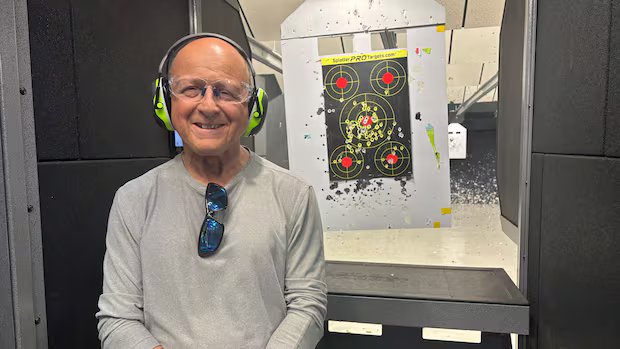
Jim Lee starts his day with an early workout and household tasks. A few times a week, he then drives to an indoor gun range near his Mississauga home to fire handguns at targets.
Lee obtained his firearms licence last year and took up shooting as a retirement hobby.
“It’s kind of exhilarating,” said Lee, who said he’s found community at the range.
“I’ve met several people in here. We come in here almost the same during the weekdays … it’s nice, you chat with them, you chat even as you’re leaving.”
Lee is part of a growing trend. Firearms license applications in the Greater Toronto and Hamilton Area (GTHA) have increased significantly over the past decade, most notably in Peel Region, where Lee lives.
RCMP data shows applications increased 49 per cent across the GTHA between 2016 and 2025. In Peel, they rose 110 per cent.
The figures include applications for Possession and Acquisition Licences (PAL), which allow people and businesses to own non-restricted firearms such as most rifles and shotguns. They also include PALs with restricted privileges, which allow the ownership of restricted firearms such as handguns. Most applications are for both.
It is unclear what is driving the increase, though it appears to be linked partly to growing interest in shooting sports. Industry observers also say the demographics are shifting, with more women, younger people and people from diverse backgrounds getting involved.
What the data shows
To obtain a PAL, applicants must complete the Canadian Firearms Safety Course — and the Canadian Restricted Firearms Safety Course for restricted privileges — undergo background checks and provide detailed information about personal relationships and mental health history.
Applicants must also provide personal references, and current and recent spouses or partners must be notified about the application. The RCMP data includes all applications received, including some that may not have been approved.
PAL holders must renew their licences every five years. Routine renewals are not included in the data, but the figures include applicants whose previous licences had expired.
Canada had 2,473,661 firearms licence holders last year, according to the RCMP’s Commissioner of Firearms Report, though not all necessarily own guns. The long-gun registry was scrapped in 2012, meaning ownership of non-restricted firearms is no longer tracked.
Firearms license holders still make up a relatively small share of the total population. In Toronto, for example, 4,297 people applied for a PAL in 2025. The city had nearly 2.8 million residents in the 2021 census.
The increase is significant, but its cause is unclear because the PAL application does not ask why someone wants a licence.
“The Canadian Firearms Program (CFP) cannot speculate as to the causes or other external factors that may affect licensing trends at any point in time in any location,” wrote RCMP spokesperson Robin Percival in an email to CBC News.

David Wall, executive director of the Firearms Safety and Education Service of Ontario, which delivers mandatory safety courses for PAL applicants, said he can only speculate about why interest has grown. He believes more free time during the pandemic, immigration and population growth may be factors.
Anecdotally, he has noticed more women, young people and newcomers taking the courses, most of them interested in shooting sports.
“Twenty years ago it was typically hunting, but times have changed,” Wall said.
“People are looking for new hobbies, a new sport. They’re taking it just to increase their own personal knowledge base of firearms and how to safely handle them.”
Wall said his instructors do not hear people say they want firearms for self-defence. There is no legal right in Canada to carry a firearm solely for personal protection, though using one for self-defence can be legal in an emergency under specific conditions.
Chief firearms officers (CFO) oversee parts of the Firearms Act in their provincial and territorial jurisdictions and can revoke licences, authorizations and approvals.
“After a firearms licence is issued, continuous eligibility screening is conducted over the term of the licence. Information of concern that is brought to the attention of a CFO (e.g., automatic reporting from police about individuals involved in certain criminal or suspicious activity) may bring an individual’s eligibility to hold a licence into question,” Percival wrote.
Popularity growing at GTA shooting ranges
Shooting sports have long been controversial in Toronto. In 2008, then-mayor David Miller pushed for a ban on shooting ranges as part of an effort to curb gun violence.
The city ultimately banned new ranges and barred existing ones from city property, forcing most Toronto ranges to close.
Elsewhere in the GTA, options range from long-established gun clubs to new businesses. Down Range Sports Shooting Range in Mississauga opened about six months ago.
“We know that there’s a lot of politics behind it, but, at the same time, it’s a sport like anything else. And that’s what we’re really focused on,” said co-owner Chris Garofalo.
Garofalo said the range attracts people from all walks of life, including doctors, tradespeople, retirees, and even families.
“That has been probably the one thing that’s blowing our minds the most; we are seeing the most diverse group of people coming in to shoot,” he said.
About 60 per cent of the club’s members are new to shooting, while the rest have held licences for years, he said.

On the other side of the GTA, Uxbridge Clays Target Sports has operated for decades. Historically, most new members had shooting experience or a family connection.
But director Brian Yee said there’s been a noticeable shift in the last few years, with more than 100 new members a year who are brand-new PAL holders — three or four times as many as a decade ago.
Yee said more young people are joining the club, including couples.
“To the point where you look down in the fields and you’ll see people walking around arm in arm. I mean, it’s, it’s pretty funny to see that at a gun range,” said Yee.
The other big difference has been a significant increase in women joining the club. When he joined the club about 40 years ago, he said women made up just one or two per cent of the membership. That’s now up to about 15 per cent.

Leigh Bianco is among those new members. She obtained her PAL in 2024 and joined Uxbridge Clays about a year ago.
Bianco had no family connection to hunting or shooting but decided to learn after being inspired by a woman on Instagram.
“It’s something very different in my life and I think it’s great to be learning something new at this age,” said Bianco, who is 57.
Now she participates in skeet shooting twice a week.
“It’s very addictive,” she said.