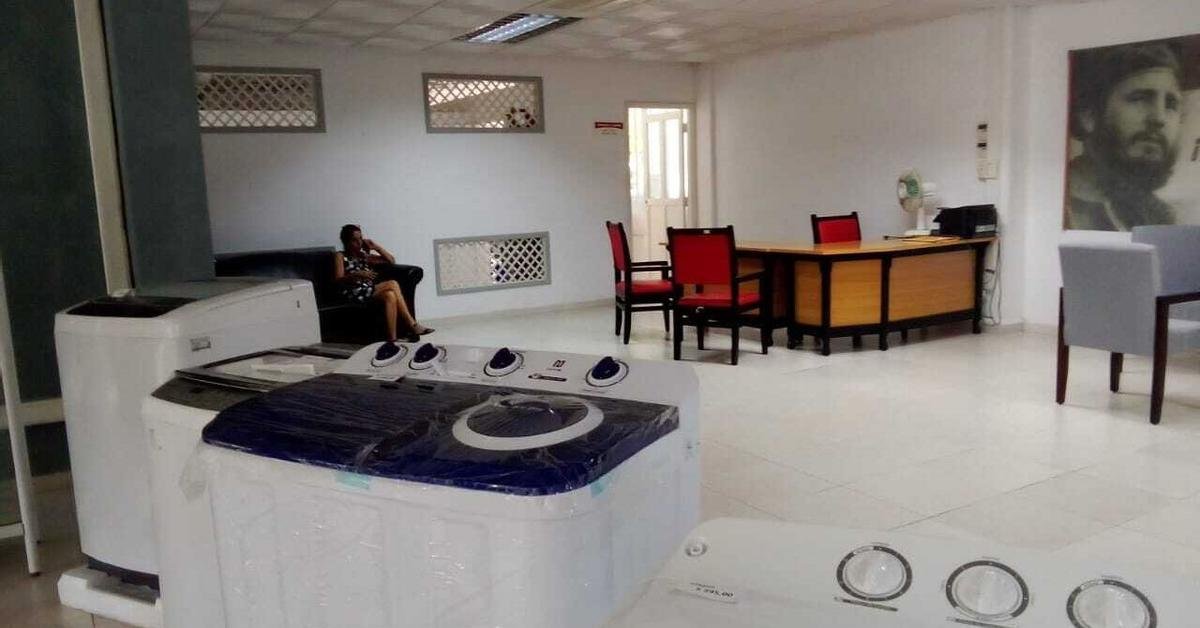
Matanzas/The first sensation when you cross the door is that of silence. There is neither the loud music of private stores nor the coming and going of customers that characterizes the busiest businesses in the city of Matanzas. Only a few visitors calmly walk through a large, impeccable room, where refrigerators, automatic washing machines, televisions, fans and rice cookers rest like exhibition pieces. In the background, a photograph of Fidel Castro observes the scene from the wall. Under that view, prices appear in dollars.
The new store inaugurated by Copextel, within the company’s own headquarters on Calzada de San Luis, once again widens one of the most visible borders of today’s Cuba: the one that separates those who receive remittances or have access to foreign currency from those who survive only with a salary paid in Cuban pesos.
The contrast is inevitable. In a province where blackouts can last for 40 or even 50 consecutive hours, the State is committed to selling modern appliances, electronic equipment and energy solutions that only a minority can afford. Most Matanzas residents continue calculating how many hours of electricity they will have that week, while contemplating display cases full of equipment designed for a country that seems to exist only within this air-conditioned room.

/ 14ymedio
“That option is not for us, the poor,” Arasay summarizes while, back at home, he scrubs his children’s clothes by hand in a plastic tub.
The art instructor came to the store because a friend living abroad wanted to know the price of a solar panel to buy for her elderly parents. However, the mission ended before it began.
“They told me that there were no panels left and that they didn’t know when they would come back in,” he says. The answer reminded him of one of the old evils of Cuban state commerce: opening a store does not guarantee having merchandise.
While walking among the automatic washing machines, Arasay couldn’t help but stop in front of one whose price was around $210. She took out her phone and took a photo to show her husband. It was the only way to take her.
“I only had 90 pesos in my wallet. Not even working for two years could I raise that money,” he laments. “They say these stores are to improve the quality of life of the people, but I still wash clothes by hand.”
/ 14ymedio
The labels show figures that, in some cases, exceed those charged by private sellers. A pedestal fan can be purchased for $85, and some small appliances run into three figures.
Carlos, an entrepreneur from Matanzas who also recently visited the establishment, believes that the project seeks above all to raise foreign currency to support Copextel.
“It strikes me that they have set up the store within the company and not in some commercial area of the city. It does not seem like a place designed to attract the public. Rather, it conveys the feeling that whoever knows it exists is coming to look for something specific,” he says.
In his opinion, competition with private sellers still leaves much to be desired.
/ 14ymedio
“The individual sells you the washing machine and many times takes it to the door of your house. That service does not exist here. In the end you have to rent transportation to move heavy equipment and that expense ends up canceling out any price difference.”
Customer service also does not seem to have escaped old bureaucratic habits. When Carlos asked how long the equipment was under warranty, the employee who attended to him couldn’t answer him.
“She told me that the only one who knew that information was the manager and that we had to wait for her to return. I couldn’t waste the entire morning for such basic information,” he recalls. “State companies still do not understand that selling also means informing, convincing and facilitating the purchase.”
Meanwhile, the room remains almost empty. The display cases look orderly and the black screens of several televisions reflect the few visitors. Outside the building, Matanzas once again looks like its usual city. The heat falls on the asphalt, the neighbors talk about the next blackout and the trays continue to replace the automatic washing machines.