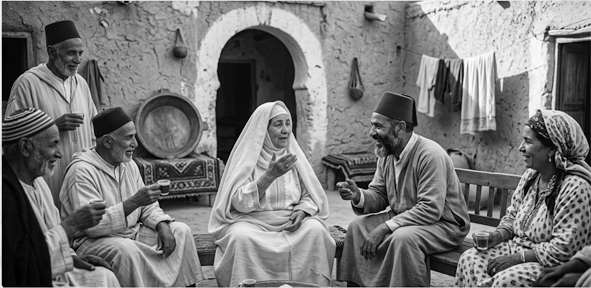
One of the old popular proverbs, which still finds its place in the Algerian cultural heritage, is such as Qash Bakhta, Maryam’s generation has perished. This proverb, which bears two of the most beautiful names sung by artists, whether in popular, familiar, or even old Rai.
But, how did Bakhta and Maryam come together in one sentence? Al-Shorouk Al-Arabi tells the beautiful story behind this most beautiful proverb.
Fans of popular art only flirt with Maryam’s beauty. Who among them does not know the poem “Walfi Maryam,” by its composer, “Sheikh Qaddour bin Ashour Al-Nadrumi Al-Zarhouni,” which was sung by “Sheikh Muhammad Al-Ghafour.” The poem was written around 1910, when Maryam’s name became famous since then.
Thirty years after the song of Sheikh Al-Ghafour, in 1940, Sheikh Abdul Qadir Al-Khalidi composed a poem that became one of the most beautiful poems of ancient Wahrani opinion. Al-Khalidi was not in love with Maryam or Maryuma, but with an extremely beautiful woman, whose name was “Bakhta.” His specialty in the life of Sheikh Abdul Qadir Al-Khalidi is every poem, every line, it is the rhyme, and it is the chest and the sacrum. Al-Khalidi’s description of Bakhta, in terms of her beauty and even her clothes, turned into his chest being like the straw of Bakhta, that is, Bakhta’s grooming, and his inability destroyed Maryam’s generation, meaning that Bakhta’s appearance comforted the generation of lovers who were in love with Maryam.
Maryam Sheikh Qaddour bin Ashour
Kaddour bin Ashour Al-Zarhouni was born in Nadrouma in the year 1850 AD. He grew up and studied for education before devoting himself entirely to asceticism starting in the year 1900. Then he moved to the city of Tlemcen, where he remained a resident from the year 1926 to the year 1930.
Sheikh Kaddour had several marriages, including one to Maryam, the granddaughter of the poet Amhamed Al-Ramoun Al-Nadroumi, the author of the famous poem that begins with “O Al-Laymani fi Layati,” who was a contemporary of him and lived with him, sitting at the time on the throne of salty poetry in Nedroumi. On his wife Maryam, Sheikh Qaddour bin Ashour wrote his wonderful poem, although there are those who have another explanation for this poem, and that Maryam is only a projection of the beauty of the soul.
Bakhta Sheikh Al-Khalidi
The story of the poet Abdul Qadir Al-Khalidi with Bakhta began in 1945, when he performed a large concert in the city of Tiaret, and there Bakhta saw him and became attached to him. He was at the height of his fame and power, and she was at the height of her youth and beauty.
The poet traveled to work, and the beautiful woman stayed in the city for a while, and he was busy with his work, but whenever he was alone to write a poem, he found Bakhta the first thing that came to his mind.
He was completely immersed in the poem, absent from the people surrounding him.
Suddenly, a driver told him that Bakhta had gotten off at the train station, and was now waiting for him in a kaleesh. It was the poem that was materializing before the eyes of its writer.
Like a passage of time
Qash Bakhta, the annihilation of Maryam’s generation, represented across time and eras, lived through the Second War and the Algerian Revolution, and spread after independence so that people could use it as an example of the poor quality of something, in contrast to the quality of the opposite.
However, like every saying, this proverb was subjected to distortion, and it became the straws of Bakhta and the cups of Mary.
A comparison between Jamal Bakhta and Hassan Maryam
Al-Khalidi describes Bakhta as an adornment for Na’at and Al-Wajab Al-Hawariyya has missed the star of Loqat in the print of the mezuzats
The mark on the neck of the slanderer is adorned by what they have earned. Iyad is cast out in the valleys, and they are distressed by it in life.
Sheikh Qaddour bin Ashour Al-Nadrumi Al-Zarhouni described Maryam as a prepared virgin who emerged from a blazing turmoil that was shameful in Qamo, and Al-Hasan Al-Fayeq is proud of Sam’s offspring.