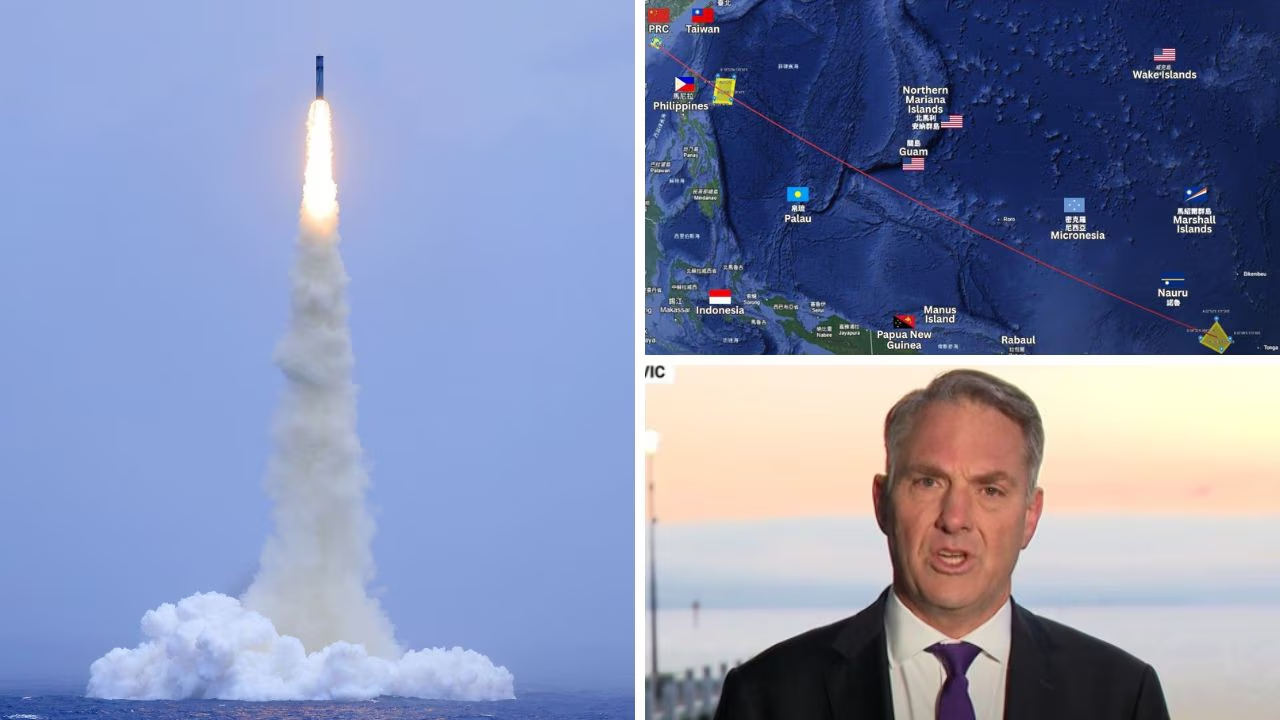
A long-range missile fired by China from a submarine reached as far as the waters off Nauru, according to the latest intelligence from Taiwan.
The snap missile test launched on Monday afternoon has sent shockwaves through the region as China announced the weapon was nuclear-capable.
Taiwan’s Secretary-General Joseph Wu said the missile was tracked passing over the Philippines, as he shared an image suggesting it landed between Nauru and Tuvalu.
“It’s a provocation that destabilises the #IndoPacific,” he wrote on X.
“#China just proved itself again to be a bully on the block.”
Nauru is a small country in Micronesia with close ties to Australia. It is located northeast of the Solomon Islands, with a flight to Brisbane taking about four-and-a-half hours.
Defence Minister and acting Prime Minister Richard Marles told Sky News on Tuesday he would not discuss the missile’s final destination, but that it had been “conveyed to us” by China.
“We are concerned about what China has done and we’ve expressed that concern to China,” he said.
“This is a long-range missile test which China itself has said would be nuclear-capable. It’s been launched from a submarine, which also implies something about the range that China is building in terms of deploying nuclear capabilities.
“And all of that is obviously destabilising to the region. And that’s our concern here.”
The test was announced hours after Prime Minister Anthony Albanese signed a defence treaty with Fiji, with Australia moving to shore up its relationship with key allies in the Pacific.
Mr Marles was asked if the launch was a “message” to Australia about its capabilities timed to coincide with the Prime Minister’s deal with Fiji, which he denied.
“To be honest I doubt that but what’s significant here is it is a long-range missile test … the message that’s being sent, or the test that’s being done here, is a display of an extended range that China now has in terms of deploying a nuclear weapon,” he said.
“And that’s obviously very concerning.”
He said Australia was building relationships with its neighbours to create an “ocean of peace in the Pacific”.
Mr Marles was asked if the test proved Australia was “powerless to stop whatever the PRC wants to do”.
“It’s important that we express our voice,” Mr Marles replied.
“But beyond that what really matters here is understanding our strategic environment and then meeting it.
“And that’s why you see Australia significantly increasing our defence capability on the one hand but also working with our friends and neighbours … to provide for the collective peace and security for the region in which we live.”
News outlet the China Military Bugle reported the test was a “routine arrangement of China’s annual military training” and “not targeted at any specific country or target”.
“We hope relevant countries will not over-interpret it,” Chinese Foreign Ministry spokesperson Mao Ning said on Monday.
State-run news agency Xinhua reported the missile carrying a dummy warhead “landed precisely within the designated waters” China had flagged to other nations.
Foreign Minister Penny Wong on Monday said the test was part of a “rapid” military build-up “lacking in the transparency and reassurance to intent that the region expects”.
Defence Industry Minister Pat Conroy revealed on Tuesday Australia had been monitoring a Chinese navy task force group that was involved in tracking the launch.
He told ABC Radio National Australia had known China planned to test a nuclear ballistic missile for some time, but that Monday’s test came with “insufficient notice”.
“I think it’s more likely to be a coincidence rather than linked but that’s ultimately a question for the Chinese government,” Mr Conroy said of the timing with the Fiji peace deal.
Opposition frontbencher Dan Tehan called on China to “come clean and provide us as to what the motives are”.
“And whether it was timed to send that message to the Australian Prime Minister when he was singing that treaty,” he said. “And if it is, that’s quite concerning.”
US Department of State spokesperson Tommy Pigott said on Tuesday morning, AEST, the US had monitored China’s test launch as he clammed the Asian power’s nuclear activities.
“At a time when the United States is working harder than ever to prevent nuclear proliferation, China is doing the opposite,” he said.
“Beijing’s rapid and opaque nuclear weapons buildup is of great concern to the region and the world. We continue to urge China to engage in meaningful arms control discussions and commit to a regularized notification arrangement for all intercontinental-range ballistic missile and space launches consistent with commitments made by all other P5 members.
“The United States remains steadfast in our defense commitments to our allies and partners.”
Allies New Zealand and Japan have also criticised China’s actions, with the latter’s government saying it expressed “grave concerns” to its neighbour.
New Zealand Foreign Affairs Minister Winston Peters said his country had “no interest in China using the South Pacific as a testing site for missile capability”.
“Launching ballistic missiles into the South Pacific is at odds with the spirit and intent of the Blue Pacific Ocean of Peace,” he said.
“This missile was fired into the South Pacific Nuclear Free Zone established by the Treaty of Rarotonga. China’s action goes against the object and intent of that Treaty.”