Medical statistics show that up to a third of people in Slovakia are at risk of a serious heart rhythm disorder. Experts encourage people to regularly monitor their pulse in addition to a healthy lifestyle.
In contrast to myocardial infarction, the incidence of which has been decreasing in recent years, the incidence of heart rhythm disorders has doubled in the last decade. Arrhythmias are taking on epidemic proportions and are becoming the dominant cardiology diagnosis, as pointed out by the Slovak Association of Cardiac Arrhythmias.
Late detection of heart rhythm disorders, their underestimation or late treatment often have devastating consequences for individuals. More often, they can suffer from strokes, heart failure or even cause sudden death.
A pacemaker (pacemaker, author’s note) is intended for patients whose heart beats too slowly or irregularly, resulting in insufficient blood flow to the body. The number of people with this device has been growing for a long time.

Cardiologist Daniel Čambál. (source: Tomáš Köppl)
The number of patients is increasing
“Population studies show a significant increase in implantations over the last decades, and at the same time, the number of people living with a pacemaker is also increasing, especially at an older age. The main reason is the aging of the population – rhythm and conduction disorders occur more often with age, as the heart’s electrical system gradually wears out,” said Daniel Čambál, a renowned cardiologist who works as the head of the cardiology department at the Trnava Faculty Hospital.
A pacemaker is used in patients who have problems with the generation or conduction of electrical impulses in the heart, resulting in an inappropriately slow or irregular rhythm.
Its implantation is considered when the disorder is objectively proven, for example on the ECG, and at the same time causes clinical difficulties or poses a risk.
Čambál identified repeated dizziness, short-term loss of consciousness, inexplicable fatigue, shortness of breath even with slight exertion, or the feeling of an irregular or slow pulse as the main warning signs.
“The occurrence of fainting in combination with a slow heart rate requires special attention. It is not only the slowing of the pulse itself that is decisive, but its effect on sufficient blood flow to the body, and precisely in cases where this mechanism fails, a pacemaker is an effective solution for restoring a stable heart rate,” added the cardiologist.
Thanks to better diagnostics, they are now able to detect even less noticeable disorders.
“At the same time, the indication criteria have been expanded, so the pacemaker is used for a wider range of conditions than in the past. Technological progress, which makes treatment safer and more accessible, also contributes to the growth, and finally, the fact that patients with a pacemaker live longer today. So their total number is naturally increasing,” stated Čambál.
A return to a full life
The main benefit of the “pacemaker” is that it ensures a sufficiently fast and regular heart rhythm, and in many patients it also enables a return to a full life, including normal daily activities, work or adequate physical exertion.
“The disadvantages are mainly of a practical nature, it is an implanted device that carries with it certain risks, such as infection, bleeding, malfunction of the electrodes or the need to replace the battery over the years. It can also rarely cause discomfort when the rhythm is incorrectly set. Despite these limits, the benefit of the treatment in most cases clearly exceeds the possible risks,” the doctor summarized.
In most cases, the body tolerates the pacemaker well. Complications can occur rather exceptionally and are divided into early and late.
“In the early period, it is mainly bleeding, hematoma, infection at the implantation site or mechanical complications, such as displacement of the electrode or, rarely, pneumothorax. Later, an infection of the system, a malfunction of the electrodes or a discharge of the battery, or the so-called pacemaker syndrome with symptoms such as fatigue or dizziness, may appear later,” explained Čambál.
The solution depends on the problem, from conservative treatment, for example by using antibiotics, through modification or replacement of electrodes to removal and reimplantation of the entire system. Overall, however, complications are relatively rare, and the benefit of treatment far outweighs the potential complications.
People with pacemakers must be particularly careful of strong electromagnetic fields, protect the implantation site from injury and inform doctors about the device before examinations or procedures. Regular check-ups with a cardiologist are also important, he monitors the function of the device and the state of the battery.
“In ordinary life, however, the restrictions are significantly reduced, after healing, most patients return to full-fledged activities, while undesirable symptoms often subside,” he assured.
Salvation is the same
A person with an electronic device is rescued in the event of a circulatory arrest in exactly the same way as any other patient. Although a pacemaker helps maintain an adequate rhythm, it cannot prevent all life-threatening conditions. Therefore, cardiac massage is started immediately during resuscitation and a defibrillator is also used if necessary.
“The presence of the device is not an obstacle. In other words, the pacemaker does not change rescue procedures. On the contrary, it is important to act quickly and without delay, just like with any other patient,” added Čambál.
Some patients would be at risk of serious complications or even death without a pacemaker, especially due to a too slow heart rhythm or impulse conduction disorder.
Most often, this is the risk of fainting, falling, insufficient blood supply to the organs and, in severe cases, sudden cessation of blood circulation, which the pacemaker helps to prevent by keeping the heart rate at a minimum.
Procedure within two hours
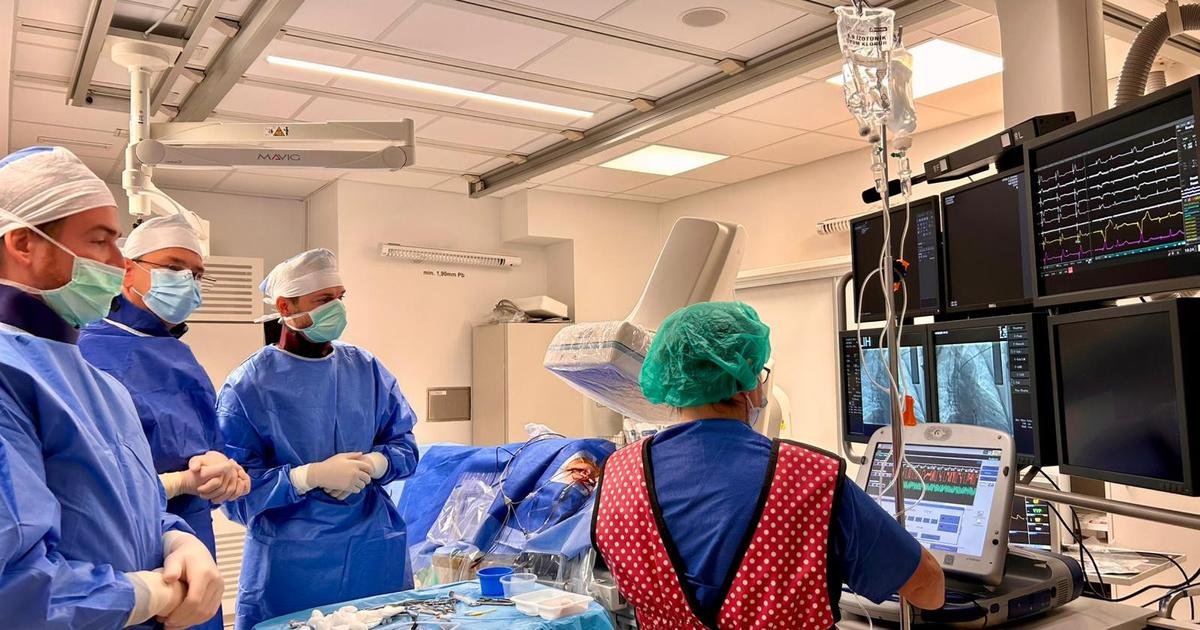
The pacemaker is introduced minimally invasively, most often under local anesthesia. “The doctor makes a small incision under the collarbone, introduces thin electrodes through the vein into the heart under X-ray control, and the ‘body’ of the device (generator) is placed under the skin in the subclavian region,” the cardiologist described.
The entire procedure takes approximately one to two hours, recovery after the procedure is relatively quick. The patient usually stays in the hospital for a day or two for observation and then continues with home treatment.
“In the first days to weeks, it is important to spare the operated arm and not raise it above the level of the shoulder, do not strain to fix the electrodes properly. Normal daily activities are gradually resumed within a few days to weeks, while full healing takes about 4 to 6 weeks,” he said.
Having a healthy heart is something that cannot be fully replaced by any device, not even a pacemaker, because it solves a problem that has already arisen, not its causes. The basis is therefore long-term prevention and a lifestyle that allows the heart to function naturally and without excessive strain.
“The key role is played by regular exercise, which improves the condition of the heart and blood vessels, a balanced diet with enough vegetables, fruits and healthy fats, as well as maintaining an adequate body weight. It is also important not to smoke, limit alcohol and make sure to get enough sleep and manage stress, as chronic stress is one of the subtle but significant risk factors,” the cardiologist described. As he continued, it is also important to regularly check blood pressure, cholesterol and blood sugar levels, which often go on for a long time without symptoms, but fundamentally affect the condition of the heart and blood vessels.
Interesting facts about the pacemaker
Pacemakers began to be used clinically in the second half of the 20th century. The first experimental devices were created already in the 1950s, but the year 1958 is considered a historical milestone, when the first fully implantable pacemaker was implanted in a patient with a rhythm disorder in Sweden.
Since then, they have undergone tremendous development. From large devices with a short lifespan to today’s small, reliable devices with a battery that lasts for several years and advanced functions that can respond precisely to the body’s needs.
From simple systems that only maintained a minimal heart rhythm, intelligent devices have evolved capable of adjusting the frequency according to the patient’s activity, storing data and enabling remote monitoring.
A newer trend is the so-called wireless pacemakers that are implanted directly into the heart without traditional electrodes, reducing the risk of complications associated with leads. At the same time, the stimulation of the conduction system of the heart is also being developed, which enables a more natural and physiological activation of the heart than the traditional stimulation of the right ventricle.
Overall, today’s pacemakers are smaller, safer, more precise and more personalized than their predecessors, and represent a sophisticated tool in modern cardiology.(PB)

Related article
People shun them, hate them on social networks. The police will not solve the problem
Read more