The Declaration of Independence turned 250 over the weekend, with star-spangled hoopla befitting the birthday of the world’s longest-running democracy. But the founding story underlying it is increasingly up for grabs.
Conservatives have accused progressives of abandoning the wisdom of the Declaration, and distorting the legacy of the American Revolution. On the left, some see the freedom narrative that once inspired people around the world as losing its grip, exposed for its hypocrisies and evasions.
Among scholars, the 50 years since the Bicentennial of 1976 have radically expanded the Revolution’s cast of characters, its geographical scope and timeline, recasting what was once seen as a unified national narrative as a more fractured, kaleidoscopic story of a civil war, nestled inside a larger global conflict.
But lurking underneath both scholarship and the polarized public conversation about 1776 is an old question: Just how revolutionary was the American Revolution anyway?
To many Americans, the question may seem odd. The revolutionary-ness of the American Revolution is baked into its name, and attested to by the very fact of the 250th celebration itself.
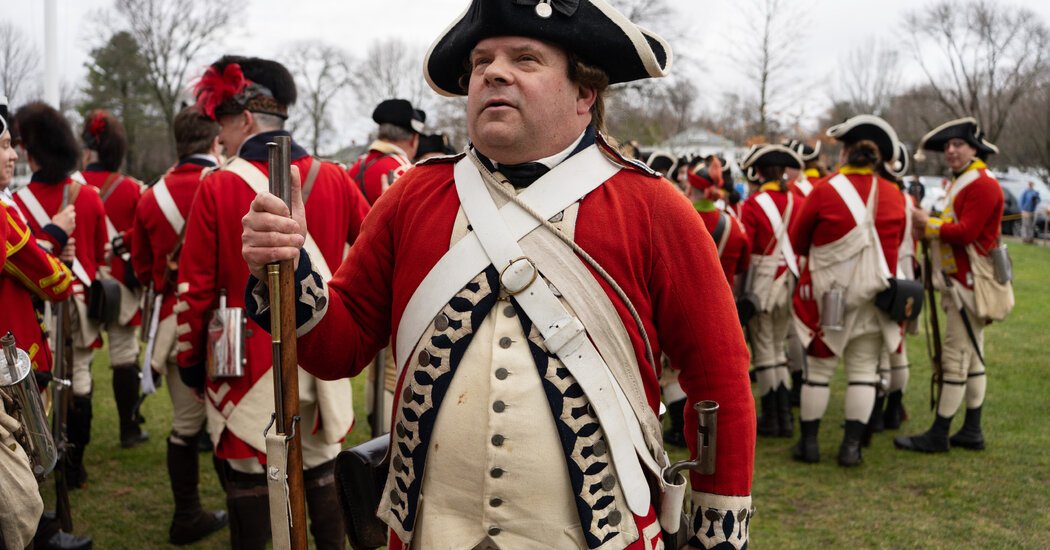
But the question is also one being implicitly debated on the ground, as President Trump’s flag-draped version of 1776 has been countered by the self-conscious Revolutionary-era iconography of the No Kings protests.
T.H. Breen, a historian at Northwestern University, called it an important if also “slightly embarrassing” question.
“If we didn’t have it, we might look like Canada,” which is also a democracy, he said. “But we did. So we want to understand, how exactly was it a revolution?”
A Conservative Revolution?
Americans have fought about the history and meaning of the Revolution pretty much from the moment it ended. In the 19th century, its legacy was claimed by abolitionists and women’s suffragists, who embraced the Declaration’s promises of equality, as well as by Southern secessionists who saw themselves as rebelling against an oppressive power.
The now-familiar patriotic founding story arose in the early 20th-century, as American leaders sought to bolster an increasingly strong national government, while also defending against newer revolutionary currents coming from Europe.
In 1926, in a speech for the 150th anniversary of the Declaration, President Calvin Coolidge described the Revolution as “a movement of the people,” but “in no sense a radical movement.” The vision laid out in the Declaration was perfect, with no need for revision.
“If all men are created equal, that is final,” he said. “If they are endowed with inalienable rights, that is final,” he said. “If governments derive their just powers from the consent of the governed, that is final.”
During the Cold War, the memory of the Revolution became a bulwark in the confrontation with the Soviet Union, defined as a struggle for individual rights and free enterprise. It was definitely a revolution, conservatives argued, but not the bad kind.
In a 1973 essay called “The American Revolution as a Successful Revolution,” the neoconservative political theorist Irving Kristol chided left-leaning scholars for downplaying it as “a French Revolution that didn’t quite come off.” Unlike in Russia or France, he wrote, its passions were constrained by reason and virtue.
“The American Revolution was successful in that those who led it were able to look back in tranquillity and what they had wrought and to say that it was good,” Kristol wrote. Unlike the leaders of more self-devouring revolutions, “they died in their beds.”
Among historians, there was a growing emphasis on the ideology of the revolutionaries, elaborated in books like Bernard Bailyn’s classic 1967 study “The Ideological Origins of the American Revolution.”
But at the same time, amid the upheavals of the 1960s and ’70s, social history focused on ordinary people began surging in the academy, as scholars excavated the perspectives of women, free and enslaved Black people, Native Americans and the working class.
At the Bicentennial, a reporter from The New York Times canvassed leading scholars, and found a sharp divergence between the old-guard ideological school and left-leaning advocates of “history from below.” To the social historians, the story of a Revolution was one of popular democratic impulses ultimately quashed by elites.
Since then, scholars have continued widening the geographical frame, to cast it as part of a broader world war involving multiple empires. It’s a story not just about debates in Philadelphia or Boston, but also Native Americans in the Ohio Valley or naval skirmishes on the Gulf Coast, slave rebellions in Jamaica or even trade in India.
The scholarship also focuses less on causes than on consequences, which were highly uneven. The result, as the historian Michael D. Hattem has put it, is an American Revolution “that looks less American and less revolutionary.”
“In the Cold War, the question was ‘Was it a Revolution?’” Hattem, the author of “The Memory of ‘’76,” a study of how the Revolution has been remembered, said in an interview. “Now, it’s ‘Whose Revolution was it?’”
Some prominent figures in the field held to more celebratory accounts. In his Pulitzer Prize-winning 1991 book “The Radicalism of the American Revolution,” Gordon S. Wood argued that the Revolution did more than institute a new form of government. It also gave rise to an egalitarian and individualistic culture that went far beyond what the Founders intended.
Today, scholars see a sharp generational break in the field, with many who came of age after the 1990s seeing the Revolution as having a deeply conservative outcome, particularly when it came to slavery and race.
After the Revolution, Northern states began abolishing slavery, as enslaved people used the ideas of the Declaration to press for freedom. But slavery became more entrenched in the South, while also expanding to the west. And for Native Americans, the unchecked western expansion unleashed by the revolution was a disaster.
“Yes, some radical things were inaugurated,” Leslie M. Harris, a specialist in early African American history at Northwestern, said in an interview. “But you can’t ignore these profoundly conservative limits on the radicalism.”
Harris, echoing other scholars, says the American Revolution looks more revolutionary when viewed as a spark for an “Age of Revolution” across the Atlantic world. It influenced events not just France but Haiti, Venezuela, Ireland, Poland and elsewhere.
The Revolution “really did spark a new way of thinking, not just about slavery, but about humanity,” Harris said. “It asked, ‘What is freedom?’”
Joanne B. Freeman, a historian at Yale, has been teaching a popular class on the Revolution for close to 30 years. It may not seem very radical now, at least in its immediate outcomes, Freeman said in an interview. But as it unfolded, people understood it as something they had to take part in.
“It touched them in ways they might not have expected,” she said. “Not necessarily as a broad ideological matter. But suddenly, they felt compelled to do something, to write something, to protest.”
Today, it is common among liberals and progressives to downplay the importance of the Revolution, and embrace the nation’s “Second Founding” after the Civil War as a more fitting origin story for our current multiracial democracy.
But David Waldstreicher, a specialist in early American history at the Graduate Center of the City University of New York, said that this misses the degree to which the Revolution brought about “an extreme politicization of ordinary people,” and not just white men.
“That politicization is the grounding of American democracy,” he said.
From Revolution to Founding
Since the Bicentennial, the right has increasingly owned the public memory of the American Revolution, embracing a legal and historical originalism focused on the verities of the founding documents.
In recent years, however, cracks have opened up in the right’s embrace. Some national conservatives have rejected the universalism of the Declaration, arguing that the United States is a homeland for a particular people and culture, rather than a nation based on a civic creed. Other “common good” conservatives have argued that the Declaration’s emphasis on individual rights undercuts the bond between God and society.
Still, the version of 1776 promoted by the Trump administration sticks close to the traditional heroic, top-down story.
The Freedom Trucks, a fleet of federally funded mobile history museums created for the 250th in partnership with Hillsdale College and the conservative educational platform PragerU, greet visitors with an video of George Washington generated by artificial intelligence. The Revolution is depicted as a series of heroic events — Lexington and Concord, Bunker Hill — flowing from the truths of the Declaration.
The exhibits acknowledge slavery, but describe the Founders collectively as proto-abolitionists who “anticipated that slavery would decline and wither away.”
The trucks have been criticized by historians for offering what they see as a sanitized history. But Matthew Spalding, a constitutional scholar and head of Washington operations for Hillsdale College, who helped create the exhibit, said the criticisms reflected a “postmodern” view of history, which imposes the values of the present on the past.
What was revolutionary, even radical, about the Revolution, Spalding said in an interview, was its deliberative, rational nature, and the idea “of announcing a new nation based on self-evident truths, beginning with ‘all men are created equal.’”
“Part of the problem is we want to see it immediately become quote-unquote revolutionary in the modern sense,” he said. “But the American Revolution put the principle down, laid the seedbed, and then it played out in American history.”
Yuval Levin, a constitutional scholar at the American Enterprise Institute, a conservative think tank that was not involved with the project, agreed that the American Revolution was a “conservative revolution.”
“It was more or less the first successful colonial revolt in the known history of the world,” he said in an email, “but it proceeded by insisting on the ideals of its mother country more than by breaking from them.”
Slavery, Levin said, was a “moral stain,” in which the founders were “complicit.” But ultimately, he said, it was abolished through the demand that the country live up to its own founding, not any attempt to overthrow it.
“I don’t think the founders as a whole were proto-abolitionists,” he said. “But the logic of the Revolution did point in that direction.”
The history of the Revolution is still being rewritten, and will never be final. Breen, the Northwestern historian, said it is the role of scholars is to “do the best they can with the surviving evidence, in hope that it instructs the American people to think honestly and critically about their origins.”
The Revolution, Breen said, belonged to the people. So, other historians said, does its legacy today, when Americans, as in 1776, may not need leaders — or historians — to tell them what it means.
“Everyone knows the American Revolution was antimonarchial,” Waldstreicher said. “No one had to open up a book to do No Kings.”