Transnational life in Nicaragua is breathed every day in the country, in the midst of complexities and realities, for those who are here and there, and of course, it calls into question the dictatorship itself. This complexity is reflected in the dispersion of transnational life, the economic effect for the country, the migratory anguish of those outside, and the repression that threatens this way of life.
Nicaragua faces difficult changes in the near future, between the return of more than 40,000 Nicaraguans, a slowdown in remittances, the uncertainty of return and fear of repression, expectations about the quality of life and the state of denial of many.
An emerging diaspora and legitimately in exile
The Nicaraguan dispersion in the world does not occur as part of a process of integration into the global economy, but as a response to a repressive wave that was unleashed after the 2018 crisis and worsened with a strong migratory movement in 2022, after the imprisonment of the country’s civic leaders. This reality cannot be hidden because it goes beyond the economic slowdown that, by 2022, had already surpassed the recovery through external debt and state capture.
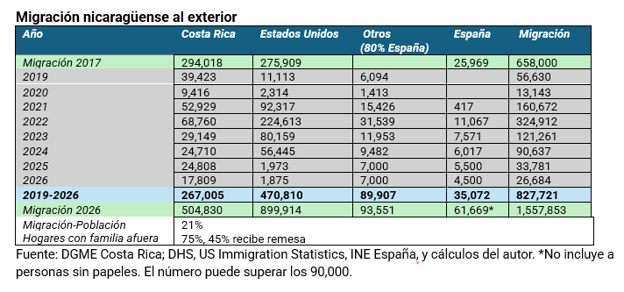
From the crisis period to the present, the number of Nicaraguans outside their country doubled, creating a transnational environment of multiple dimensions, including the exile of thousands of citizens whose connection with civic life was severed, and families who decide to leave in the face of the hostile environment and lack of economic opportunities that prevail. The vast majority of the almost one million Nicas who left reorganize their lives as a transnational family, maintaining their obligations across borders, taking care of their children from outside, sending money with the little they earn.
The economic in transnationality
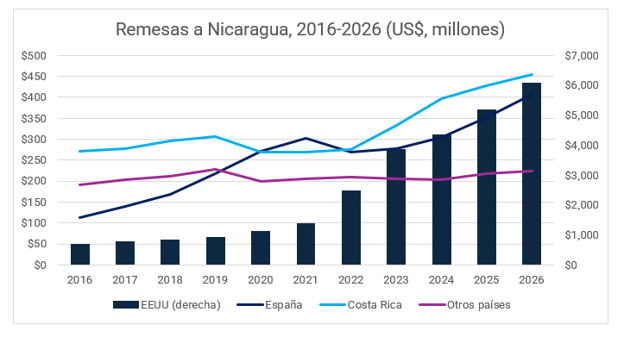
For many, the issue of remittances, which before 2022 it was almost unknownit is a priority issue and it is no wonder.
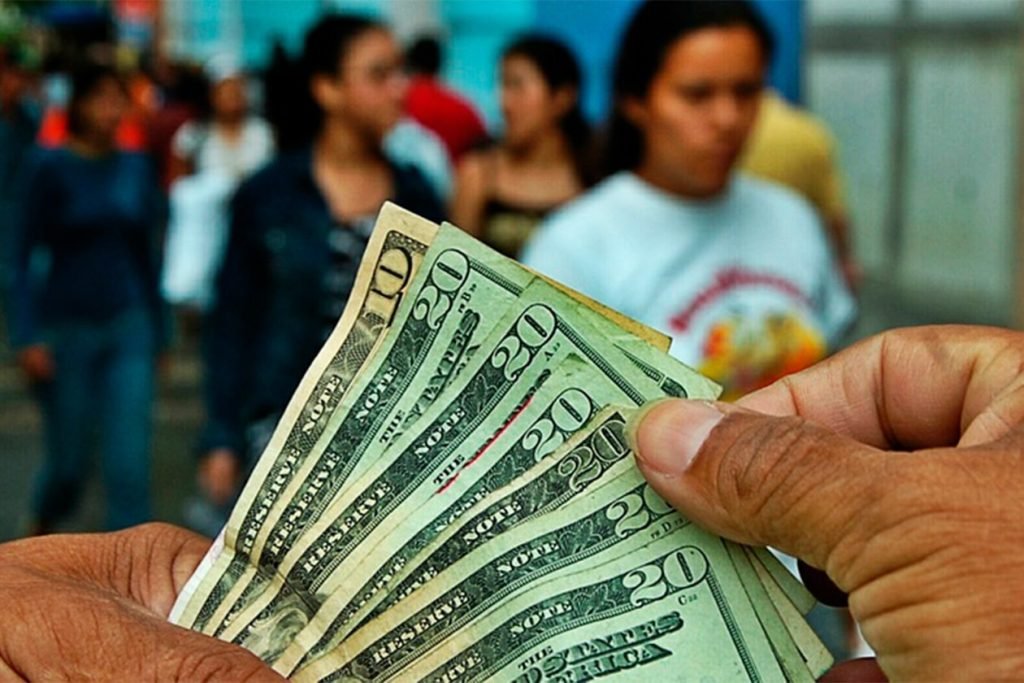
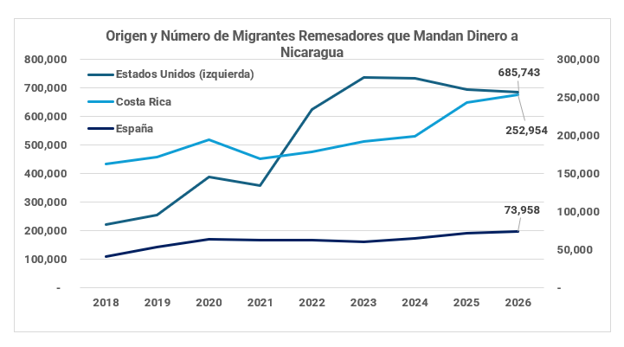
Migration unleashed a strong flow of remittances that created a great economic dependence on the same people who had to emigrate. By 2026 they will be more than $7 billion, or 32% of national income, but for a country in which public spending and investment do not translate into well-being, the reality is that remittances support 43% of private consumption, a percentage similar to the number of households that depend on remittances. This dependency implies that a drastic change in their behavior will affect the country’s economy and even the State coffers that suck taxes from those who consume remittance income. Statistically, a 3% increase in remittances increases GDP by 1%, in the same way their slowdown will affect growth.
The migratory of the transnational
Behind that money that is sent from Los Angeles, San José, Madrid or Panama City is a multitude of people anxious about their future, because in the vast majority of these populations their legal authorization in the country is not clear.
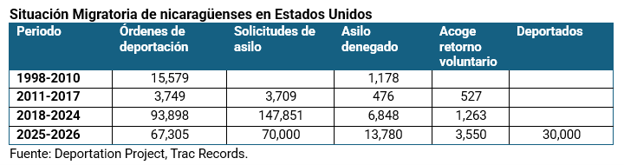
In Spain, Panama or Costa Rica, there are pending papers to complete to obtain full residency. And the situation in the United States is completely adverse to this community that has just arrived. Of the nearly half a million people who arrived in the United States since the political crisis, the majority are in limbo.
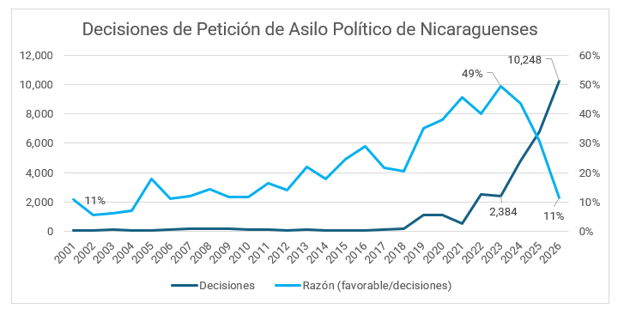
More than half are not only in an irregular situation, but are exposed to the raids that are occurring throughout the country. Almost 14,000 Nicaraguans were deported in 2025 and this year the number will exceed 15,000. Practically, the equivalent of those who already have a deportation order (45%) have been expelled. On top of that, of a total of 221,000 asylum seekers, only 20,000 have been processed and of those 90% were denied.
People are scared. She does not have any legal protection, she is devastated, anguished and distressed because the idea of returning is an existential issue for a majority that had already abandoned the idea of returning to Nicaragua and who are afraid to return to a country without opportunities and with a police State that receives them at the airport.
The majority, even those who have chosen to opt for voluntary return, are assuming the risk of staying and exposing themselves to being detained and expelled.
Families are aware of their relatives, and the anguish they are going through, which goes beyond whether they will stop receiving remittances, but rather how they manage to live in the country and safely. Calls between families always include the warning, “Take good care of yourself, don’t get caught on the street.” Mothers tell their son, “Save more than you can, just in case something happens to you.”
However, the paradox is that they used the savings to send more money and have even gone from a fixed job to a more variable one so that they do not get stuck in one place. Every day, you wake up thinking about what will become of me today. That is the definition of living day to day.
transnational repression
And yes, the other thing is the environment of transnational repression. Those who were not involved in any protests still worry that they will return them and watch them or arrest them, the fear is latent. There is also the family member who wants to travel to see his family outside, but does not dare for fear that they will not be allowed to enter again, because you never know how that entry and exit process works.
And those who are actually exiled have been physically and psychologically affected by the violence of the regime outside the country: ten murdered and many attempted murders, all unpunished, constitute a weapon of control and surveillance that the dictatorship maintains and which is a well-kept secret that Nicaraguans inside the country are unaware of. They also fear that their asylum applications will be capriciously denied by judges who are unaware of the situation in the country and that they will be sent to a ‘safe’ third country. It is a tense environment in which the notion of protection is an abstraction, because in reality it is conspicuous by its absence.
Where is the Nicaraguan transnational family going?
There are inevitable material circumstances for this transnational life, from the decrease in remittances, the return of thousands of Nicas, to the fear of police siege. In addition to people in the United States, there is a temporary return among those who lived in Costa Rica. Between 2025 and June 2026, requests for refuge and stays in that country have decreased, in part because there are no good jobs. However, life in Nicaragua in the face of little employment and good income persists and will push people back to emigrate to the same countries, including the United States; It is a matter of a year: the intention to migrate remains strong.
This is not an easy situation in the middle of a country where it is on the verge of another electoral farce and Rosario Murillo is sharpening surveillance and social control over the entire population.
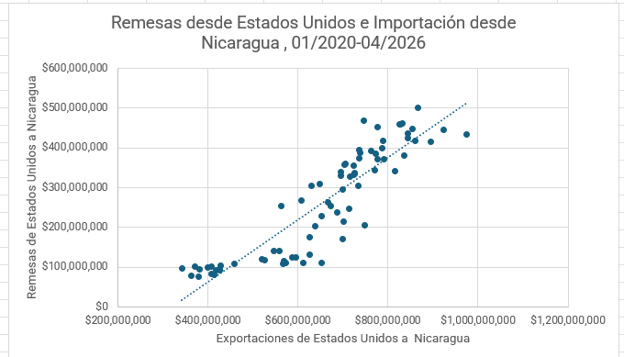
The latent problem is not the specter of family reunification but the drastic social, political and economic change that Nicaragua will face in 2027 and 2028 in the routines of the population. The slowdown in remittances will reduce import capacity (even for Chinese merchandise) and consumption in the short term: the correlation between remittance income and imports is very strong.
This reality will affect the entire population, the lifestyle of those who bought American clothes, and go out to take photos in nice restaurants, and those who have debts or those who are clear about the political reality in which they live and are not in denial. Change is not in sight today, and the hope that things will not happen any further overrides the realism of the current environment. But the scenario in which the labor force rate is greater than 20% from 2025, purchasing power contracts and the feeling of need and greater opportunities grows is just around the corner.
What are the expectations of Rosario Murillo and Ovidio Reyes? The Central Bank economist refuses to reveal the remittance data and refers you to the co-president’s office; However, the macroeconomic problem for a country that is not advancing is not a matter of withdrawing international reserves, but of income redistribution: remittances have been the only distributive tool in the country, and their decrease slows down the economy. Rosario Murillo, the president of the BCN Ovidio Reyes, or Lisbeth Laguna, do not have a plan. What is the alternative for transnational families? What do the opponents plan to propose to the authorities to prevent a debacle?
These issues are already being configured and hopefully they will not remain shelved like other issues, and rather form part of the list of priority issues that must be addressed now.