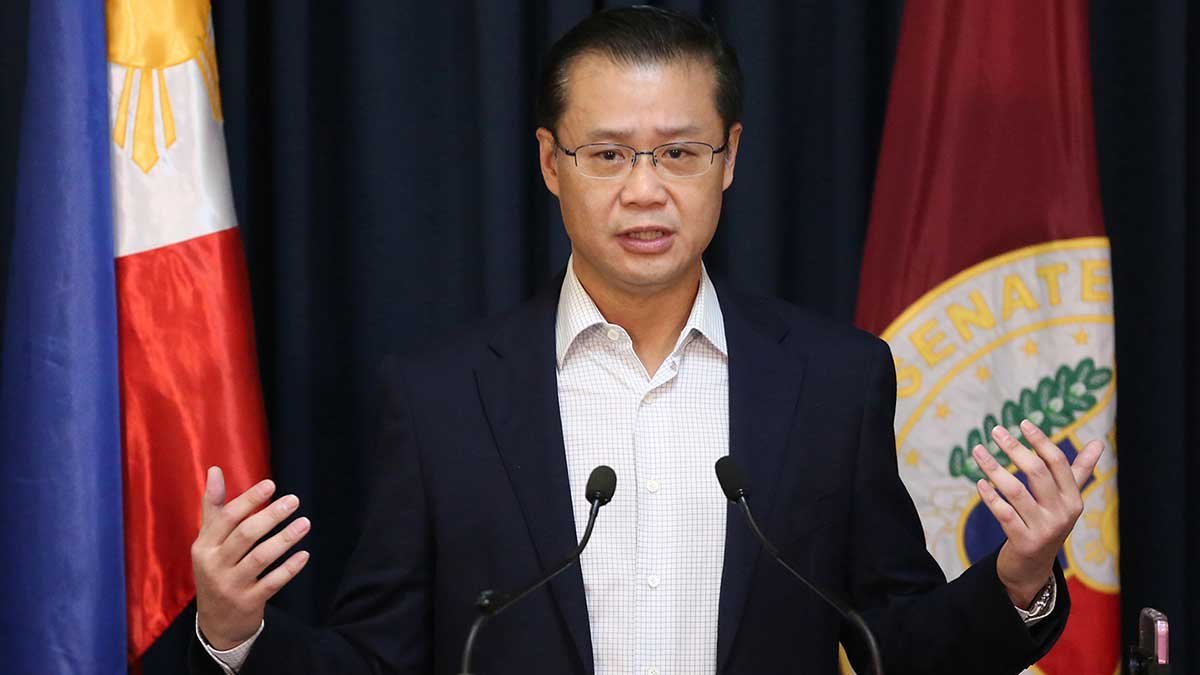

MANILA, Philippines — Senate President Sherwin Gatchalian on Sunday renewed his call to ban children aged 16 and below from using social media, saying stronger safeguards against harmful online content should be among the top priorities of Congress following the deadly June 22 shooting in Tacloban City and other reports of school violence.
Two leading medical organizations had also warned against unsupervised use of social media by children, reinforcing concerns about the need to shield minors from harmful online content.
Gatchalian said his proposed Social Media Safety for Children Act (Senate Bill No. 2066) seeks to address one of the factors influencing violent behavior among minors.
“That, for me, is the priority. It’s one of the priority bills that I submitted,” he said.
READ: Docs’ prescription: Keep kids off social media
“The biggest question here is what influences children these days to commit violence? Children are not violent in nature. There are influences that happen that affect the way they think.”
READ: Pedia group: Kids must not use social media without adult supervision
‘Strict verification’
His renewed push came after the shooting last Monday at San Jose National High School in Tacloban City, where two Grade 9 students allegedly opened fire inside the campus, killing three students and injuring 20 others.
Authorities earlier disclosed that one of the suspects allegedly played the violent online game Gorebox before the attack.
READ: Gov’t, civil society groups split on reviewing juvenile justice law
Under the bill, social media platforms would be required to implement reliable age and identity verification systems, regularly deactivate underage accounts, provide parental controls and content-filtering tools, and redesign features that encourage compulsive use, such as autoplay, addictive notifications, and algorithm-driven recommendations. Violators could face fines and suspension or revocation of their authority to operate.
“Their parental controls and identification validation systems should be strict. Opening social media should not be easily allowed just because you provided an email. There should really be facial recognition or age verification,” Gatchalian said, adding that cybercrime authorities should move faster in blocking accounts by underaged users.
Even as he rejected proposals to lower the minimum age of criminal responsibility, Gatchalian said children in conflict with the law can still be reformed through proper intervention and called for more Bahay Pag-asa rehabilitation facilities nationwide.
Over the weekend, the Philippine Pediatric Society said it does not recommend social media use among children aged 16 and below. If access is allowed, accounts should be co-managed by parents or guardians with active supervision, clear boundaries, and age-appropriate guidance, especially for children with developmental or psychosocial vulnerabilities.
The Philippine Society for Developmental and Behavioral Pediatrics echoed the position, saying its members have directly treated young patients suffering from anxiety, emotional dysregulation, sleep disturbances, and worsening behavioral and developmental problems linked to unregulated social media use.
Review of juvenile law
The shooting has left many students and parents hesitant to return to San Jose National High School.
In a vlog on Saturday, President Ferdinand Marcos Jr. directed education, health, and law enforcement agencies, local governments, and communities to strengthen measures protecting students.
“The school should be a place of learning, dreams, and growth. Not a place where parents fear for the safety of their children,” he said, citing the Tacloban shooting, two stabbing incidents involving minors in Cavite, and the deaths of two Ateneo de Manila University student-athletes during a team-building activity in Aurora.
Separately, Sen. Erwin Tulfo announced that the Senate committee on social justice, welfare, and rural development would conduct a “total review” of the implementation of Republic Act No. 9344, or the Juvenile Justice and Welfare Act of 2006.
The inquiry will examine the shortage of functional Bahay Pag-asa facilities as well as intervention programs for children in conflict with the law, parental accountability, and whether the current minimum age of criminal responsibility of 15 remains appropriate.
Juvenile welfare body’s view
Malacañang has expressed openness to reviewing the age threshold, saying the recommendation by the Philippine National Police to lower it to 12 appears “reasonable.”
The Juvenile Justice and Welfare Council, however, said it opposes lowering the age, noting that 94 percent of children aged 12 to 15 who undergo rehabilitation in Bahay Pag-asa are successfully reintegrated into their communities.
The council also said the number of children in conflict with the law fell by 77 percent, from 24,683 in 2016 to 5,698 in 2025.
Instead of harsher penalties, the council urged a multi-agency approach focusing on family support, school-based interventions, mental health services, antibullying programs, stronger guidance services, and tighter regulation of children’s exposure to violent online content. —With reports from Dexter Cabalza and Joey A. Gabieta /atm