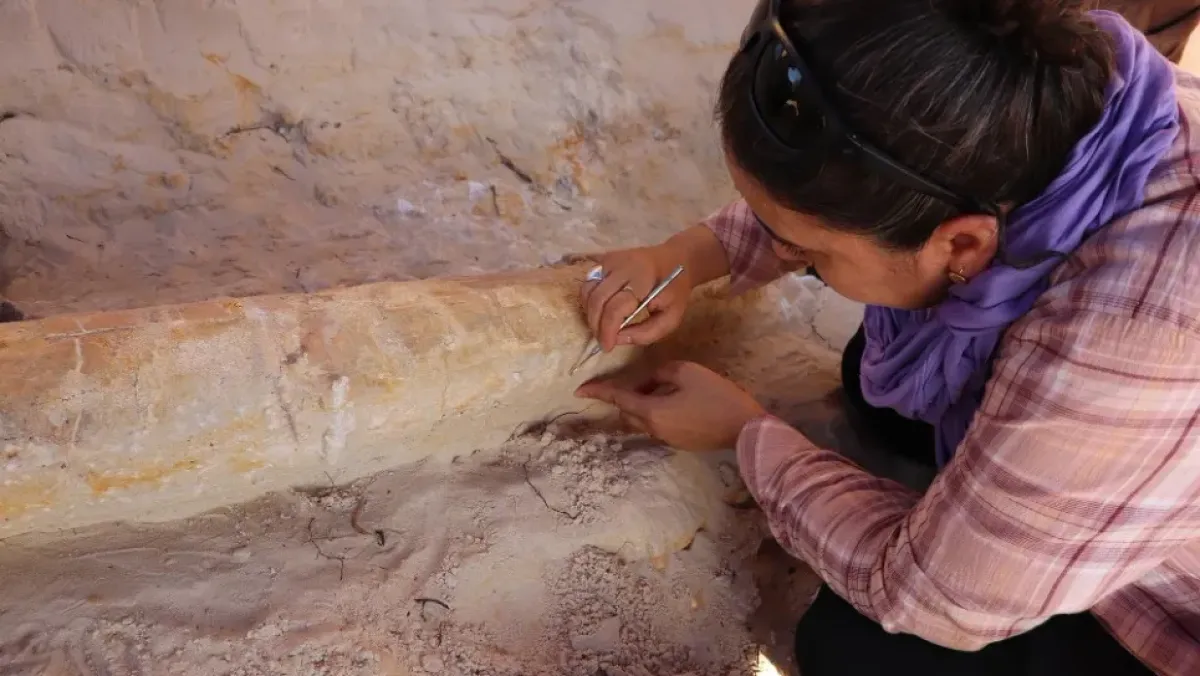
The Ministry of Culture and Arts announced an “extremely important” scientific discovery at the Tignev archaeological site in the state of Mascara, which was the discovery of an elephant tusk preserved to an exceptional degree and in almost complete condition, attributed to the extinct species Loxodonta atlantica.
A statement from the Ministry said today that field excavations supervised by a multidisciplinary research team from the National Center for Research in Prehistory, Anthropology and History, led by Professor Mohamed Sahnoun, resulted, between June 6 and June 22, 2026, in the extraction of this tusk, which is about 2.35 meters long and is characterized by rare structural integrity, which raises this specimen to the ranks of the most complete examples of this type among North African discoveries.
The Tignev site is considered a pivotal station in archaeological chronology, as it is known for being one of the most prominent sites that revealed the remains of the oldest fossil human in North Africa, known as Homo erectus/Atlantropus mauritanicus, as well as huge collections of mammal bone fossils and Acheulian stone tools that are dated to between one million and one million and two hundred thousand years.
The importance of this new discovery, according to the Ministry, is that it represents a unique scientific window to study the environment, ecology and paleobiology of this type of elephant that roamed North Africa during the Lower and Middle Pleistocene period.
The structural integrity of the tusk, despite the fragility of the ivory material and its vulnerability to geological processes, provides researchers with an unprecedented opportunity to carefully analyze the nutritional, environmental and climatic systems of this region.
The Ministry of Culture and Arts confirmed that this discovery constitutes a new scientific addition that highlights the depth and authenticity of Algeria’s natural and historical heritage, and praises the tireless scientific efforts of researchers at the CNRPAH National Center. Accordingly, the sample will be stabilized and transported safely to specialized laboratories, where it will be subject to precise treatment and preservation protocols, followed by in-depth scientific studies, in preparation for examining the possibility of displaying it to the general public in the future in national museums, within the framework of introducing Algeria’s exceptional archaeological and paleontological heritage, the statement adds.
The Ministry appreciated the efforts made by researchers, experts and technicians supervising these scientific works, specifying its commitment to supporting archaeological and scientific research, and strengthening programs to protect and value the national cultural heritage, in a way that contributes to consolidating knowledge of Algeria’s history and highlighting its cultural and human depth.