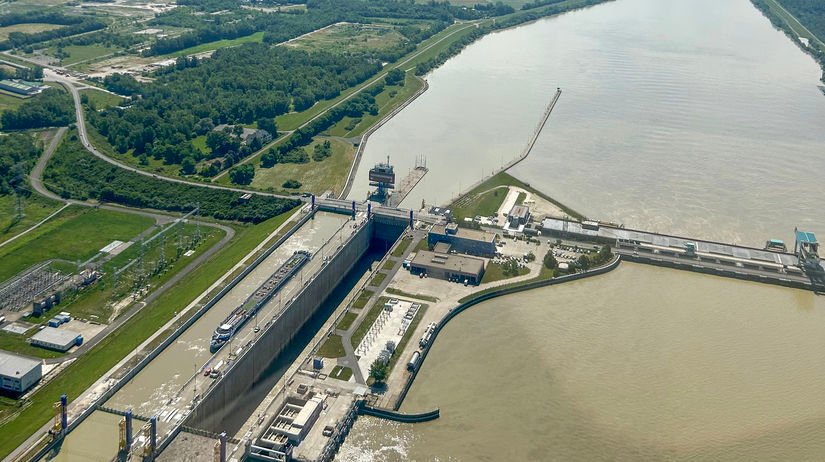
What will happen to the largest hydropower plant in Slovakia? The state has been talking about saving Gabčíkov for years, but after a series of postponements and canceled tenders, the problem is beginning to be heard directly in the operation. A serious technical problem was last seen in June, when there was a threat that six of the eight turbines, which according to the environmental ministry are already 10 years past their useful life, will not produce electricity by the end of the year.
Minister of the Environment Tomáš Taraba (nom. SNS) once again pointed out that the outdated technology of the power plant needs repair. He also reminded that the problem has existed since the 90s of the last century, since when the state failed to start its modernization. “There was a big short circuit and all the international companies that specialize in this technology said that they didn’t have time to come to the rescue,” stated the head of the Enviro Resort.
Therefore, according to Tarab, the employees of the Gabčíkovo Water Works had to fix the fault themselves. According to the minister, they should have found a solution within about three weeks, thanks to which it was possible to maintain production at most facilities. Therefore, Taraba described the failure as further evidence that without the modernization of Gabčíkov, Slovakia’s strategic source of electricity production is at risk.
 Read more The heat will shut Slovaks in greenhouses. A cool apartment becomes an expensive luxury
One and a half nuclear block
The data clearly show that the Slovak energy mix is long-term based on the core. In 2025, almost 30 terawatt hours (TWh) of electricity were produced in our country – more than 67 percent of this volume was produced by nuclear power plants.
As for water, it also steadily belongs to the important sources of electricity production. Last year, dozens of Slovak hydropower plants produced a commodity in the volume of about 3.2 TWh (that is, more than 10 percent of the total production). It is true that only Gabčíkovo produces about 2.2 TWh of electricity.
The importance of Gabčíkov can also be seen when comparing it with the mentioned core. The hydroelectric plant alone has an installed capacity of 720 megawatts, while one new Mochoviec unit has 471 megawatts today with plans to increase it to over 500 megawatts. On paper, the capacity of Gabčíkovo is close to approximately one and a half units of Mochovce and represents about three quarters of the capacity of the two new units of Mochovce 3 and 4 combined. The difference is that the core produces steadily throughout the year, while Gabčíkov’s production depends on the flow of the Danube.
If the power plant could be modernized, according to experts, a source could be in play that, by Slovak standards, has an output comparable to a large nuclear unit, in the construction of which Slovakia plans to invest billions of euros in the next few years. At the same time, restoring old turbines, generators and control systems would reduce the risk of breakdowns, increase the efficiency of the equipment and allow more electricity to be produced from the same amount of water.
How to get cheaper electricity?
Gabčíkov’s ownership may also represent one of the few tools that the state has directly in its hands when it comes to electricity prices. “In Slovakia, the state does not have full control of nuclear plants, but it is the 100 percent owner of Gabčíkov and other hydropower plants in the Vodohospodárske vástúbba portfolio,” pointed out analyst Radovan Potočár from the website energie-portal.sk.
It means that with nuclear power, which is dominant in our mix, the state cannot simply decide that part of the electricity will be sold cheaper to Slovak factories, since Slovenské elektrárne does not own all of it. However, the situation is different at Gabčíkov, because the power plant is operated by a state-owned enterprise. Today, Vodohospodárska výstba sells electricity from Gabčíkov on the market. If the prices are high, the state-owned enterprise makes money from it, and part of the money can then also end up in public finances. However, Potočár’s point is that the state could theoretically give up part of this income and use electricity from its own water source as a tool to support industry.
France is offered as an example, although there it was not water but nuclear electricity. For years, a mechanism known as ARENH, i.e. regulated access to historical nuclear electricity, operated there. In practice, this meant that competitors of the state-controlled Électricité de France – France’s state-owned energy company – could buy some of the electricity from older nuclear plants at a predetermined regulated price, rather than directly at market prices. The goal was that the advantage of cheaper historical electricity did not remain only with the dominant producer, but also reached consumers through suppliers.
The Slovak model would have to be set up differently, because Gabčíkovo is a smaller source and the volume of its production is not enough to reduce the price of electricity across the entire economy. However, even a part of more than two terawatt-hours per year could be a significant help for energy-intensive industries. The condition would be for the system to be set up transparently and pass European Union (EU) rules on state aid.
Tenders fail
Gabčíkov’s biggest problem is that the state hasn’t been able to put out a tender for repairs and complete the contract for years. The first big attempt managed to lead to the announcement of the winner after the power plant was taken over by the state 11 years ago. At that time, the Združenie Gabčíkovo consortium offered the repair for almost 81 million euros. Slovak companies CEDIS and HANT BA, Czech Strojírny Brno and Italian company Todini Construzioni Generali were members of the association. However, the order never took off.
During the government of Petr Pellegrini, i.e. between 2018 and 2020, the contract could not be signed, and another turning point came after the inauguration of the government of Igor Matovič (Movement Slovakia). The management of Vodohospodárske výstba, appointed by the then Minister of the Environment Ján Budaj, canceled the original tender. At the time, the department argued that the competition had several shortcomings and errors. After years, the project practically returned to the beginning.
Another tender was announced by the new management of Water Management Construction already under Minister Taraba. However, the repair has become significantly more expensive in the meantime. While the sum was originally around 80 million euros, Taraba mentioned after taking office that the general could cost 200 million euros and the upper estimate could reach up to 340 million euros. In the new procurement, the expected value of the contract finally reached approximately EUR 350 million.
However, even this attempt did not go smoothly. The deadlines for submitting bids were repeatedly moved – first from June to September, then to December, then to January, and finally to April 2025. Water management explained this with questions and requests from interested parties, who wanted to give them more time to prepare bids. According to the company, the goal was to receive as many relevant offers as possible and to find a partner capable of managing one of the state’s largest energy investments.
In the end, even this tender did not survive. In February 2025, the state canceled it and the project switched to a new regime of strategic investment. The reason was that, according to the water managers, they could not reasonably adapt the original procurement to the new procedure and the wider scope of work. In June 2025, the state launched another attempt, already with an estimated value of around 371 million euros. However, it also began to drag on – the deadline for applications to participate was moved from August to mid-September in the summer, and the competition documents also changed.
After the September deadline last year, Vodohospodárí construction confirmed that it was evaluating applications from interested parties, but did not publish either their number, the names of the applicants, or the date when the result could be known. According to the company, this is a multi-stage procurement, after the evaluation of the applications, the submission of offers and negotiations with the applicants should follow.