An educational vision focused on innovation and application
Space projects and global partnerships open horizons for young people
Jordan is moving towards a modern education based on creativity and skill
On a national occasion in which Jordanians celebrate the birth anniversary of His Royal Highness Prince Hussein bin Abdullah II, Crown Prince, there is renewed praise for the role that His Highness plays in supporting development and modernization paths, especially in the education and youth sector, as it is one of the most important engines of development and building the future in Jordan.
Academic Dr. Badr Al-Mady said that His Highness the Crown Prince’s assumption of the duties of monitoring a number of vital sectors, most notably the youth sector, came under royal guidance and vision, given the importance this sector represents in shaping the national identity and shaping the features of the future, stressing that His Highness has the ability to advance development paths in the fields of education, rehabilitation and empowerment.
Al-Mady added to Al-Rai that His Highness the Crown Prince paid clear attention to developing education and its outcomes at the level of schools and universities, and contributed to enhancing the culture of creativity among young people, considering education a national priority, indicating that the current stage requires moving from education based on indoctrination to education based on empowerment and the discovery of talents and inclinations, in line with the needs of the local and global labor market.
He explained that this trend aims to build a generation capable of producing knowledge and modern technology, and not just consuming it, with a focus on the technological dimension as one of the most important drivers of the contemporary economy, in a way that serves national development priorities and enhances Jordan’s competitiveness.
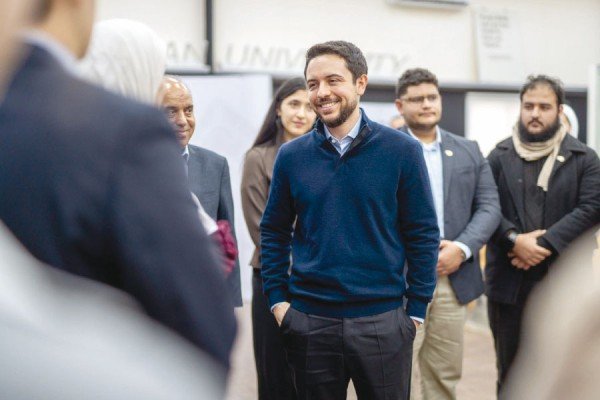
Al-Mady pointed out that His Highness the Crown Prince is keen to visit distinguished universities and educational institutions, and meet with students and academic departments, to emphasize the importance of working as a team, and to support modern educational environments that keep pace with global developments, especially in the fields of applied and technical education and vocational training.
He pointed out that this vision contributes to consolidating the culture of vocations from the early school stages, which enhances students’ readiness for the requirements of the future, and makes education a practical path for building capabilities and opportunities, and not just a traditional school stage, considering that in light of these visions and initiatives, the education sector in Jordan remains facing a qualitative transformation stage that enhances the capabilities of young people and opens broader horizons for creativity and innovation before them.
For his part, the academic and educationalist, Professor Qaisar Al-Gharaibeh, confirmed that His Highness the Crown Prince presented an advanced model in understanding education as a tool for empowering people and building their skills, and not just a traditional academic path. He pointed out that this trend contributed to reformulating the philosophy of education towards more linking knowledge and application, and introducing the concept of “skill and empowerment” as an alternative to being satisfied with an academic achievement certificate alone.
Al-Gharaibeh explained that the current stage of development focused on building the student’s personality in all its aspects, by enhancing the values of leadership, teamwork, and the spirit of initiative, in addition to consolidating the concept of active citizenship and community participation, which makes the student a true partner in building his community, through initiatives such as “Haqq,” which contributed to spreading the culture of leadership and volunteer work in schools, and the “We” platform, which established the concept of organized giving, documenting volunteer hours, and linking them to the students’ academic and professional path.
He added that the growing interest in innovation and technology has opened new horizons for Jordanian youth, by encouraging them to engage in modern fields related to programming, artificial intelligence, and applied sciences, pointing to a qualitative leap represented in supporting space projects, where Jordanian students and engineers succeeded in launching a mini-satellite, in addition to strengthening partnerships with international institutions such as NASA and MIT, which provided quality training opportunities for Jordanian youth in advanced scientific centers. Al-Gharaibeh explained that providing innovation incubators such as “TechWorks” represented an important shift in supporting creativity, as students were now able to transform their ideas into realistic projects using modern manufacturing tools, which strengthened the culture of production instead of just receiving.
He also pointed out that technical education and linking it to the labor market constituted one of the most important paths of development, through practical educational models that depend on combining study and application, and requiring students to undergo long training periods in private sector institutions, which reflected positively on the employment rates of graduates in technical specializations.
He pointed out that the establishment of Al-Hussein Technical University (HTU) constituted a “white revolution” in higher education, through the adoption of applied curricula that exceeded 60% of practical training, and the introduction of modern courses such as design thinking and programming, in addition to achieving high employment rates among graduates thanks to linking education directly with the labor market.
Al-Gharaibeh stressed that celebrating the birthday of His Highness the Crown Prince represents a national occasion to evoke an ambitious educational vision that invests in the Jordanian person to be able to innovate and compete, noting that Jordan is moving steadily towards further development in the education sector.